Best Equipment in MTG: The Ultimate Commander Voltron & Equipment Guide (2026)
Equipment is the quiet engine behind some of the most powerful — and most beginner-friendly — decks in Magic. A single well-chosen artifact can turn a 2/2 into a game-ending threat, protect your commander from removal, or draw you half a dozen cards. This is the definitive guide to the best equipment in MTG: what to play, how it actually works, the “Voltron” commanders built around it, and the rules traps that cost beginners games. Every card below has been verified live on Scryfall for Commander legality and cheapest current printing price.
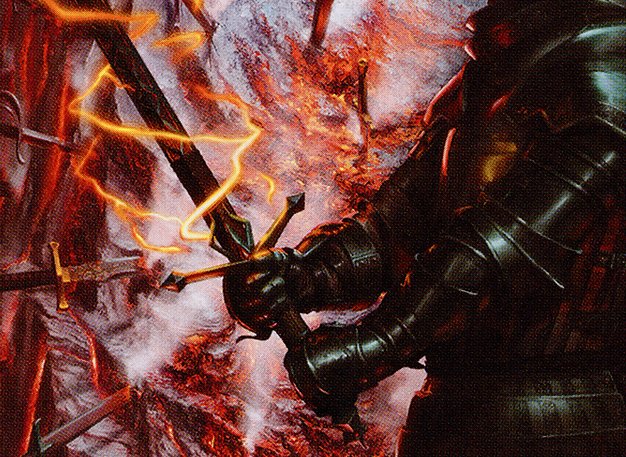
What is equipment in MTG (and how does it actually work)?
Equipment is a subtype of artifact. You cast it like any other artifact, but on its own it does nothing — you have to equip it to a creature you control to get the bonus. A few rules beginners trip over constantly:
- Equip is sorcery-speed and costs mana every time. You can only pay an equip cost during your main phase with an empty stack — not mid-combat, not on an opponent’s turn (unless a card explicitly says otherwise). Moving a sword from a dying creature to a fresh one costs the equip cost again.
- One creature at a time. Equipping to a new creature moves it off the old one. You can only attach during your turn.
- The equipment survives its creature. If your equipped creature dies or is exiled, the Equipment simply falls off and stays on the battlefield — re-equip it next turn. This is why equipment is more resilient to board wipes than Auras (which die with the creature).
- Living weapon equipment (Batterskull, Kaldra Compleat) creates its own 0/0 Germ token to hold it when it enters, so it’s never a dead card even with an empty board.
That last point is the whole reason equipment decks are so consistent: your threats are recyclable. New to Commander entirely? Start with our step-by-step guide to building a Commander deck, then come back to load it up.
Protection equipment: keep your creatures alive
The most important equipment in most decks isn’t the flashy sword — it’s the cheap boots that stop your commander from getting killed. This is also home to the single most-confused interaction in the format.

| Equipment | Grants | Equip cost | ~Price |
|---|---|---|---|
| Lightning Greaves | Shroud + haste | {0} (free!) | $3.33 |
| Swiftfoot Boots | Hexproof + haste | {1} | $1.88 |
| Champion’s Helm | +1/+1, can’t be targeted by opponents | {2} | $1.23 |
| Whispersilk Cloak | Unblockable + shroud | {2} | $1.29 |
| Mask of Avacyn | +1/+1 + hexproof | {2} | $0.89 |
The shroud-vs-hexproof trap. This is the nuance that separates real players from netdeckers: Lightning Greaves grants shroud, not hexproof. Shroud means the creature can’t be targeted by anyone — including you. So while the Greaves are on your commander, you can’t stack another Equipment or Aura on it, can’t hit it with your own targeted pump spell, and can’t tutor-and-equip onto it. Swiftfoot Boots grant hexproof — opponents can’t target it, but you still can. In a deck that wants to pile more toys onto one creature, Boots are usually better despite the extra {1}; the free-equip Greaves shine when you just want haste-and-protect on a fresh threat. Know the difference before you build.
Card-advantage equipment: turn combat into cards
Some equipment does the single most important thing in Commander — refill your hand. These belong in nearly any deck, Voltron or not.

- Skullclamp (~$4.70) — the best card-advantage engine in the game. Equipped creature gets +1/-1, and when it dies you draw two. Point it at a 1-toughness token and it dies immediately — draw two for one mana, repeatedly. Important: Skullclamp is banned in Modern, Legacy, Pioneer and Pauper, but it is fully legal in Commander — don’t let the banlist confusion scare you off. It’s a staple.
- Mask of Memory (~$0.34) — deal combat damage to a player, draw two and discard one. Absurd value for the price; pairs with graveyard decks that want the discard.
- Rogue’s Gloves (~$0.26) — a budget “draw a card on hit.” Fine filler for low-budget builds.
For the full picture on refilling your hand, see our best card draw in MTG guide — Skullclamp and the Swords below are equipment that doubles as card advantage.
The Swords cycle: protection plus a payoff

The “Mirran/Phyrexian swords” are a cycle of two-mana Equipment that all give +2/+2, protection from two colors (dodging removal and letting the creature slip past blockers of those colors), plus a powerful hit trigger. The cycle has grown to nine; here are the most-played, verified at cheapest current printing:
| Sword | Protection from | On combat damage | ~Price |
|---|---|---|---|
| Sword of Feast and Famine | Black & green | Opponent discards; untap all your lands | $35.55 |
| Sword of Fire and Ice | Red & blue | Deal 2 damage; draw a card | $23.80 |
| Sword of Truth and Justice | White & blue | +1/+1 counter; proliferate | $29.43 |
| Sword of Body and Mind | Green & blue | Make a 2/2 Wolf; opponent mills 10 | $17.38 |
| Sword of Hearth and Home | Green & white | Flicker a creature; fetch a basic | $16.11 |
| Sword of War and Peace | Red & white | Damage = your hand; gain life | $9.66 |
| Sword of Light and Shadow | White & black | Gain 3 life; reanimate a creature | $7.04 |
Sword of Feast and Famine and Sword of Fire and Ice are the two best (the ramp and the card/removal, respectively), but they carry premium price tags. On a budget, Sword of Light and Shadow at ~$7 gives you protection plus recursion for a fraction of the cost. Check live prices on our MTG card price tool before you buy — swords fluctuate.
Aggressive equipment and Voltron finishers
“Voltron” is the archetype of loading one creature (usually your commander) with enough equipment to win through combat damage or commander damage (21 in a single hit ends a player). These are the payoffs:
- Embercleave (~$8.93) — flashes in for as little as {R}{R} in a wide deck, granting +1/+1, double strike, and trample. The definitive “surprise, you’re dead” finisher.
- Kaldra Compleat (~$7.64) — living weapon that makes a 5/5 with first strike, trample, indestructible, and haste, and exiles anything it fights. A one-card threat.
- Batterskull (~$3.19) — living weapon 4/4 vigilance lifelink that you can bounce back to hand to dodge artifact removal. Grindy, resilient, cheap.
- Commander’s Plate (~$44.36) — +3/+3 and protection from every color not in your commander’s identity. On a mono-color commander that’s protection from four colors — nearly unkillable and unblockable. On a five-color commander it’s just +3/+3 with no protection at all. Know your identity before you buy this one.
- Shadowspear (~$18.47) — +1/+1, trample, lifelink, and a crucial ability: {1} makes all opponents’ creatures lose hexproof and indestructible. That turns off the two things that stop your removal and your attacks. Underrated utility, not just a pump. See our removal guide for why stripping indestructible matters.
- Umezawa’s Jitte (~$3.78) — oppressive when it connects: bank charge counters to pump, shrink a blocker, or gain life. Strongest in creature-light metas and 1v1.
- Loxodon Warhammer (~$1.13) — +3/+0, trample, lifelink for a dollar. The budget Voltron backbone.
- Bonesplitter (~$0.16) — +2/+0 for a one-mana cast and {1} equip. Pound-for-pound the most efficient aggressive equipment ever printed.
The Colossus Hammer trap. Colossus Hammer (~$0.83) grants a monstrous +10/+10 — but its equip cost is {8}, which is unpayable in a real game. It’s only good with a free-equip enabler (Puresteel Paladin with metalcraft, Sigarda’s Aid, Nazahn, or a Sram-style engine). Don’t jam it in a deck that can’t cheat the equip — it’ll rot in your hand.
Equipment tutors & free-equip enablers

An equipment deck lives and dies by consistency — you want your best sword every game. That’s what equipment tutors are for (a sub-type of the broader tutor toolbox we covered here):
- Stoneforge Mystic (~$29.83) — tutors an Equipment to hand, then cheats it into play for {1}{W}. The best equipment enabler in the game; pricey but format-defining.
- Steelshaper’s Gift (~$6.99) — {W} to tutor any Equipment straight to hand. One mana, no restrictions.
- Open the Armory (~$2.33) — {1}{W} tutor for an Equipment or Aura; budget-friendly.
- Stonehewer Giant (~$7.99) — attack trigger fetches an Equipment and attaches it for free. A repeatable engine.
- Puresteel Paladin (~$0.68) — with metalcraft, equip for {0}, and draw a card whenever an Equipment enters. The budget Voltron all-star.
- Sigarda’s Aid (~$17.93) — gives all your Equipment flash and attaches them free as they enter. Turns Colossus Hammer into a real card.
- Urza’s Saga (~$36.43) — a land that builds a Construct and tutors a {0}- or {1}-cost artifact (grab Skullclamp, Bonesplitter, or a mana rock). A powerhouse if it’s in budget.
- Kor Outfitter (~$0.15) — ETB, attach an Equipment for free. Bulk-priced glue.
Best Voltron / equipment commanders

Search demand for “equipment commanders” is real — here are the best homes for an equipment deck, from budget to premium, all verified legal and priced:
| Commander | Colors | Why it’s great | ~Price |
|---|---|---|---|
| Sram, Senior Edificer | White | Draw a card whenever you cast Equipment/Aura/Vehicle — a mono-white engine for ~50 cents | $0.60 |
| Kemba, Kha Regent | White | Makes a 2/2 Cat for each Equipment attached — go-wide + Voltron | $0.24 |
| Balan, Wandering Knight | White | {W}{W}: attach ALL your Equipment and gain double strike — one-shot finisher | $0.42 |
| Nazahn, Revered Bladesmith | Green-white | ETB tutors Hammer of Nazahn (free-equip); taps down blockers | ~$1.45 |
| Wyleth, Soul of Steel | Red-white | Attacks and draws a card per Aura/Equipment on it — refuels itself | ~$3.42 |
| Syr Gwyn, Hero of Ashvale | Mardu | Equipment costs {1} less, free-equip, and draws on combat damage | $2.73 |
| Ardenn, Intrepid Archaeologist | White (partner) | Upkeep: attach any number of Equipment/Auras to any creatures for free | $3.86 |
| Halvar, God of Battle | White | Your equipped creatures get double strike; back side is itself an Equipment | $26.24 |
Sram is the best beginner Voltron commander, full stop — a sub-dollar card that turns every equipment you cast into a cantrip, so your deck never runs out of gas. Want more cheap-to-build commander ideas? See our best budget commanders guide.
A budget equipment core (under ~$15 total)
You can build a functional Voltron shell for the price of a booster pack. Start here and upgrade later:
- Protection: Swiftfoot Boots ($1.88), Champion’s Helm ($1.23)
- Card advantage: Skullclamp ($4.70), Mask of Memory ($0.34)
- Aggression: Bonesplitter ($0.16), Loxodon Warhammer ($1.13), Colossus Hammer ($0.83)
- Enablers: Puresteel Paladin ($0.68), Kor Outfitter ($0.15), Open the Armory ($2.33)
That’s roughly $13 for the whole equipment package — slot it under Sram or Kemba and you have a real deck. Every price here is Scryfall’s cheapest current printing; verify before you buy on our card price tool.
Common equipment mistakes
- Running Colossus Hammer with no free-equip. The {8} equip cost makes it a dead card. Only play it with an enabler.
- Confusing Lightning Greaves’ shroud for hexproof. You can’t target your own creature through shroud — it blocks your buffs and re-equips too.
- Too much equipment, not enough creatures. Equipment needs a body. If your board gets wiped and you have no creatures, all your swords sit idle. Run ~15–20 creatures even in a Voltron deck.
- Ignoring protection. A Voltron threat is a giant target. Without Boots, Greaves, or a Sword’s protection, one removal spell undoes your whole turn. Protect before you pump.
- Buying Commander’s Plate for a multicolor commander. Its protection only covers colors outside your identity — it does far less in a 3+ color deck.
Voltron’s weakness — and how to cover it
Equipment decks are resilient to board wipes (the equipment survives) but vulnerable to targeted removal and edicts (sacrifice effects that ignore hexproof). Cover it three ways: cheap protection equipment (Boots/Greaves), a few extra creatures so an edict doesn’t hit your commander, and recursion to rebuild. Because your commander returns from the command zone, you’re always one turn from re-suiting-up — that’s the archetype’s built-in insurance.
Build your equipment deck in seconds
Reading a list is one thing — building the deck is another. KrakenTheMeta’s AI MTG deck builder can generate a full 100-card Voltron list around any commander (Sram, Syr Gwyn, Nazahn, your pick) in under a minute, complete with the right protection, tutors, and mana base. Then paste it into our MTG deck analyzer to check your curve and equipment count, or browse community-built decks for inspiration. Create a free account to save and share your builds.
Frequently asked questions
How many equipment should a Voltron deck run?
Around 10–15 pieces is the sweet spot: a few protection options, one or two card-advantage engines (Skullclamp is mandatory), two or three big payoffs (a Sword or two, Embercleave), and the rest tutors and enablers. Keep ~15–20 creatures so you always have something to equip.
What’s the best equipment in MTG?
For raw power across all decks: Skullclamp (card advantage), Swiftfoot Boots / Lightning Greaves (protection), and Sword of Feast and Famine or Sword of Fire and Ice (the premium payoffs). If you can only buy one card, buy Skullclamp.
What’s the best budget Voltron commander?
Sram, Senior Edificer at ~$0.60. It draws a card every time you cast an Equipment, so a cheap deck never runs out of cards. Kemba and Balan are also sub-dollar and excellent.
Is Skullclamp banned?
It’s banned in Modern, Legacy, Pioneer, and Pauper — but it is fully legal in Commander, where it’s one of the format’s best cards. The banlist confusion scares a lot of new players off a card they should absolutely be playing.
Can you equip at instant speed?
No — the equip ability is sorcery-speed by default, so you can only do it on your own turn with an empty stack. A handful of cards (like Sigarda’s Aid, which grants flash and free attach) get around this, but as a rule you plan your equips during your main phase.
Card legality and prices verified live on Scryfall at time of writing (July 2026); prices reflect the cheapest current paper printing and will fluctuate. Card art © Wizards of the Coast, sourced via Scryfall.