
Best Spellslinger Commanders in MTG: Every Archetype + How to Build a Spellslinger Deck (2026)
Ask five Commander players to name the best spellslinger commander and you’ll get five different answers — and they’ll all be right. That’s the trap of this archetype: “spellslinger” isn’t one deck. It’s a family of decks that happen to share a habit (casting a mountain of instants and sorceries), but the payoff is completely different depending on the commander. One spellslinger deck wins by making an army of tokens. Another wins by pinging everyone to death. A third goes off with a storm-count combo turn. Slot the wrong commander into the wrong plan and the deck does nothing but durdle.
This guide fixes that. We’ll define what a spellslinger deck actually is, rank the best commanders by the sub-archetype they’re built for (so you pick the one that matches how you want to win), give you the payoff and enabler shortlists that make any of them tick, and lay out a concrete build recipe plus a budget starter shell. Every card, cost, and rules interaction below was verified against the live Scryfall database on the day this was written — including a few “staple” plays that don’t work the way most lists claim.

What is a spellslinger deck in MTG?
A spellslinger deck is built to cast a high volume of noncreature spells — mostly instants and sorceries — and win off the triggers those spells cause rather than off the spells’ own effects. You’re not casting Lightning Bolt to kill a creature; you’re casting it to trigger the four permanents that reward you for casting it. The spell is the fuel. The payoff permanents are the engine.
Almost every serious spellslinger deck lives in Izzet (blue-red), because blue supplies the cheap card-draw cantrips that keep spells flowing and red supplies the “whenever you cast a spell” damage and token payoffs. But the archetype splits into distinct game plans, and this is the single most important thing to understand before you pick a commander:
- Magecraft value — every spell draws you cards, makes Treasure, or grows a threat. You win by out-resourcing the table.
- Storm & copy combo — you chain spells in one turn, copying them for a lethal burst.
- Spell-damage “pinger” burn — each spell deals damage to every opponent; you win without ever attacking.
- Token go-wide — each spell makes a creature; you swarm the board and swing.
Pick your win condition first. Then pick the commander built for it. Get that order backwards and you’ll build a pile of cantrips with nothing to cantrip into.
The one mistake that kills spellslinger decks
New builders fill the deck with 40 instants and sorceries, a couple of counterspells, and call it a spellslinger deck. Then it loses, because casting spells isn’t a win condition — it’s a cost. Without enough payoff permanents, you’re paying mana to draw cards and remove things while your opponents actually build a board.
The fix is payoff density. A healthy spellslinger deck runs 10–14 permanents that turn spell-casts into board impact (tokens, damage, cards, Treasure). Those are the cards that do the winning. The instants and sorceries are just there to pull the triggers. If you can’t name your ten payoffs, you don’t have a spellslinger deck — you have a control deck with no finisher.
The second half of the fix is respecting board wipes. Your token-makers and pingers are creatures, and a single board wipe resets the whole engine. Spellslinger decks want a light counterspell suite to protect the key payoff, and the resilience to rebuild — not a false sense of safety because “my deck is mostly spells.”
The three trigger words that are NOT the same
This is where most spellslinger lists quietly mislead you. Three different abilities look interchangeable and are not. The exact wording on the card decides which of your spells actually counts — and copies of spells behave differently for each.
| Trigger wording | What sets it off | Do copied spells count? |
|---|---|---|
| “Whenever you cast an instant or sorcery” (Young Pyromancer, Guttersnipe, Talrand) | Only instants and sorceries you actually cast. Artifacts and enchantments do nothing. | No — a copy isn’t “cast,” so these do not trigger off copies. |
| “Whenever you cast a noncreature spell” (Third Path Iconoclast, Monastery Mentor, Firebrand Archer, prowess) | Broader: any noncreature spell — including artifacts, enchantments, and planeswalkers. | No — still keys on casting, not copying. |
| Magecraft — “cast or copy an instant or sorcery” (Veyran, Archmage Emeritus, Storm-Kiln Artist, Zaffai) | Instants and sorceries you cast or copy. | Yes — copies explicitly count. This is the whole point of magecraft. |
Two practical consequences fall out of that table. First, a Sol Ring or any artifact pumps Monastery Mentor and Third Path Iconoclast (noncreature) but does nothing for Young Pyromancer or Archmage Emeritus (instant/sorcery only). Second, if your deck copies spells — and good spellslinger decks copy constantly — only the magecraft payoffs get paid for the copies. That single distinction changes which payoffs belong in a copy-heavy build versus a raw-cast build.
Best spellslinger commanders by sub-archetype (2026)
Here are the commanders that actually define the format, grouped by the plan they’re built for. All are Commander-legal and, unlike a lot of the archetype’s “premium” reputation, most are dirt cheap. Prices are Scryfall market at time of writing.
| Commander | Colors | Plan | Why it’s a top pick | ~Price |
|---|---|---|---|---|
| Veyran, Voice of Duality | Izzet | Magecraft value | Doubles every magecraft trigger you control — the best cheap engine commander in the archetype. | $1.34 |
| Zaffai, Thunder Conductor | Izzet | Magecraft value | Scry every spell, spit out 4/4s off your five-drops, and randomly nuke opponents with your bombs. | $0.98 |
| Kalamax, the Stormsire | Temur | Storm & copy | Free copy of your first instant each turn — a copy engine that snowballs +1/+1 counters. | $0.66 |
| Stella Lee, Wild Card | Izzet | Storm & copy | Impulse-draws off your second spell and copies anything once you’ve cast three — a real combo commander. | $4.97 |
| Mizzix of the Izmagnus | Izzet | Big-mana / storm | Experience counters make your spells progressively free — the classic ramp-into-huge-turns engine. | $0.81 |
| Melek, Izzet Paragon | Izzet | Storm & copy | Casts spells off the top of your library and copies them — and it costs 19¢. | $0.19 |
| Niv-Mizzet, Parun | Izzet | Spell-damage burn | Every spell draws you a card, every card deals a point — a self-contained win condition that can’t be countered. | $5.74 |
| Krark, the Thumbless | Mono-red | Coin-flip copy | Partner-copy commander; pairs with Sakashima for a copy-everything deck. High-variance fun. | $1.70 |
| Galazeth Prismari | Izzet | Artifact ramp | Turns your mana rocks into spell-only mana — ramps hard into a big-mana spellslinger plan. | $0.35 |
| Kess, Dissident Mage | Grixis | Graveyard value | Recast an instant or sorcery from your graveyard every turn — doubles your best spells over a game. | $4.12 |
| Codie, Vociferous Codex | 5-color | Cascade / no-permanents | A pure spells engine — but read the fine print below before you build it. | $0.30 |
| Elminster | Azorius | Scry-value spellslinger | The one great non-Izzet option: scry to discount spells, then bury opponents in Faerie Dragons. | $1.20 |
Magecraft value: Veyran and Zaffai
Veyran, Voice of Duality is the commander most new spellslingers should start with. Her second ability is deceptively huge: “if casting or copying an instant or sorcery causes a triggered ability of a permanent you control to trigger, that ability triggers an additional time.” That doubles every magecraft payoff on your board — Archmage Emeritus draws two, Storm-Kiln Artist makes two Treasures, and Veyran even doubles her own +1/+1. Stack a few magecraft creatures and a single cantrip snowballs into a full turn of value. At $1.34, nothing else in the archetype gives you that much engine for the money.
Zaffai, Thunder Conductor rewards a slightly higher curve. Scry on every spell smooths your draws, big spells (mana value 5+) make 4/4 Elementals, and your true bombs (MV 10+) fling 10 damage at a random opponent. Zaffai wants a few expensive X-spells and overloaded sweepers to hit those thresholds.

The storm half of that name has its own guide now. Our storm guide counts all 34 cards with the keyword, works out how many spells each one needs to kill (Tendrils of Agony at storm nine, Grapeshot at nineteen), lists the three cards that grant storm to spells that do not have it, and builds a 100-card Kess, Dissident Mage deck for $89 that runs 20 of the 25 storm cards legal in Grixis. The copy commanders below are the other half: none of them is a storm card, but every one of them makes the copies that storm payoffs count.
Storm & copy: Kalamax, Stella Lee, Mizzix, Melek
These commanders reward chaining spells in a single turn. Kalamax, the Stormsire copies your first instant each turn — but only if Kalamax is tapped. That wording matters: you have to tap him (attack, or use convoke/crew effects) before you cast, or you get no copy. A huge number of Kalamax misplays come from casting instants on an untapped commander and wondering why nothing happened. Mizzix ramps you into explosive turns as experience counters pile up; Melek casts and copies spells off the top of your library; Stella Lee is closest to a dedicated combo piece, copying spells for a lethal loop once you’ve cast three in a turn.
Spell-damage burn: Niv-Mizzet, Parun
If you want a spellslinger deck that wins without attacking, Niv-Mizzet, Parun is the gold standard. Any player casting an instant or sorcery draws you a card; each drawn card deals a point of damage anywhere. Pair him with a single “no maximum hand size / draw a card” effect and he becomes a combo kill, and the spell can’t even be countered. He’s the most expensive commander on this list at $5.74 and worth every cent.
The trap pick: Codie, Vociferous Codex
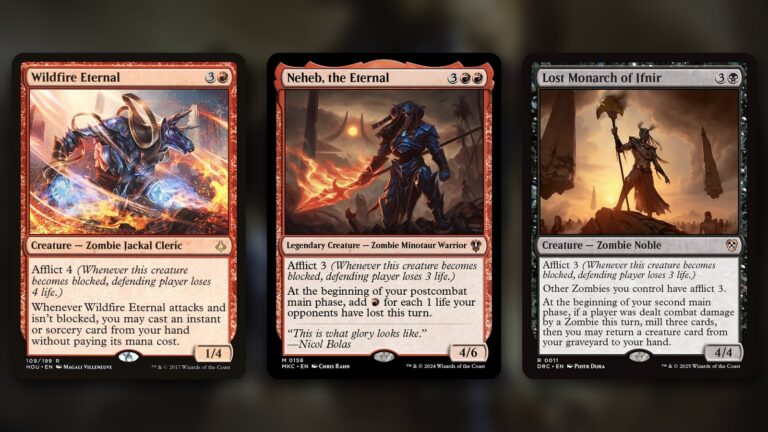
Codie shows up at #1 on some “best spellslinger commander” lists, and it’s a genuinely powerful engine — but its first line reads “You can’t cast permanent spells.” That’s a hard deckbuilding restriction, not a drawback you play around: creatures, artifacts, enchantments, and planeswalkers are all dead cards in your hand if you try to cast them. A Codie deck is instants, sorceries, and permanents that arrive some other way (tokens, the free casts off Codie’s own ability). New builders slot their favorite creatures into a Codie list and brick constantly. Build it on purpose or not at all.
The best spellslinger payoffs (the engine cards)
Whatever commander you pick, these are the permanents that convert spell-casts into wins. This is your payoff shortlist — run 10–14 of them. Note which trigger word each uses (from the table above) and match it to whether your deck casts or copies.
| Card | Trigger | Payoff | ~Price |
|---|---|---|---|
| Young Pyromancer | Cast instant/sorcery | 1/1 Elemental token — the best cheap go-wide payoff | $0.30 |
| Talrand, Sky Summoner | Cast instant/sorcery | 2/2 flying Drake — evasive tokens that close games | $1.02 |
| Murmuring Mystic | Cast instant/sorcery | 1/1 flying Bird — a resilient blue wall-of-tokens | $0.98 |
| Archmage Emeritus | Magecraft (cast/copy) | Draw a card — the premier card-advantage payoff | $0.48 |
| Storm-Kiln Artist | Magecraft (cast/copy) | Treasure token — ramp that fuels the same turn’s spells | $1.31 |
| Guttersnipe | Cast instant/sorcery | 2 damage to each opponent — the classic pinger | $0.29 |
| Electrostatic Field | Cast instant/sorcery | 1 damage to each opponent, on a defensive Wall body | $2.36 |
| Balmor, Battlemage Captain | Cast instant/sorcery | Team +1/+0 and trample — turns tokens lethal | $0.27 |
| Third Path Iconoclast | Cast noncreature | 1/1 artifact Soldier — also triggers off your rocks | $0.28 |
| Monastery Mentor | Cast noncreature | 1/1 Monk with prowess — snowballs off any noncreature spell | $0.54 |
| Docent of Perfection | Cast instant/sorcery | 1/1 Wizard, then flips into a team anthem | $0.46 |
| Metallurgic Summonings | Cast instant/sorcery | X/X Construct sized to the spell — plus a graveyard reload | $2.60 |
| Aria of Flame | Cast instant/sorcery | Escalating burn — but see the honesty catch below | $0.66 |
| Firebrand Archer | Cast noncreature | 1 damage to each opponent — noncreature version of Guttersnipe | $0.26 |
The enablers: cost reducers, rituals, and recursion
Payoffs win the game; enablers let you cast enough spells to get there. Spellslinger is a mana-hungry archetype — every spell you cast has a cost on top of the fuel it burns — so cost reduction and recursion do a lot of quiet work.
| Card | Role | What it does | ~Price |
|---|---|---|---|
| Goblin Electromancer | Cost reducer | Instants and sorceries cost {1} less — the cheapest way to cast more per turn | $0.29 |
| Baral, Chief of Compliance | Cost reducer | Same {1}-off discount, plus card filtering when you counter | $2.67 |
| Archmage’s Charm | Flexible interaction | Counter, draw two, or steal a cheap permanent — a spellslinger staple | $1.95 |
| Jeska’s Will | Ritual + card advantage | With your commander out, both a huge red ritual and three impulse-drawn cards | $41.53 |
| Mizzix’s Mastery | Recursion / combo | Recast your best instant/sorcery from the graveyard — overload for a game-ending copy chain | $9.11 |
| Thousand-Year Storm | Copy engine | Copies each spell for every spell cast before it that turn — the storm payoff | $1.14 |

How to build a spellslinger deck: the recipe
Here’s a starting ratio for a 100-card Izzet spellslinger deck. Adjust for your commander — a burn build runs more cheap spells, a storm build runs more rituals and cost reducers — but this skeleton keeps the engine humming without durdling.
- 1 commander — pick your win condition first (see the sub-archetype table).
- 10–14 payoffs — the non-negotiable core. This is the deck.
- 28–32 instants and sorceries — the fuel: cheap cantrips (Ponder, Preordain, Opt), interaction (removal, counters), and a few finishers.
- 6–8 cost reducers, rituals, and recursion — Electromancer, Baral, Jeska’s Will, Mizzix’s Mastery.
- 8–10 mana rocks & ramp — spellslinger is greedy; Arcane Signet, Izzet Signet, and friends let you double-spell early.
- 34–36 lands — you can shave a land or two versus a normal deck because your cantrips smooth draws, but don’t over-cut or you’ll fizzle.
Two build notes. First, favor cheap card draw over expensive draw — a spellslinger deck would rather cast three one-mana cantrips (three triggers) than one three-mana draw spell (one trigger). Second, run a small counterspell package specifically to protect your key payoff through a board wipe. For the rest of the engine’s staples — ramp rocks, interaction, the usual Commander staples — the standard EDH shell applies. If you’re brand new to the format, our step-by-step Commander guide covers the mana base and land count in detail.
A budget spellslinger starter shell (Veyran, Izzet)
This is a magecraft-value core to build around, not a finished 100 — it’s the engine plus a starter set of fuel. Add your ramp rocks, ~34–36 lands, extra cantrips, and interaction to complete the deck. Every card here is in print and cheap.
Veyran Izzet Spellslinger — Starter Shell
24 cards — one click loads the full list into a TCGplayer cart so you can check real prices and grab the whole deck at once.
Buy this deck on TCGplayerView it on KrakenTheMetaAffiliate link — buying through it supports KrakenTheMeta at no extra cost to you.Want the software to assemble the other 76 cards and a legal mana base for you? KrakenTheMeta’s AI deck builder will spin up a full Veyran spellslinger list in seconds, and you can browse other players’ public spellslinger decks for ideas.
Honesty catches: spellslinger traps most lists get wrong
A few widely-repeated claims about this archetype are wrong, and one card is a genuine trap. All verified against oracle text:
- Copies don’t trigger “cast” payoffs. If your Kalamax or Thousand-Year Storm copies a spell, that copy does not trigger Young Pyromancer, Guttersnipe, or Talrand — those read “whenever you cast.” Only magecraft payoffs (which say “cast or copy”) get paid for the copies. Copy-heavy decks should lean on magecraft creatures.
- Veyran doubles other permanents, not just herself. Her value line reads more like “doubles all my magecraft triggers.” With two magecraft payoffs out, one cantrip resolves four instances of value. She’s an engine multiplier, not a beatstick.
- Aria of Flame gives each opponent 10 life first. Its enter-the-battlefield clause hands every opponent 10 life before it starts dealing damage. It’s a powerful late finisher once you’re chaining spells, but it’s a liability if you play it early — you’ve just extended the game you’re trying to end.
- Kalamax only copies your first instant each turn, and only while tapped. Tap him before you cast. And note it’s instants only — sorceries don’t get the copy.
- Codie can’t cast permanent spells. Repeating it because it’s the most common brick: no creatures, artifacts, or enchantments as cast spells in a Codie deck.
Frequently asked questions
What is the best spellslinger commander for beginners?
Veyran, Voice of Duality at around $1.34. She’s cheap, she’s mono-plan (magecraft value), and she doubles every payoff you add, so the deck gets stronger as you learn it. If you’d rather win with damage than tokens, Niv-Mizzet, Parun is the most self-contained finisher.
Is spellslinger the same as storm?
Storm is a subset of spellslinger. Storm decks chain many spells in one turn for a burst kill (Kalamax, Stella Lee, Thousand-Year Storm). Plenty of spellslinger decks instead grind value over many turns (Veyran, Kess) and never “go off.” Both are spellslinger; not all spellslinger is storm.
What colors are best for a spellslinger deck?
Izzet (blue-red) is the home of the archetype — blue for cheap card draw, red for spell-damage and Treasure payoffs. Grixis (Kess) adds graveyard recursion, Temur (Kalamax) adds ramp, and Azorius (Elminster) is the one strong option outside red.
How many lands should a spellslinger deck run?
Around 34–36. You can run slightly fewer than a typical Commander deck because your cheap cantrips dig for lands, but going much below 34 risks fizzling before your engine comes online. Pair the lower land count with 8–10 mana rocks.
What’s the difference between magecraft and prowess?
Prowess triggers on any noncreature spell you cast (including artifacts and enchantments) and only pumps the creature. Magecraft triggers on casting or copying an instant or sorcery specifically, and its effect varies by card (draw, Treasure, damage). They overlap but aren’t interchangeable — check the exact wording before you assume a card counts.
Build your next deck with AI
KrakenTheMeta’s AI deck builder researches the current meta and writes you a complete, format-legal decklist in about a minute — free to try.
Build a Deck with AIor browse community decks