

Best Voltron Commanders in MTG: How to Build a Voltron Deck That Actually Connects (2026)
Every Commander player has watched it happen. Someone spends four turns stacking Auras and Equipment onto a single creature, finally swings for lethal — and the table’s blue player spends one mana on Swords to Plowshares. Four turns of investment, gone to a card that costs less than a Sol Ring.
That is the entire Voltron problem in one sentence, and it is why most “best Voltron commanders” lists are only half an answer. Picking a powerful legend is the easy part. Building a deck that still has a threat on the battlefield when the removal starts flying is the actual skill — and it comes down to a ratio you can count before you ever shuffle up.
This guide covers both halves: which commanders are genuinely worth building in 2026, grouped by how each one survives, and the protection-to-evasion-to-payoff ratio that turns a pile of good Equipment into a deck that closes games. Every card below has been checked against Scryfall for current Oracle text, Commander legality, and market price.
What “Voltron” Means in MTG
Voltron is a Commander strategy that wins by stacking Auras and Equipment onto one creature — almost always your commander — and killing opponents with commander damage instead of a wide board. It is a nickname, not an official mechanic; you will not find the word printed on a single card.
The name comes from the 1980s cartoon, in which five separate lion robots combine into one enormous super-robot. That is exactly what the deck does: a dozen individually unremarkable permanents assemble into one creature that ends games in two connections.
Voltron is a natural fit for Commander specifically because of the format’s commander-damage rule, which no other format has. It also happens to be one of the cheapest archetypes to build — many of the strongest Auras in the deck cost well under a dollar.
The 21-Damage Math: How Fast Voltron Actually Kills
In Commander, a player loses if they take 21 or more combat damage from a single commander over the course of the game. That total is tracked per commander, and it accumulates — it does not reset when the commander dies and gets recast.
Two rules consequences matter enormously for this archetype and almost never get mentioned. First, a token copy of your commander deals no commander damage at all — the commander designation is an attribute of the card, and a token has no card, so Blade of Selves and Helm of the Host generate huge board damage while your 21-clock stands still. Second, if an opponent steals your commander and swings it back, that damage accumulates against you, because the rule says “the same commander” without saying who controls it. Both are covered in full, with the rules text, in our guide to how commander damage actually works.
Twenty-one sounds like a lot until you break it into swings:
- Two hits requires an 11-power commander. Entirely routine — Colossus Hammer alone is +10/+10 for one mana.
- Three hits requires only 7 power. Most Voltron commanders reach that with two Auras.
- One hit requires 21 power, or 11 power with double strike — which is why Embercleave and Rafiq of the Many show up in so many lists.
The crucial consequence: you do not need an enormous creature. You need a 7-power creature that connects three times. Every card in the deck should be judged against that sentence — and “connects” is doing far more work in it than “7-power.”
The Three Ways Voltron Decks Actually Lose
Failed Voltron decks nearly always die to one of three things, and each has a specific card-count answer.
1. Targeted removal. Your commander eats a Swords to Plowshares, a Pongify, or a board wipe. Every recast then costs two more mana than the last. This is the big one, and the answer is protection density — 8 to 12 pieces, not two.
2. Chump blockers. A 30/30 trampler is terrifying; a 30/30 without trample is stopped cold by a 1/1 Soldier token forever. Evasion is not a luxury slot in this deck, it is a win condition.
3. The Aura two-for-one. Auras die with the creature they enchant. Lose the commander with three Auras attached and you have lost four cards to their one. Equipment does not have this problem — it survives and re-attaches — which is the entire reason experienced players skew their builds toward Equipment.
Best Voltron Commanders in MTG, Grouped by How They Survive
Rather than an arbitrary power ranking, here are the commanders worth building sorted by the problem each one solves. Prices are current market as of July 2026.
Self-Protecting: They Solve the Removal Problem Themselves
Uril, the Miststalker is the most-recommended Voltron commander in the format for one reason: hexproof. Opponents simply cannot target it, so half the removal in the game is blank against you — but you can still target it with your own Auras, because hexproof only stops your opponents. Uril also gets +2/+2 per Aura, so two Auras make it a 10/10 before those Auras add their own stats. The catch is a Naya (red-green-white) mana base and no built-in evasion.
Sigarda, Host of Herons brings hexproof plus flying — protection and evasion in one card — and shuts off opposing sacrifice effects, which are the standard answer to hexproof creatures. It is the safest commander on this list and the one that asks the least of your deck.
Card-Advantage Engines: They Replace What Removal Takes
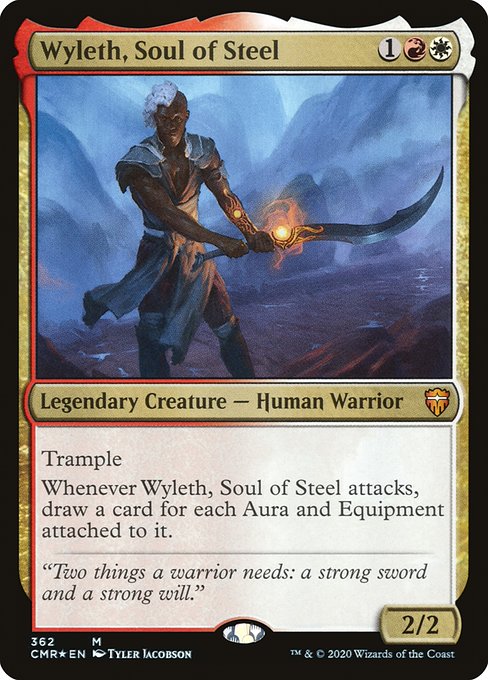
Wyleth, Soul of Steel draws a card for each Aura and Equipment attached whenever it attacks, and comes with trample built in. Three attachments means three cards per swing. At three mana in Boros colors it is the best “I want to actually enjoy this deck” pick — losing Wyleth hurts far less when it has already refilled your hand twice.
Syr Gwyn, Hero of Ashvale gives all your Equipment equip Knight {0} and draws on attack, with vigilance and menace attached. Free equip costs completely change how the deck plays — you can re-suit a fresh body the same turn your commander dies.
Light-Paws, Emperor’s Voice tutors a fresh Aura onto itself every time you cast one, chaining a two-mana Aura into a free one. It is a two-mana commander that assembles its own suit.
Cheap and Recastable: They Ignore Commander Tax
Rograkh, Son of Rohgahh costs {0}. Even after five deaths it costs ten mana less than most commanders after one. It arrives with first strike, menace, and trample already — genuinely all three keywords Voltron wants — and Partner lets you pair it with a support legend like Ardenn.
Skullbriar, the Walking Grave keeps its +1/+1 counters when it changes zones, so killing it does not reset your progress. Haste means it starts attacking the turn it lands, and at two mana it recasts cheaply forever.
Free Attachment: They Turn Removal Into a Speed Bump
Ardenn, Intrepid Archaeologist moves any number of Auras and Equipment you control to any permanent each combat, for free. If your commander dies, Ardenn relocates the entire suit to a new creature at no mana cost — the single best answer to the two-for-one problem in the archetype.
Halvar, God of Battle gives every enchanted or equipped creature you control double strike, halving the number of connections you need, and moves an attachment each combat. It also flips into Sword of the Realms, an Equipment that returns the equipped creature to your hand when it dies — dodging removal and saving the commander tax.
Bruna, Light of Alabaster reattaches every Aura on the battlefield — plus Auras from your graveyard and hand — whenever it attacks or blocks. It rebuilds the whole suit from the graveyard after a wipe.
Damage Multipliers: They Shorten the Clock
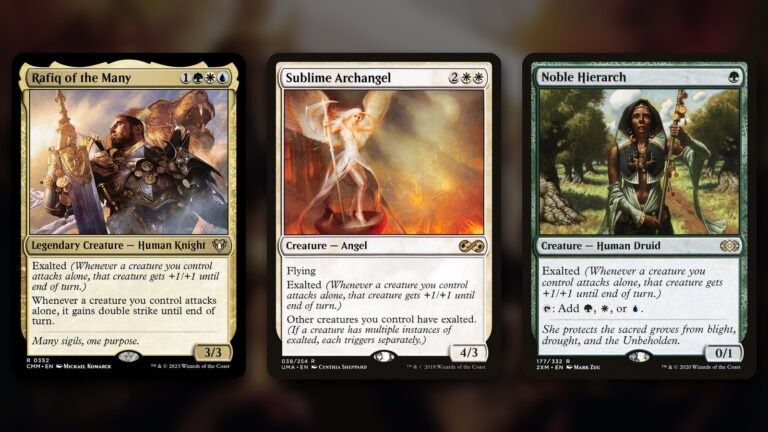
Rafiq of the Many gives double strike to any creature attacking alone, so 11 power is lethal in a single connection. He also has exalted, and our exalted guide shows how stacking it with double strike gets there, with a $68 budget Rafiq deck. Killian, Ink Duelist has menace and makes every targeted Aura cost {2} less, which is a genuine mana engine in a deck full of targeted spells.
| Commander | Colors | Cost | Why It Wins | Price |
|---|---|---|---|---|
| Uril, the Miststalker | Naya | {2}{R}{G}{W} | Hexproof + gets +2/+2 per Aura | $1.17 |
| Wyleth, Soul of Steel | Boros | {1}{R}{W} | Trample; draws per attachment on attack | $3.58 |
| Sigarda, Host of Herons | Selesnya | {2}{G}{W}{W} | Flying, hexproof, sacrifice-proof | $3.18 |
| Syr Gwyn, Hero of Ashvale | Mardu | {3}{R}{W}{B} | Equip Knight {0}; draws on attack | $2.80 |
| Ardenn, Intrepid Archaeologist | White | {2}{W} | Moves the whole suit free each combat | $5.37 |
| Rograkh, Son of Rohgahh | Red | {0} | Free to recast; first strike, menace, trample | $2.30 |
| Halvar, God of Battle | White | {2}{W}{W} | Double strike for equipped creatures | $26.07 |
| Light-Paws, Emperor’s Voice | White | {1}{W} | Tutors a free Aura per Aura cast | $3.63 |
| Skullbriar, the Walking Grave | Golgari | {B}{G} | Counters survive death; haste | $2.26 |
| Rafiq of the Many | Bant | {1}{G}{W}{U} | Double strike when attacking alone | $0.29 |
| Bruna, Light of Alabaster | Azorius | {3}{W}{W}{U} | Rebuilds the Aura suit from the graveyard | $0.49 |
| Killian, Ink Duelist | Orzhov | {W}{B} | Menace; targeted Auras cost {2} less | $0.25 |
The Lightning Greaves Trap: Shroud vs. Hexproof
This is the single most common mistake in a first Voltron build, and it is a rules distinction, not a preference.
Lightning Greaves grants shroud — “can’t be the target of spells or abilities.” Not opponents’ spells. Any spells, including yours. A commander wearing Lightning Greaves cannot be enchanted by an Aura you cast, cannot be targeted by your protection tricks, and cannot have another Equipment equipped to it, because the equip ability targets.
Swiftfoot Boots grants hexproof — “can’t be the target of spells or abilities your opponents control.” Your own Auras and equip abilities work perfectly.
In most Commander decks Lightning Greaves is a premium card; the free equip cost and haste are excellent. In a Voltron deck it actively prevents your deck from functioning. Play the Boots. The same trap applies to Whispersilk Cloak, which also grants shroud — its unblockable clause is strong enough to be worth it, but equip the Cloak last, after everything else is already attached.
The same logic explains why Uril, the Miststalker is so highly rated while creatures with printed shroud are not: hexproof is a one-way door, and shroud closes it in both directions.
| Card | Cost | What It Does | Voltron Verdict | Price |
|---|---|---|---|---|
| Swiftfoot Boots | {2} | Hexproof and haste | Auto-include — hexproof, not shroud | $1.93 |
| Champion’s Helm | {3} | +2/+2; hexproof if legendary | Auto-include — your commander is legendary | $3.40 |
| Blacksmith’s Skill | {W} | Hexproof and indestructible until EOT | Best one-mana save in white | $0.38 |
| Snakeskin Veil | {G} | +1/+1 counter and hexproof until EOT | One mana, leaves a permanent counter | $0.28 |
| Heroic Intervention | {1}{G} | All your permanents gain hexproof and indestructible | Beats board wipes, not exile | $16.64 |
| Flawless Maneuver | {2}{W} | Indestructible; free if you control a commander | Free protection — but not vs. exile or bounce | $20.84 |
| Teferi’s Protection | {2}{W} | Phases out everything you control | The best save in the format; expensive | $52.60 |
| Robe of Stars | {1}{W} | +0/+3; phases the creature out for {1}{W} | Repeatable dodge, keeps the Auras attached | $14.30 |
| Hyena Umbra | {W} | +1/+1, first strike, totem armor | One mana, eats a removal spell outright | $0.36 |
| Boar Umbra | {2}{G} | +3/+3, totem armor | Stat boost that doubles as a counterspell | $0.28 |
| Bear Umbra | {2}{G}{G} | +2/+2, untaps your lands on attack, totem armor | Protection plus a ritual — premium | $12.07 |
| Lightning Greaves | {2} | Haste and shroud | Avoid — shroud blocks your own Auras and equips | $3.66 |
Note what the Umbras do, because it is the most underrated interaction in the archetype. Umbra armor reads: “If enchanted creature would be destroyed, instead remove all damage from it and destroy this Aura.” A one-mana Hyena Umbra absorbs a Murder entirely. It does not stop exile, bounce, or sacrifice effects — but against destruction-based removal, cheap Umbras are the most mana-efficient protection in the game, and they add power while sitting there doing it.
Evasion: 21 Damage Means Nothing If It Gets Chump-Blocked
A commander with 40 power and no evasion loses to a single 1/1 token every combat, forever. Run 6 to 8 evasion sources. Trample is the most reliable because it scales with your power — as the creature grows, chump blocking gets worse and worse for the defender. The rest of the evasion menu is really a question of which combat step you are editing: menace and flying change who is allowed to block, while unblockable effects remove the question entirely. Our guide to menace, vigilance, haste and reach lays out which does what.
| Card | Cost | Effect | Why It Matters | Price |
|---|---|---|---|---|
| Rogue’s Passage | Land | {4}, {T}: target creature can’t be blocked | A land slot that guarantees a connection | $0.39 |
| Shadowspear | {1} | +1/+1, trample, lifelink; strips opposing hexproof | Trample plus an answer to hexproof blockers | $30.54 |
| Loxodon Warhammer | {3} | +3/+0, trample, lifelink | Budget trample and a huge life swing | $2.65 |
| Rancor | {G} | +2/+0 and trample; returns to hand when it dies | One mana of trample you can never lose | $1.82 |
| Embercleave | {4}{R}{R} | Flash; +1/+1, double strike, trample; auto-attaches | Halves the connections needed, at instant speed | $9.17 |
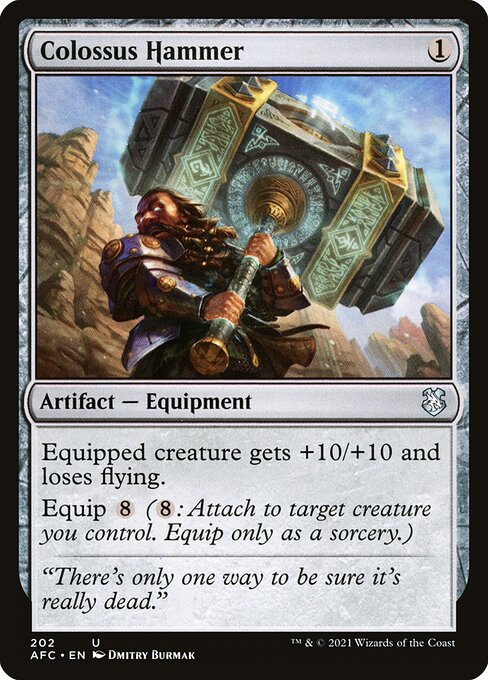
| Colossus Hammer | {1} | +10/+10, loses flying; equip {8} | Lethal on its own — pair with free-equip effects | $1.87 |
| Trailblazer’s Boots | {2} | Nonbasic landwalk | Nearly unblockable in Commander’s greedy mana bases | $3.25 |
| Whispersilk Cloak | {3} | Unblockable and shroud | Guaranteed damage — but attach it last | $1.60 |
| Sword of Feast and Famine | {3} | +2/+2, pro-black/green; untaps lands | Protection from two colors is evasion and defense | $38.99 |
| Sword of Fire and Ice | {3} | +2/+2, pro-red/blue; 2 damage and a card | Dodges the colors most likely to kill you | $49.49 |
The Swords deserve their own note: protection from a color means the creature cannot be blocked by, targeted by, or dealt damage by that color. A single Sword is simultaneously evasion against two colors and immunity to their removal — which is why they cost what they do.
Auras vs. Equipment: Choosing Your Poison
Auras are cheaper, hit harder per mana, and are far more dangerous to rely on. Equipment costs more up front and re-attaches after your creature dies. Most good Voltron decks run both, weighted by their commander: an Aura-payoff commander like Uril or Light-Paws leans Auras; Wyleth or Syr Gwyn leans Equipment.
If you go the Aura route, the payoff is that Aura-count scaling gets absurd quickly:
| Card | Cost | Effect | Price |
|---|---|---|---|
| Ethereal Armor | {W} | +1/+1 per enchantment you control, first strike | $0.40 |
| All That Glitters | {1}{W} | +1/+1 per artifact and/or enchantment you control | $0.58 |
| Ancestral Mask | {2}{G} | +2/+2 per other enchantment on the battlefield | $2.41 |
| Daybreak Coronet | {W}{W} | +3/+3, first strike, vigilance, lifelink | $5.49 |
| Sage’s Reverie | {3}{W} | +1/+1 per Aura and draws that many cards | $0.32 |
| Armored Ascension | {3}{W} | +1/+1 per Plains you control, and flying | $0.33 |
| Unquestioned Authority | {2}{W} | Protection from creatures; draws a card | $3.76 |
| Snake Umbra | {2}{G} | +1/+1, draw on damage, totem armor | $1.29 |
Two details worth knowing. Ancestral Mask counts every other enchantment on the battlefield, including your opponents’ — in an enchantment-heavy pod it can be +10/+10 or more for three mana. And Daybreak Coronet reads “enchant creature with another Aura attached to it,” so it cannot be your first Aura; it is also uncounterable-adjacent in a specific sense — if your creature’s only other Aura is removed in response, Coronet is countered on resolution for having an illegal target.
Against Aura decks, the card-advantage fix is to run the payoffs that draw: Kor Spiritdancer ($0.37) draws on every Aura cast, Sram, Senior Edificer ($0.80) draws on Auras, Equipment, and Vehicles alike, and Sigarda’s Aid ($18.19) lets you flash in Auras and Equipment — turning a removal spell into a blowout when you attach at instant speed after blockers.
The Voltron Deck Skeleton
Here is the ratio that separates decks that connect from decks that get blown out. These are 99-card slots, excluding your commander.
| Slot | Count | Why |
|---|---|---|
| Lands | 34–36 | Voltron curves low; include Rogue’s Passage |
| Ramp | 8–10 | You need to recast through commander tax |
| Protection | 8–12 | The number most new builds get wrong — go higher, not lower |
| Evasion | 6–8 | Trample preferred; it scales with your power |
| Auras / Equipment (payload) | 18–24 | Enough to rebuild twice, not so many you flood |
| Card draw | 8–10 | Attachment-triggered draw is best |
| Tutors | 3–5 | Open the Armory, Steelshaper’s Gift, Stoneforge Mystic |
| Interaction / removal | 6–8 | You still have to answer blockers and combo |
The single most common building error is running 20+ payload cards and 3 protection cards. Trade four Auras for four protection spells and the deck’s win rate moves immediately — you cannot deal 21 damage with a creature that is not on the battlefield.
A Budget Wyleth Starter Shell
Wyleth is the best entry point: three mana, trample built in, draws cards on every attack, and Boros keeps the mana base cheap. This core runs well under most budgets — note that Lightning Greaves is deliberately absent for the shroud reason above.
Wyleth Boros Voltron — Starter Shell
35 cards — one click loads the full list into a TCGplayer cart so you can check real prices and grab the whole deck at once.
Buy this deck on TCGplayerAffiliate link — buying through it supports KrakenTheMeta at no extra cost to you.Fill the remaining slots with 34 lands, Boros ramp (Arcane Signet, Boros Signet, Sol Ring), and interaction. Puresteel Paladin is the engine to prioritize — with three artifacts out, every Equipment gains equip {0}, which is what makes Colossus Hammer‘s equip {8} cost irrelevant.

Frequently Asked Questions
Is Voltron a real MTG mechanic?
No. Voltron is a community nickname for the strategy of stacking Auras and Equipment onto one creature to win with commander damage. It appears on no card and in no rulebook, but it is universally understood at Commander tables.
How much commander damage do you need to win?
21 damage from a single commander eliminates a player. It is tracked separately per commander and per opponent, and it persists across that commander’s deaths and recasts.
Are Auras or Equipment better for Voltron?
Equipment is more resilient because it survives your creature dying and can be re-attached; Auras are cheaper and scale harder. Most strong decks run both, weighted toward whichever their commander rewards. If you are new to the archetype, skew toward Equipment — the two-for-one risk on Auras punishes inexperience hardest.
Why is Lightning Greaves bad in a Voltron deck?
It grants shroud, which prevents all targeting — including your own. You cannot enchant or equip a creature wearing Lightning Greaves. Swiftfoot Boots grants hexproof instead, which only stops opponents, and is the correct card for this archetype.
What is the best budget Voltron commander?
Wyleth, Soul of Steel at around $3.58 — trample, three mana, and it draws a card for every attachment when it attacks. Rafiq of the Many ($0.29) and Killian, Ink Duelist ($0.25) are even cheaper if you want a specific color pair.
Does commander damage reset if my commander dies?
No. Damage dealt by a commander accumulates for the whole game against each opponent, regardless of how many times that commander dies and is recast. This is what makes cheap, recastable commanders like Rograkh and Skullbriar viable — you keep every point of progress.
Where to Go From Here
Voltron rewards precision more than power. Count your protection before you count your payload, make sure every point of power can actually connect, and remember that the archetype’s most-recommended Equipment is the one card you should leave out.
If you want to go deeper on the payload half of the deck, our guide to the best Equipment in MTG ranks the full card pool in detail. For the protection package, board wipes and removal spells cover what you are defending against, and Commander staples covers the ramp and utility slots every build wants. New to the format entirely? Start with how to build a Commander deck.
You can also skip the spreadsheet stage: KrakenTheMeta’s AI deck builder will draft a full Voltron list around any commander on this page, with the protection and evasion ratios already balanced, and you can browse what other players have built in the public deck gallery.
Build your next deck with AI
KrakenTheMeta’s AI deck builder researches the current meta and writes you a complete, format-legal decklist in about a minute — free to try.
Build a Deck with AIor browse community decks

2 Comments
Comments are closed.