
Dash MTG: How It Works, All 22 Cards, When to Dash and a $48 Kolaghan Deck (2026)
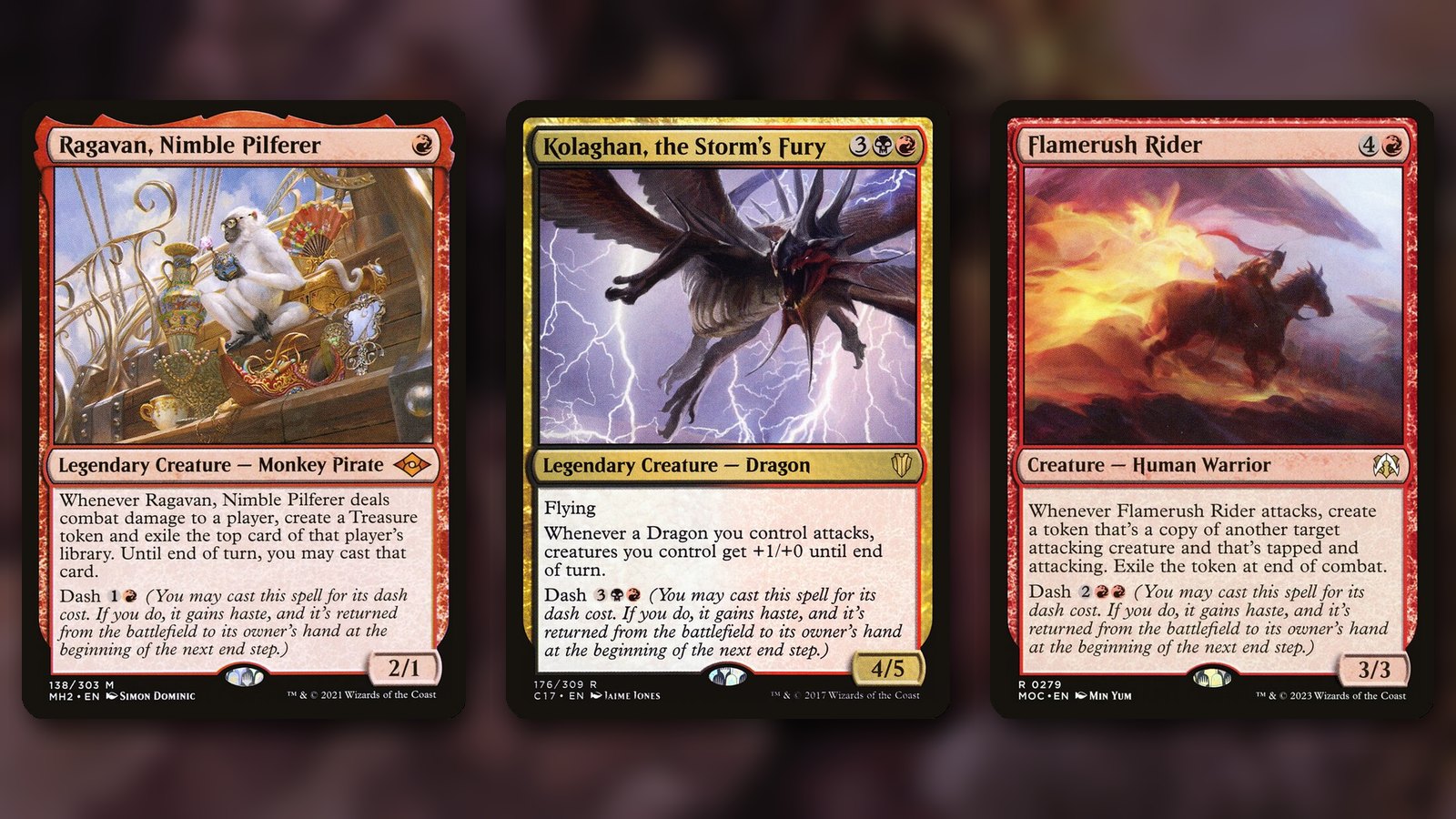
Dash is the Magic: The Gathering keyword that lets you cast a creature for its dash cost instead of its mana cost. A dashed creature has haste, and at the beginning of the next end step it goes back to your hand. Next turn you can dash it again, cast it normally, or keep it in hand. Ragavan, Nimble Pilferer costs {R}, or {1}{R} to dash: the dashed version attacks the turn it comes down and is safe in your hand when the opponents take their turns.
There are 22 cards with dash, and the first thing the numbers show is that dash is not a discount. 9 of the 22 dash costs are one mana more than the card’s normal cost, 5 are the same, and 8 are one mana less. None saves two. You pay for haste and for the trip back to your hand, every turn you use it.
So is it worth paying? We built a budget Kolaghan, the Storm’s Fury deck with 16 dash creatures and ran it through 50,000 test games three ways: dash everything, never dash, and dash only when the normal cost doesn’t fit. Against an opponent who does nothing, dashing everything killed by turn 10 in 68% of games against 95% for never dashing. Against a table that kills your best creature once a turn cycle, it flipped: 53% against 17%. This guide covers the rules (including the commander-tax trick), the full test, all 22 cards, the best dash commanders, legality, how to beat dash, and the $48 Kolaghan deck.

What is dash in MTG?
Dash is rule 702.109 of the Comprehensive Rules. Rule 702.109a says dash represents three abilities. “Dash [cost]” means:
“You may cast this card by paying [cost] rather than its mana cost,” “If this spell’s dash cost was paid, return the permanent this spell becomes to its owner’s hand at the beginning of the next end step,” and “As long as this permanent’s dash cost was paid, it has haste.”
Each of the three parts matters on its own.
- It’s an alternative cost. You are still casting the creature spell, at the normal time (your main phase, empty stack, unless something gives it flash). It can be countered. Its mana value doesn’t change.
- The return is a delayed trigger. It happens at the beginning of the next end step and only finds the creature if it’s still on the battlefield. If it died in combat, it stays in the graveyard.
- The haste is static. The creature has haste for as long as it’s on the battlefield with its dash cost paid, not only for one turn.
Dash first appeared in Fate Reforged (January 2015) as the mechanic of the Mardu clan, and came back two months later in Dragons of Tarkir as the mechanic of the Kolaghan dragonlord’s clan. It has turned up only four times since: Treetop Ambusher in Modern Horizons (2019), Ragavan, Nimble Pilferer in Modern Horizons 2 (2021), and two Commander-deck cards in 2023, Death-Greeter’s Champion and Riders of Rohan.
Dash rules: 14 common situations
| Situation | What happens | Source |
|---|---|---|
| Dashing your commander from the command zone | Allowed. Commander tax is added on top of the dash cost, like any other cost increase | Rules 903.8, 601.2f |
| Your dashed commander returns at end step | It goes to your hand. You may put it into the command zone instead, but you don’t have to | Rule 903.9b |
| Dashing your commander from your hand next turn | No commander tax. Tax only counts casts from the command zone | Rule 903.8 |
| Mana value of a dashed creature | Unchanged. Kolaghan is mana value 5 whether you dash it or not | Rule 118.9c |
| Combining dash with another alternative cost | Not possible. You can’t dash a creature you are casting “without paying its mana cost” | Rule 118.9a |
| Cost increases and reductions | They apply to the dash cost. Sphere of Resistance makes it one more; Warbringer makes it two less | Rule 601.2f; Warbringer rulings |
| Warbringer and coloured mana | It only reduces generic mana. A dash cost of {1}{R} becomes {R} | Warbringer ruling |
| A counterspell in response | Dash is cast, so it can be countered. The card goes to the graveyard | Dash rulings |
| The dashed creature dies before the end step | It stays in the graveyard. The return trigger only moves it if it is still on the battlefield | Dash rulings |
| You don’t want to attack | You don’t have to. Haste allows an attack; it doesn’t force one | Dash rulings |
| Blinking a dashed creature, or Conjurer’s Closet at end step | It returns as a new object: no haste, and it won’t go back to your hand. Let the Closet trigger resolve first and you keep it | Rule 400.7 |
| A copy of a dashed creature | The copy has no haste and isn’t returned to hand | Dash rulings |
| The return trigger is countered (Stifle) | The creature stays, and it keeps haste, because the haste lasts as long as its dash cost was paid | Rule 702.109a |
| Enters and leaves abilities | Both happen every time. Riders of Rohan makes two Knight tokens each time you dash it, and the tokens stay | Rule 702.109a |
The commander rows are the trick most players miss. Dash Kolaghan from the command zone once, for {3}{B}{R} plus any tax you owe. At the end step, let it go to your hand. From then on you can dash it from your hand for {3}{B}{R} every turn, and the tax never goes up again, because you are no longer casting it from the command zone. If an opponent wipes the board while it’s in your hand, it survives.

Dash costs more than you think
Most guides describe dash as a cheap, hasty attacker. The cards say otherwise. Here is every dash cost compared with the card’s normal mana cost.
| Card | Mana cost | Mana value | Dash cost | Dash costs |
|---|---|---|---|---|
| Mardu Shadowspear | {B} | 1 | {1}{B} | One more |
| Ragavan, Nimble Pilferer | {R} | 1 | {1}{R} | One more |
| Zurgo Bellstriker | {R} | 1 | {1}{R} | One more |
| Kolaghan Skirmisher | {1}{B} | 2 | {2}{B} | One more |
| Ambuscade Shaman | {2}{B} | 3 | {3}{B} | One more |
| Death-Greeter’s Champion | {2}{R} | 3 | {3}{R} | One more |
| Mardu Strike Leader | {2}{B} | 3 | {3}{B} | One more |
| Pitiless Horde | {2}{B} | 3 | {2}{B}{B} | One more |
| Riders of Rohan | {3}{R}{W} | 5 | {4}{R}{W} | One more |
| Lightning Berserker | {R} | 1 | {R} | Same |
| Mardu Scout | {R}{R} | 2 | {1}{R} | Same |
| Treetop Ambusher | {1}{G} | 2 | {1}{G} | Same |
| Kolaghan Forerunners | {2}{R} | 3 | {2}{R} | Same |
| Kolaghan, the Storm’s Fury | {3}{B}{R} | 5 | {3}{B}{R} | Same |
| Reckless Imp | {2}{B} | 3 | {1}{B} | One less |
| Screamreach Brawler | {2}{R} | 3 | {1}{R} | One less |
| Alesha’s Vanguard | {3}{B} | 4 | {2}{B} | One less |
| Goblin Heelcutter | {3}{R} | 4 | {2}{R} | One less |
| Vaultbreaker | {3}{R} | 4 | {2}{R} | One less |
| Warbringer | {3}{R} | 4 | {2}{R} | One less |
| Flamerush Rider | {4}{R} | 5 | {2}{R}{R} | One less |
| Sprinting Warbrute | {4}{R} | 5 | {3}{R} | One less |
The cheap one-drops pay a premium. Ragavan, Zurgo Bellstriker and Mardu Shadowspear all cost one mana to cast and two to dash. The savings sit on the bigger creatures: six of the eight cheaper dash costs belong to four- and five-drops, such as Goblin Heelcutter, Vaultbreaker, Warbringer and Sprinting Warbrute. No dash card saves more than one. Compare warp, where 25 of 32 cards save two or three mana: warp is a discount, dash is a premium.
What does the premium buy? Three things. Haste, so a creature attacks the turn it lands. Protection from sorcery-speed removal and board wipes, because the creature spends the opponents’ turns in your hand. And repeated enters triggers: Riders of Rohan makes two tokens each time and Ambuscade Shaman’s +2/+2 fires for every creature that enters.
Is dash worth it? 50,000 test games
We ran the Kolaghan deck below (16 dash creatures, Kolaghan in the command zone) through 50,000 games for each of three ways to play it, in three kinds of game.
- Dash everything: every dash creature is dashed, every turn, and Kolaghan is dashed from the command zone once and then from your hand.
- Never dash: everything is cast normally.
- Dash only when needed: cast normally when you can afford it, dash only when the dash cost fits and the normal cost doesn’t.
The three games: an opponent who does nothing; an opponent who wipes the board once, right after your turn 6; and a table that kills your biggest creature (Kolaghan first) after each of your turns from turn 4. The count is damage to one opponent at 40 life.
| Game | How you play dash | Damage by turn 4 | By turn 6 | By turn 8 | By turn 10 | Killed a 40-life opponent by turn 10 |
|---|---|---|---|---|---|---|
| Opponent does nothing | Dash everything | 6.4 | 18.2 | 33.7 | 53.9 | 68% |
| Opponent does nothing | Never dash | 5.0 | 26.5 | 71.0 | 136.0 | 95% |
| Opponent does nothing | Dash only when needed | 5.5 | 26.1 | 68.5 | 130.8 | 94% |
| One board wipe after your turn 6 | Dash everything | 6.3 | 18.2 | 29.9 | 45.3 | 62% |
| One board wipe after your turn 6 | Never dash | 4.9 | 26.3 | 33.1 | 55.9 | 78% |
| One board wipe after your turn 6 | Dash only when needed | 5.5 | 26.2 | 33.4 | 56.8 | 79% |
| Your best creature killed every turn from turn 4 | Dash everything | 6.4 | 15.7 | 27.3 | 41.2 | 53% |
| Your best creature killed every turn from turn 4 | Never dash | 4.9 | 11.3 | 17.9 | 24.0 | 17% |
| Your best creature killed every turn from turn 4 | Dash only when needed | 5.5 | 11.8 | 18.4 | 24.4 | 16% |
Against an opponent who does nothing, dash everything is the worst plan. It kills by turn 10 in 68% of games, against 95% for never dashing. The reason is mana: by turn 10 the dash-everything deck has spent an average of 36 mana on dash costs and recast Kolaghan 5.6 times. That’s mana it didn’t spend adding creatures that stay. Dash does hit earlier: 6.4 damage by turn 4 against 5.0. It just doesn’t build.
A single board wipe doesn’t change the answer. When the wipe comes, the dash-everything deck loses 0.4 creatures on average and has 4.2 safe in hand; the never-dash deck loses 3.3 and has 1.3. That’s a real save, but the never-dash deck had already done more damage by then (26 against 18 by turn 6), and it still kills by turn 10 more often (78% against 62%).
| How you play dash | Creatures lost to the wipe | Creatures safe in hand | Damage by turn 10 | Killed by turn 10 |
|---|---|---|---|---|
| Dash everything | 0.4 | 4.2 | 45.3 | 62% |
| Never dash | 3.3 | 1.3 | 55.9 | 78% |
| Dash only when needed | 3.0 | 1.5 | 56.8 | 79% |
Steady removal does change it. When the table kills your best creature after every turn, the never-dash deck spends its turns replacing creatures and kills by turn 10 in only 17% of games. The dash-everything deck has almost nothing on the battlefield when the removal comes, and kills in 53%. That’s the case dash was designed for.
The middle plan, dashing only when the normal cost doesn’t fit, scored within two points of never dashing in all three games. It dashes less than once a game. So the honest rule is: dash is removal insurance, and you pay the premium every turn. Cast normally against a quiet table. Switch to dash when the table is holding removal, when a wipe is coming, or when the haste damage ends the game this turn.
The model is simple: one land a turn, no mulligans, no blockers, card draw and removal spells ignored, and every dash creature treated the same. Real tables block, so expect lower damage in every row. The gap between the rows is the point. To check your own odds of drawing a card by a given turn, use the MTG odds calculator.

All 22 dash cards
Sorted by how many Commander decks play them on EDHREC (12 November 2026). Prices are the cheapest regular printing on Scryfall.
| Card | Mana cost | Dash cost | Colour | Power/toughness | What else it does | First set | Rarity | Commander decks (EDHREC) | Cheapest |
|---|---|---|---|---|---|---|---|---|---|
| Ragavan, Nimble Pilferer | {R} | {1}{R} | Red | 2/1 | Combat damage to a player: make a Treasure, exile their top card, you may cast it this turn | MH2 (2021) | Mythic | 395,989 | $40.03 |
| Flamerush Rider | {4}{R} | {2}{R}{R} | Red | 3/3 | Attacks: make a token copy of another attacking creature, exiled at end of combat | FRF (2015) | Rare | 33,403 | $0.14 |
| Riders of Rohan | {3}{R}{W} | {4}{R}{W} | Red-white | 4/4 | Enters: make two 2/2 Knight tokens with trample and haste | LTC (2023) | Rare | 21,825 | $0.31 |
| Kolaghan, the Storm’s Fury | {3}{B}{R} | {3}{B}{R} | Black-red | 4/5 | Flying; whenever a Dragon you control attacks, your creatures get +1/+0 | FRF (2015) | Rare | 21,522 | $0.65 |
| Mardu Shadowspear | {B} | {1}{B} | Black | 1/1 | Attacks: each opponent loses 1 life | FRF (2015) | Uncommon | 7,694 | $0.18 |
| Mardu Strike Leader | {2}{B} | {3}{B} | Black | 3/2 | Attacks: make a 2/1 Warrior token | FRF (2015) | Rare | 7,569 | $0.28 |
| Death-Greeter’s Champion | {2}{R} | {3}{R} | Red | 2/1 | Backup 1; gives double strike | MOC (2023) | Rare | 7,298 | $0.35 |
| Zurgo Bellstriker | {R} | {1}{R} | Red | 2/2 | Can’t block creatures with power 2 or greater | DTK (2015) | Rare | 4,510 | $0.27 |
| Goblin Heelcutter | {3}{R} | {2}{R} | Red | 3/2 | Attacks: target creature can’t block this turn | FRF (2015) | Common | 2,012 | $0.09 |
| Mardu Scout | {R}{R} | {1}{R} | Red | 3/1 | No other ability | FRF (2015) | Common | 2,005 | $0.06 |
| Lightning Berserker | {R} | {R} | Red | 1/1 | {R}: +1/+0 until end of turn | DTK (2015) | Uncommon | 1,701 | $0.16 |
| Ambuscade Shaman | {2}{B} | {3}{B} | Black | 2/2 | It or another creature you control enters: that creature gets +2/+2 | DTK (2015) | Uncommon | 1,388 | $0.04 |
| Kolaghan Forerunners | {2}{R} | {2}{R} | Red | */3 | Trample; power equal to the number of creatures you control | DTK (2015) | Uncommon | 1,355 | $0.08 |
| Reckless Imp | {2}{B} | {1}{B} | Black | 2/2 | Flying; can’t block | DTK (2015) | Common | 1,212 | $0.04 |
| Pitiless Horde | {2}{B} | {2}{B}{B} | Black | 5/3 | You lose 2 life in each of your upkeeps | DTK (2015) | Rare | 1,204 | $0.19 |
| Vaultbreaker | {3}{R} | {2}{R} | Red | 4/2 | Attacks: you may discard a card to draw a card | FRF (2015) | Uncommon | 802 | $0.07 |
| Warbringer | {3}{R} | {2}{R} | Red | 3/3 | Your other dash costs cost {2} less | DTK (2015) | Uncommon | 635 | $0.04 |
| Screamreach Brawler | {2}{R} | {1}{R} | Red | 2/3 | No other ability | DTK (2015) | Common | 528 | $0.03 |
| Treetop Ambusher | {1}{G} | {1}{G} | Green | 2/1 | Attacks: target creature you control gets +1/+1 | MH1 (2019) | Common | 508 | $0.20 |
| Alesha’s Vanguard | {3}{B} | {2}{B} | Black | 3/3 | No other ability | FRF (2015) | Common | 431 | $0.03 |
| Sprinting Warbrute | {4}{R} | {3}{R} | Red | 5/4 | Attacks each combat if able | DTK (2015) | Common | 384 | $0.02 |
| Kolaghan Skirmisher | {1}{B} | {2}{B} | Black | 2/2 | No other ability | DTK (2015) | Common | 166 | $0.04 |
Ragavan is in a class of its own: 395,989 decks, 77% of every dash slot on EDHREC, and the only dash card above $1. The rest are cheap. 21 of the 22 cost under a dollar, and every card in the table is a creature. 19 are mono-red or mono-black. The other three are Riders of Rohan (red-white), Kolaghan (black-red) and Treetop Ambusher, the only green dash card ever printed.
Best dash commanders
Three legendary creatures have dash. Their EDHREC deck counts (12 November 2026) tell you how the format plays them.
| Commander | Colours | Mana cost | Dash cost | Decks as commander (EDHREC) | Cheapest |
|---|---|---|---|---|---|
| Ragavan, Nimble Pilferer | Red | {R} | {1}{R} | 3,071 | $40.03 |
| Kolaghan, the Storm’s Fury | Black-red | {3}{B}{R} | {3}{B}{R} | 270 | $0.65 |
| Zurgo Bellstriker | Red | {R} | {1}{R} | 194 | $0.27 |
Ragavan is a one-mana commander that wins on treasure and stolen cards; dash is mostly a way to bring it back after a wipe. Kolaghan is the dash commander in the full sense: a dragon anthem that wants to attack every turn, with a dash cost equal to its mana cost, so the command-zone trick above costs you nothing extra. Zurgo Bellstriker is a two-power one-drop for equipment and burn decks. For other attacking keywords, see evoke (sacrificed at once, the other side of the coin) and emerge.
Is dash legal in Standard, Modern and Commander?
| Format | Dash cards legal (12 November 2026) | Notes |
|---|---|---|
| Standard | 0 | No dash card is in a current Standard set |
| Pioneer | 18 | Every Fate Reforged and Dragons of Tarkir dash card |
| Modern | 20 | All except the two Commander-deck cards; Ragavan is legal |
| Legacy | 21 | Ragavan, Nimble Pilferer is banned |
| Vintage | 22 | All, none restricted |
| Pauper | 8 | The commons, such as Mardu Scout and Goblin Heelcutter |
| Commander | 22 | All legal, none on the Game Changers list |
Budget Kolaghan dash deck ($48)
Kolaghan, the Storm’s Fury is a black-red 4/5 flying Dragon for five: whenever a Dragon you control attacks, your creatures get +1/+0 until end of turn. The deck runs 16 dash creatures alongside budget Dragons and haste enablers (Fervor, Dragon Tempest, Lightning Greaves, Hellrider, Hero of Oxid Ridge). 38 lands, 9 mana rocks, average mana value 3.08 without lands, no Game Changers. Total $48.29 at the cheapest regular printing of each card. KrakenTheMeta has no public Kolaghan deck yet; for a Mardu Warriors list you can open in the builder, see Zurgo Warriors, or browse the community decks.
Budget Kolaghan, the Storm's Fury Dash
100 cards — one click loads the full list into a TCGplayer cart so you can check real prices and grab the whole deck at once.
Buy this deck on TCGplayerAffiliate link — buying through it supports KrakenTheMeta at no extra cost to you.How the deck plays
Ramp for the first few turns, then put Kolaghan out on turn 4 or 5. Cast your creatures normally while the table is quiet; that is where the test says the damage comes from. Hold the dash cards for the turns that need them: when an opponent has open mana and a removal spell, when someone is close to a wipe, or when haste turns a big attack into a kill.
Kolaghan is the creature to protect. If the table keeps killing it, dash it from the command zone once and keep it in your hand after that. You pay five every turn, but never seven, nine or eleven.
Key cards
- Warbringer makes every other dash cost two less. With it out, Mardu Strike Leader dashes for {1}{B} and Flamerush Rider for {R}{R}.
- Ambuscade Shaman gives +2/+2 to each creature that enters, and dashed creatures enter every turn.
- Mardu Strike Leader makes a 2/1 Warrior each time it attacks, and the tokens stay when it goes back to hand.
- Flamerush Rider copies another attacking creature for the combat. Copy your biggest Dragon (not Kolaghan: the copy would be legendary). The token was never declared as an attacker, so it won’t trigger Kolaghan, but its damage counts.
- Dragon Tempest and Scourge of Valkas deal damage each time a Dragon enters, which Kolaghan does every turn you dash it.
The ten most expensive cards
| Card | Type | Cheapest printing | Price |
|---|---|---|---|
| Ganax, Astral Hunter | Creature | PLST | $4.43 |
| Sarkhan’s Triumph | Instant | DTK | $3.69 |
| Skullclamp | Artifact | TRC | $3.25 |
| Phyrexian Arena | Enchantment | FDN | $3.13 |
| Professional Face-Breaker | Creature | TRC | $2.79 |
| Lightning Greaves | Artifact | TRC | $2.63 |
| Fervor | Enchantment | TLE | $2.52 |
| Bladewing the Risen | Creature | C17 | $2.13 |
| Dragon Tempest | Enchantment | FDC | $1.48 |
| Haunted Ridge | Land | FRA | $1.44 |
The ten priciest cards make up 57% of the deck’s cost. Ragavan would take the total past $85 on its own, which is why it isn’t here. If you own one, put it in for Kolaghan Skirmisher. To price any card or check its legality, use the card finder.

How to beat dash
Dash creatures are on the battlefield only during their controller’s turn. Sorcery-speed removal and wipes on your own turn will usually find nothing, so the answers have to work during theirs.
| Card | Why it works |
|---|---|
| Swords to Plowshares | Instant-speed exile during their combat. A dashed creature that is exiled doesn’t come back to hand |
| Settle the Wreckage | Exiles every attacking creature. Dash decks attack with everything |
| Ghostly Prison | Each attacker costs {2} more. Dash decks have already spent their mana on the dash costs |
| Blind Obedience | Opponents’ creatures enter tapped, so haste does nothing |
| Authority of the Consuls | Same effect for {W}, and you gain a life every time a dashed creature enters |
| Counterspell | Dash is cast, so it can be countered, and a countered dash creature goes to the graveyard |
The cheapest answer is a blocker. 19 of the 22 dash creatures have toughness 3 or less, and they attack into whatever you left untapped.

Dash FAQ
What does dash do in MTG?
You may cast the creature for its dash cost instead of its mana cost. If you do, it has haste, and it returns to your hand at the beginning of the next end step.
Is dash cheaper than casting the creature?
Usually not. Of the 22 dash cards, 9 have a dash cost one mana higher than their mana cost, 5 the same and 8 one mana lower.
Can you dash a commander from the command zone?
Yes. You pay the dash cost plus commander tax. When it returns at end step, you can leave it in your hand and dash it from there later with no tax.
Does dash avoid commander tax?
Only after the first cast. Commander tax applies to every cast from the command zone, dash included. Casting from your hand never adds tax, so a dashed commander kept in hand stays at its dash cost.
What happens if a dashed creature dies?
It stays in the graveyard. The end-step trigger only returns it if it is still on the battlefield. Blitz is the keyword built for that case: the creature is sacrificed at end step and draws you a card when it dies.
Does a dashed creature have to attack?
No. Dash gives haste; it doesn’t force an attack. Sprinting Warbrute is the exception, because its own text makes it attack each combat.
Does dash trigger enters abilities again?
Yes. The creature leaves and re-enters each time, so enters and leaves abilities trigger every time you dash it.
How many dash cards are there?
22, all creatures, from Fate Reforged and Dragons of Tarkir (2015), Modern Horizons (2019), Modern Horizons 2 (2021) and two 2023 Commander products.
Is Ragavan legal in Commander?
Yes. Ragavan, Nimble Pilferer is legal in Commander and Modern, banned in Legacy, as of 12 November 2026.
What is the best dash card?
Ragavan, Nimble Pilferer, in 395,989 Commander decks on EDHREC. On a budget, Flamerush Rider (33,403 decks) and Kolaghan, the Storm’s Fury (21,522) are the next most played. For more keywords that bend timing, see warp, evoke and transmute.
Build your next deck with AI
KrakenTheMeta’s AI deck builder researches the current meta and writes you a complete, format-legal decklist in about a minute — free to try.
Build a Deck with AIor browse community decks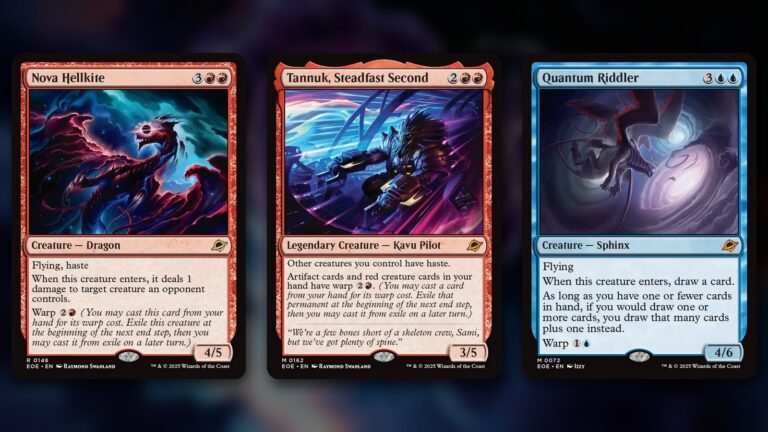

3 Comments
Comments are closed.