
MTG Devotion Explained: All 61 Cards, the Rules, and an Erebos Commander Deck (2026)
Devotion is the most misunderstood counting mechanic in Magic. Players talk about it as if it rewards playing lots of permanents, or lots of tokens, or a heavy mono-coloured mana base. It rewards none of those things. Devotion counts coloured mana symbols printed in the mana costs of permanents you control — and once you understand exactly which symbols qualify, half the “devotion deck” advice on the internet stops making sense.
This guide is built from the current Scryfall card database and the official rulings, not from memory. Every card that references devotion in its rules text is listed here — there are 61 of them in paper Magic — along with what they cost, when they were printed, what they are legal in, and what they are worth today. At the end there is a complete 100-card mono-black Commander deck built around the mechanic.

What devotion actually counts
The Comprehensive Rules define it at 700.5: your devotion to a colour is the number of mana symbols of that colour among the mana costs of permanents you control. Your devotion to two colours is the number of symbols among those mana costs that are the first colour, the second, or both.
Three words in that sentence do all the work. Mana costs — not abilities, not text boxes, not what you actually paid. Permanents — not spells on the stack, not cards in hand, not anything in a graveyard. You control — control, not ownership, which is why an Aura you control that is attached to an opponent’s creature still counts for you.
Devotion is checked continuously. It is not a counter, it is not stored anywhere, and it changes the instant a permanent enters or leaves. If a Theros God is a creature because your devotion is five, and someone kills one of your two-pip creatures in response, the God stops being a creature immediately and is removed from combat.
The five things that do not count — and this is where decks go wrong
This is the section that costs people games. Every one of these is confirmed by the official rulings printed on the cards themselves.
| Source of symbols | Counts toward devotion? | Why |
|---|---|---|
| Basic lands | No | They have no mana cost at all — there is nothing to count |
| Tokens that are not copies | No | A token created from nothing has no mana cost |
| Tokens that are copies | Yes | A copy copies the original’s mana cost, pips included |
| Generic numerals and {X} | No | Only coloured symbols count |
| {C} colourless symbols | No | Colourless is not a colour |
| Mana symbols in a text box or ability | No | Only the mana cost is counted, never the rules text |
| The back face of a transformed double-faced permanent | No | The back face has no mana cost, and the front face’s symbols stop counting while it is flipped |
| Cards in hand, graveyard, exile, or on the stack | No | Devotion counts permanents you control, nothing else |
| The mana you actually spent | No | Alternative costs and cost reduction change nothing |
The token entry is the one that ruins the most brews. “Go wide, get devotion” sounds right and is completely wrong: a token that was not created as a copy of something has no mana cost at all, so a board of twenty Soldier tokens contributes zero to your devotion to white. If you like making copies of things, the populate mechanic is a much better fit, because a token that is a copy of a real permanent copies that permanent’s mana cost — pips included.
The land entry is the second-biggest trap. Basic lands have no mana cost. Neither do most non-basic lands. A mono-black deck running twenty-one Swamps gets nothing from any of them, which is exactly why devotion decks want cheap, pip-dense spells rather than a beautiful mana base. It is also why colourless mana rocks are actively anti-synergistic here: Sol Ring ramps you, but it adds nothing to the number the deck is trying to grow.
The four things that do count, and surprise people
Hybrid symbols count for both of their colours. A permanent costing {G/W} adds one to your devotion to green and one to your devotion to white. If a card asks about your devotion to two colours at once, a hybrid symbol that is both of those colours is counted just once — that is the specific ruling printed on March of the Canonized.
Monocoloured hybrid symbols count. A cost of {2/R} can be paid with two generic mana and still contributes a red pip. That means there are permanents you can cast without spending a single point of coloured mana that nevertheless raise your devotion — Magmablood Archaic costs {2/R}{2/R}{2/R} and puts three red pips on the battlefield for six colourless mana.
Phyrexian symbols count. Pay the two life; the pip is still printed on the card and still counts.
A God counts its own mana cost. Heliod, God of the Sun is {3}{W}, so Heliod itself contributes one to your devotion to white while sitting on the battlefield as a non-creature enchantment. There is a beautiful piece of timing attached to this: when a God enters, replacement effects that care about creatures entering are checked before it is on the battlefield, so its own pip is not counted for those — but triggered abilities that fire “whenever a creature enters” do see its own pip. The same card can enter as a non-creature for one effect and as a creature for another.
Every God with devotion: all 22
Fifteen Gods came out of the original Theros block — five mono-coloured in Theros, then two cycles of five two-colour Gods in Born of the Gods and Journey into Nyx. Seven more arrived in Theros Beyond Death. The mono-coloured Gods want devotion five; the two-colour Gods want seven.
| Commander | Mana cost | Devotion threshold | Debut set | Price |
|---|---|---|---|---|
| Erebos, God of the Dead | {3}{B} | five to black | Theros (THS) | $10.43 |
| Heliod, God of the Sun | {3}{W} | five to white | Theros (THS) | $3.89 |
| Nylea, God of the Hunt | {3}{G} | five to green | Theros (THS) | $9.61 |
| Purphoros, God of the Forge | {3}{R} | five to red | Theros (THS) | $28.89 |
| Thassa, God of the Sea | {2}{U} | five to blue | Theros (THS) | $3.78 |
| Ephara, God of the Polis | {2}{W}{U} | seven to white and blue | Born of the Gods (BNG) | $7.98 |
| Karametra, God of Harvests | {3}{G}{W} | seven to green and white | Born of the Gods (BNG) | $5.22 |
| Mogis, God of Slaughter | {2}{B}{R} | seven to black and red | Born of the Gods (BNG) | $5.36 |
| Phenax, God of Deception | {3}{U}{B} | seven to blue and black | Born of the Gods (BNG) | $16.33 |
| Xenagos, God of Revels | {3}{R}{G} | seven to red and green | Born of the Gods (BNG) | $9.86 |
| Athreos, God of Passage | {1}{W}{B} | seven to white and black | Journey into Nyx (JOU) | $14.72 |
| Iroas, God of Victory | {2}{R}{W} | seven to red and white | Journey into Nyx (JOU) | $10.03 |
| Keranos, God of Storms | {3}{U}{R} | seven to blue and red | Journey into Nyx (JOU) | $11.85 |
| Kruphix, God of Horizons | {3}{G}{U} | seven to green and blue | Journey into Nyx (JOU) | $3.22 |
| Pharika, God of Affliction | {1}{B}{G} | seven to black and green | Journey into Nyx (JOU) | $3.97 |
| Athreos, Shroud-Veiled | {4}{W}{B} | seven to white and black | Theros Beyond Death (THB) | $1.05 |
| Erebos, Bleak-Hearted | {3}{B} | five to black | Theros Beyond Death (THB) | $1.72 |
| Heliod, Sun-Crowned | {2}{W} | five to white | Theros Beyond Death (THB) | $19.86 |
| Klothys, God of Destiny | {1}{R}{G} | seven to red and green | Theros Beyond Death (THB) | $1.12 |
| Nylea, Keen-Eyed | {3}{G} | five to green | Theros Beyond Death (THB) | $4.59 |
| Purphoros, Bronze-Blooded | {4}{R} | five to red | Theros Beyond Death (THB) | $3.68 |
| Thassa, Deep-Dwelling | {3}{U} | five to blue | Theros Beyond Death (THB) | $26.57 |
Every one of these is indestructible and legendary, and every one of them is an enchantment whether or not it is currently a creature. That last point matters more than the devotion threshold does: a God that is “switched off” cannot be hit by creature removal, but it can always be hit by enchantment removal, and it is always a creature card in every zone except the battlefield.

The five Demigods
Theros Beyond Death printed a cycle of uncommon Demigods whose power or toughness simply is your devotion. They are the cleanest possible teaching cards: each one costs two coloured pips, so each one is already counting itself.
| Creature | Mana cost | Own pips | What it does with devotion | Price |
|---|---|---|---|---|
| Anax, Hardened in the Forge | {1}{R}{R} | 2 | Anax’s power is equal to your devotion to red. | $0.15 |
| Callaphe, Beloved of the Sea | {1}{U}{U} | 2 | Callaphe’s power is equal to your devotion to blue. | $0.21 |
| Daxos, Blessed by the Sun | {W}{W} | 2 | Daxos’s toughness is equal to your devotion to white. | $0.24 |
| Renata, Called to the Hunt | {2}{G}{G} | 2 | Renata’s power is equal to your devotion to green. | $0.25 |
| Tymaret, Chosen from Death | {B}{B} | 2 | Tymaret’s toughness is equal to your devotion to black. | $0.18 |
All five are legendary enchantment creatures, all five cost under thirty cents, and all five are legal in Commander — which makes this cycle the cheapest way to find out whether a devotion shell actually functions before spending money on it.
The other 34 devotion cards
Strip out the Gods and Demigods and you are left with 34 cards that use devotion as an ordinary number in an ordinary effect: draw that many, deal that much, make that many tokens, add that much mana.
| Card | Mana cost | Type | Debut set | Price |
|---|---|---|---|---|
| Nykthos, Shrine to Nyx | — | Legendary Land | THS | $51.92 |
| Aspect of Hydra | {G} | Instant | BNG | $0.27 |
| Acolyte’s Reward | {1}{W} | Instant | BNG | $0.18 |
| March of the Canonized | {X}{W}{W} | Enchantment | LCC | $0.29 |
| Skyreaping | {1}{G} | Sorcery | BNG | $0.19 |
| Thassa’s Oracle | {U}{U} | Creature — Merfolk Wizard | THB | $20.60 |
| Thassa’s Rebuff | {1}{U} | Instant | BNG | $0.34 |
| Threnody Singer | {1}{U} | Creature — Siren | THB | $0.14 |
| Thunderous Might | {1}{R} | Enchantment — Aura | BNG | $0.28 |
| Altar of the Pantheon | {3} | Artifact | THB | $0.33 |
| Mogis’s Marauder | {2}{B} | Creature — Human Berserker | THS | $0.27 |
| Reverent Hunter | {2}{G} | Creature — Human Archer | THS | $0.21 |
| Setessan Petitioner | {1}{G}{G} | Creature — Human Druid | THB | $0.14 |
| Disciple of Phenax | {2}{B}{B} | Creature — Human Cleric | THS | $0.09 |
| Drag to the Underworld | {2}{B}{B} | Instant | THB | $0.18 |
| Fanatic of Mogis | {3}{R} | Creature — Minotaur Shaman | THS | $0.28 |
| Grim Servant | {3}{B} | Creature — Zombie Warlock | MH3 | $0.24 |
| Karametra’s Acolyte | {3}{G} | Creature — Human Druid | PTHS | $0.35 |
| Master of Waves | {3}{U} | Creature — Merfolk Wizard | THS | $0.28 |
| Nylea’s Disciple | {2}{G}{G} | Creature — Centaur Archer | THS | $0.08 |
| Nylea’s Huntmaster | {3}{G} | Creature — Centaur Shaman | THB | $0.07 |
| Nyx Lotus | {4} | Legendary Artifact | THB | $4.85 |
| Daybreak Chimera | {3}{W}{W} | Creature — Chimera | THB | $0.15 |
| Elspeth, Undaunted Hero | {2}{W}{W}{W} | Legendary Planeswalker — Elspeth | THB | $0.37 |
| Gray Merchant of Asphodel | {3}{B}{B} | Creature — Zombie | THS | $1.00 |
| Reverent Hoplite | {4}{W} | Creature — Human Soldier | THB | $0.22 |
| Sanguimancy | {4}{B} | Sorcery | BNG | $0.21 |
| Blight-Breath Catoblepas | {4}{B}{B} | Creature — Beast | THB | $0.07 |
| Clive, Ifrit’s Dominant // Ifrit, Warden of Inferno | {4}{R}{R} | Legendary Creature — Human Noble Warrior | FIN | $3.13 |
| Evangel of Heliod | {4}{W}{W} | Creature — Human Cleric | THS | $0.18 |
| Klothys’s Design | {5}{G} | Sorcery | THB | $0.19 |
| Underworld Hermit | {4}{B}{B} | Creature — Human Peasant | MH2 | $0.12 |
| Abhorrent Overlord | {5}{B}{B} | Creature — Demon | PTHS | $0.47 |
| Marshmist Titan | {6}{B} | Creature — Giant | BNG | $0.11 |
Two of them are the reason the mechanic still gets built at all. Gray Merchant of Asphodel drains each opponent for your devotion to black and gains you the total — in a four-player Commander game with devotion six that is eighteen damage and eighteen life from a five-mana common. Thassa’s Oracle looks at the top X cards where X is your devotion to blue, and wins the game outright if X is at least the size of your library, which is why it is the most-played win condition in competitive Commander despite never mentioning combat.
Where devotion came from, and where it went
Devotion is a Theros mechanic and the numbers say so bluntly. Of 61 cards, 57 debuted in a Theros-branded set.
| Set | Code | Devotion cards | Released |
|---|---|---|---|
| Theros Beyond Death | THB | 24 | 2020-01-24 |
| Theros | THS | 14 | 2013-09-27 |
| Born of the Gods | BNG | 12 | 2014-02-07 |
| Journey into Nyx | JOU | 5 | 2014-05-02 |
| Theros Promos | PTHS | 2 | 2013-09-21 |
| Modern Horizons 2 | MH2 | 1 | 2021-06-18 |
| The Lost Caverns of Ixalan Commander | LCC | 1 | 2023-11-17 |
| Modern Horizons 3 | MH3 | 1 | 2024-06-14 |
| Final Fantasy | FIN | 1 | 2025-06-13 |
| Total | 61 |
Two rows in that table deserve a note. Theros Promos is not a set anybody drafted — Abhorrent Overlord and Karametra’s Acolyte were prerelease promos dated 2013-09-21, six days before Theros itself hit shelves on 2013-09-27. The first two devotion cards in players’ hands were promos, not booster packs.
The other note is the tail. After Theros Beyond Death in January 2020, devotion has appeared exactly four times in six and a half years: once in Modern Horizons 2, once in a Lost Caverns of Ixalan Commander deck, once in Modern Horizons 3, and once in Final Fantasy in June 2025. That last card, Clive, Ifrit’s Dominant, is the only devotion card legal in Standard today — one out of sixty-one.
Devotion by format
| Format | Legal devotion cards | Share of 61 |
|---|---|---|
| Standard | 1 | 2% |
| Pioneer | 58 | 95% |
| Modern | 60 | 98% |
| Legacy | 61 | 100% |
| Vintage | 61 | 100% |
| Commander | 61 | 100% |
| Pauper | 9 | 15% |
| Brawl | 52 | 85% |
The Pioneer number is the interesting one, and it runs the opposite way to most old mechanics. Pioneer’s card pool starts at Return to Ravnica (October 2012), and Theros shipped eleven months later — so unlike mechanics that debuted before the cutoff, essentially the entire devotion catalogue is Pioneer-legal. 58 of 61 are, and the three that are not are supplemental-product cards from Modern Horizons 2, Modern Horizons 3 and a Commander deck, not Theros cards at all.
Pauper players get exactly nine cards, and those nine are precisely the nine commons in the roster — verified as identical sets rather than assumed. Gray Merchant of Asphodel is one of them, which is most of the reason mono-black devotion is a real Pauper archetype.
Devotion by colour — and why red cannot do it
Here is a measurement that no card list will tell you. Devotion does not care how many permanents you have; it cares how many coloured pips those permanents carry. So the real question for any devotion deck is: how pip-dense can this colour actually get?
Across all of paper Magic, there are 383 Commander-legal permanents whose mana cost contains three or more symbols of a single colour. They are not distributed evenly.
| Colour | Permanents with 3+ pips | With 4+ pips | Densest single permanent | 3 pips at 3 mana |
|---|---|---|---|---|
| White | 57 | 3 | Anti-Venom, Horrifying Healer {W}{W}{W}{W}{W} (5) | 9 |
| Blue | 54 | 3 | Demilich {U}{U}{U}{U} (4) | 9 |
| Black | 107 | 8 | Doomsday Excruciator {B}{B}{B}{B}{B}{B} (6) | 24 |
| Red | 63 | 0 | — | 12 |
| Green | 102 | 10 | Khalni Hydra {G}{G}{G}{G}{G}{G}{G}{G} (8) | 18 |
Red has zero permanents with four or more red pips. Not one, in thirty-three years of card design. Black has eight, green has ten, white and blue have three each — and red has none at all. Red’s ceiling is three pips on a permanent, full stop.
That single row explains more about devotion decks than any strategy article. Black has 107 permanents at three-plus pips and 24 of them cost exactly three mana; green has 102 and 18. Those are the two colours that can flood a battlefield with pips quickly, and they are the two colours that actually show up in competitive devotion shells. Red gets Purphoros, God of the Forge, which is the most expensive God on this list at $28.89, and then runs out of runway.

Nykthos math: when the shrine is actually worth activating
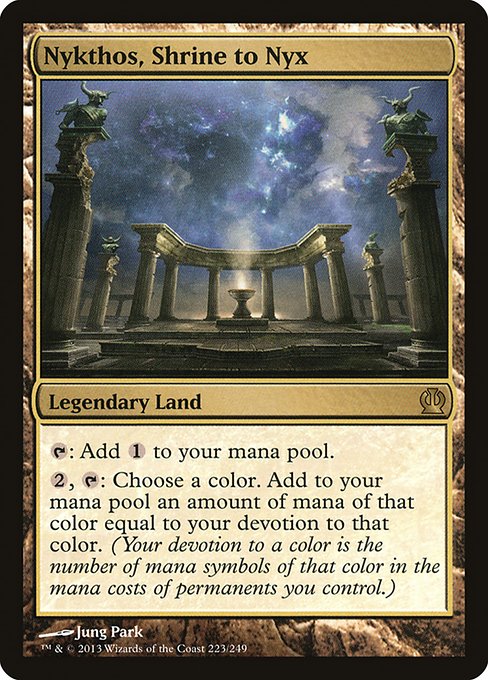
Nykthos, Shrine to Nyx is the most famous card in this article and the most frequently misplayed. Its second ability costs {2} and a tap and produces mana equal to your devotion to a chosen colour. Its first ability taps for one colourless. So the honest comparison is not “does Nykthos make mana” — it is “does the big ability beat the small one.”
| Your devotion | Mana the big ability makes | Net after the {2} | Gain vs. just tapping for {C} | Worth activating? |
|---|---|---|---|---|
| 1 | 1 mana | -1 | -2 | No |
| 2 | 2 mana | +0 | -1 | No |
| 3 | 3 mana | +1 | +0 | Break-even |
| 4 | 4 mana | +2 | +1 | Yes |
| 5 | 5 mana | +3 | +2 | Yes |
| 6 | 6 mana | +4 | +3 | Yes |
| 7 | 7 mana | +5 | +4 | Yes |
| 8 | 8 mana | +6 | +5 | Yes |
At devotion three, activating Nykthos is exactly as good as tapping it for {C} and nothing more. It only starts profiting at devotion four. Cards that break the game with Nykthos — the ones you have seen in Pioneer mono-green — are doing it at devotion seven or eight, not at four, and they get there with pip-dense three-drops rather than with a wide board.
Nyx Lotus is the same effect without the {2}, which sounds strictly better and mostly is; it costs four mana and enters tapped, so it is a turn slower and much easier to remove. Nykthos, meanwhile, has been printed in paper exactly three times in thirteen years — Theros, The List, and a Pro Tour promo — and none of those is a standard-set reprint. That scarcity is why one land is $51.92, which is 17.8% of the $292.56 it costs to buy one of every card in this guide.
What the whole mechanic costs
All 61 devotion cards together are $292.56 at cheapest paper printing. Thirty-four of them are under a dollar and total $7.33 between them. The five most expensive cards — Nykthos ($51.92), Purphoros, God of the Forge ($28.89), Thassa, Deep-Dwelling ($26.57), Thassa’s Oracle ($20.60) and Heliod, Sun-Crowned ($19.86) — are $147.84 of that, a little over half. Devotion is a cheap mechanic with five expensive cards attached to it.
| Colour identity | Devotion cards |
|---|---|
| B | 13 |
| G | 11 |
| W | 9 |
| U | 7 |
| R | 6 |
| Colourless | 3 |
| GR | 2 |
| BW | 2 |
| UW | 1 |
| GW | 1 |
| BR | 1 |
| BU | 1 |
| RW | 1 |
| RU | 1 |
| GU | 1 |
| BG | 1 |
| Total | 61 |
A mono-black devotion Commander deck: Erebos, God of the Dead
Erebos, God of the Dead is the right commander for a devotion deck for an unglamorous reason: he is a {3}{B} indestructible enchantment who draws cards for two life whenever you want, and he does that whether or not your devotion is high enough to make him a creature. Nothing is wasted on a turn where the count is low.
The deck below is built the way the rules say to build it — cheap permanents with as many black pips as possible, rather than expensive permanents with one. It contains 77 permanents carrying 70 black pips, of which 24 permanents carry two or more. Thirty-six lands contribute nothing at all, which is the whole lesson stated as a deck-building constraint.
Erebos Mono-Black Devotion (100 cards)
100 cards — one click loads the full list into a TCGplayer cart so you can check real prices and grab the whole deck at once.
Buy this deck on TCGplayerAffiliate link — buying through it supports KrakenTheMeta at no extra cost to you.The engine is simple. Zodiark, Umbral God ({B}{B}{B}{B}{B}) and Phyrexian Obliterator ({B}{B}{B}{B}) are the two densest black permanents you can reasonably cast; Ayara, First of Locthwain, Underworld Dreams and Bolas’s Citadel each add three. Once the count is at six or seven, Nykthos and Nyx Lotus turn a single land drop into a whole extra turn of mana, Gray Merchant of Asphodel becomes an eighteen-point swing in a four-player pod, and Exsanguinate ends it.
Cheapest paper printings put the list at $271.48, with 40 cards under a dollar totalling $13.79 between them. Nykthos alone is $51.92 of it — nineteen percent of the deck in one land. If you are testing the archetype before committing, cut Nykthos first and run a Swamp; the deck is meaningfully worse and still perfectly playable, which is not something you can say about cutting Gray Merchant.
There is a sixth way that deserves its own note, because it looks like an exception and is not: bestow. A bestow card cast for its bestow cost is an Aura, not a creature — but it is still a permanent you control with its printed mana cost, so its coloured pips count toward your devotion exactly as they would if it were standing there as a creature. It even counts while attached to a creature an opponent controls, because devotion asks who controls the permanent, not what it is stuck to.
Five ways to raise your devotion that are not “play more creatures”
- Play three-mana permanents with three pips. Black has 24 of them and green has 18. This is the single highest-leverage deck-building rule in the archetype.
- Count your commander. A God’s own mana cost counts, and so does any legendary permanent you can reliably keep on the battlefield.
- Use Altar of the Pantheon. It is the only card in Magic that raises your devotion directly — by one to each colour and each combination of colours, and by one to a two-colour pair, not by two or three.
- Put Auras on other people’s creatures. You still control the Aura, so its pips still count for you. A removal Aura on an opponent’s commander is devotion and interaction in one card.
- Prefer hybrid costs when you have the choice. {2/B} costs you nothing in colour requirements and still counts.
None of those involve going wider. All of them involve going denser — which is the difference between a devotion deck that works and one that keeps a God switched off all game.
Frequently asked questions about devotion
Do lands count toward devotion?
Almost never. Devotion counts mana symbols in mana costs, and basic lands have no mana cost at all. A handful of non-basic lands do have one, but the twenty-one Swamps in a mono-black deck contribute exactly zero.
Do tokens count toward devotion?
Only if the token is a copy of something. A token created as a copy of a permanent copies that permanent’s mana cost, pips included. A token created from nothing — a 1/1 Soldier, a 2/2 Zombie — has no mana cost and adds nothing.
Does the mana I spend affect my devotion?
No. Devotion looks at the symbols printed in mana costs, not at what you actually paid. Casting a spell for free, with an alternative cost, or off a cost-reduction effect changes nothing about the pips it brings to the battlefield.
Do hybrid mana symbols count?
Yes, for both of their colours. A {G/W} symbol adds one to green and one to white. If an effect asks for your devotion to green and white together, that same symbol is counted only once.
Do Phyrexian mana symbols count?
Yes. {B/P} is a black symbol printed in the mana cost, so it counts toward your devotion to black whether you paid the mana or the two life.
Does {X} count toward devotion?
No. Neither do generic numerals or {C}. Only coloured symbols count, which is why a battlefield full of large colourless artifacts has a devotion of zero.
Does a God count its own mana cost?
Yes, once it is on the battlefield. Erebos, God of the Dead is {3}{B}, so he supplies one of the five black pips he needs.
Are the Theros Gods creatures when devotion is low?
No — they are indestructible legendary enchantments. Their abilities still function, counters stay on them, and they are still creature cards in every zone other than the battlefield. If a God stops being a creature mid-combat it is removed from combat and does not rejoin.
Can enchantment removal kill a God?
Yes, at any time. Indestructible stops damage and destruction, not exile or sacrifice, and a God is an enchantment whether or not it is currently a creature. That is the reliable answer to a switched-on God.
Do Auras on my opponent’s creatures count for me?
Yes. Control is what matters, not what the Aura is attached to. You control the Aura, so its mana symbols count toward your devotion.
What is the best devotion payoff in Commander?
Gray Merchant of Asphodel for damage and life, and Thassa’s Oracle for winning outright. Gary is an uncommon that costs about five dollars; the Oracle is $20.60 and is the reason blue devotion exists in competitive play.
Is devotion still being printed?
Barely. Four cards in the six and a half years since Theros Beyond Death, most recently Clive, Ifrit’s Dominant in Final Fantasy in June 2025 — the only devotion card legal in Standard today.
What is the cheapest way to try a devotion deck?
The five Theros Beyond Death Demigods cost under thirty cents each and each one turns your devotion into a visible number on a creature. Add Gray Merchant of Asphodel and a handful of three-pip three-drops and you will know within a few games whether the archetype suits you.
Where to go from here
Devotion rewards a very specific kind of deck: cheap, pip-heavy, mono-coloured, and patient. If you want to see what a pip-dense mana base looks like in practice, our Commander mana base guide covers which lands earn their slot when your colour requirements are punishing. If you want to build one without doing all this counting by hand, the public deck gallery is full of mono-coloured lists you can copy, and the card pricing tool will tell you what swapping Nykthos for a Swamp actually saves you.
Build your next deck with AI
KrakenTheMeta’s AI deck builder researches the current meta and writes you a complete, format-legal decklist in about a minute — free to try.
Build a Deck with AIor browse community decks
4 Comments
Comments are closed.