
Soulbond MTG: How It Works, All 25 Cards, Deadeye Combos and a $57 Roon Deck (2026)
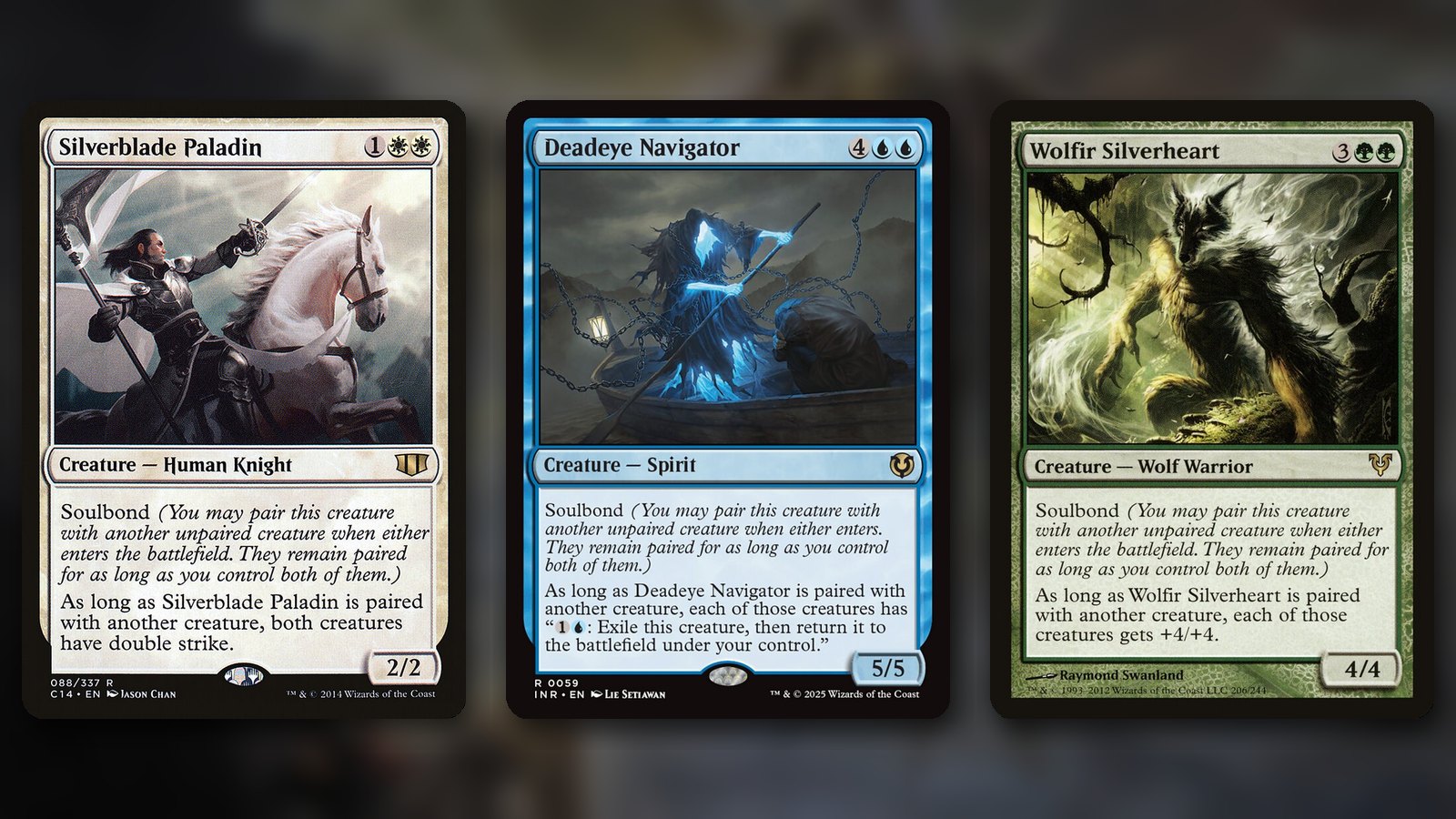
Soulbond is the Magic: The Gathering keyword that pairs two of your creatures so they share a bonus. When a creature with soulbond enters, you may pair it with another unpaired creature you control, and they stay paired for as long as you control both of them. It also works the other way: if the soulbond creature is already on the battlefield and unpaired, it can pair with the next creature that enters under your control. While they’re paired, both creatures get whatever the card grants. That’s double strike for Silverblade Paladin, +4/+4 for Wolfir Silverheart, and a two-mana blink ability for Deadeye Navigator.
There are only 25 soulbond cards. 19 came out in Avacyn Restored in 2012, five in the Crimson Vow Commander decks in 2021 and one, Donna Noble, in the Doctor Who decks in 2023. Most cost under a dollar. The question for a Commander deck is how often you actually get a pair, so we ran our list through 100,000 test games. With 13 soulbond creatures among 37 creatures, the deck had at least one pair by turn 6 in 74% of games and by turn 8 in 86%.
This guide covers the soulbond rules, what each pair is really worth, all 25 cards, the Deadeye Navigator combos, the best commanders, legality in every format, how to beat it and a $57 Roon of the Hidden Realm Commander deck.

What is soulbond in MTG?
Soulbond is rule 702.95 of the Comprehensive Rules. Rule 702.95a says it represents two triggered abilities:
- When the soulbond creature enters, if you control it and another creature and both are unpaired, you may pair it with another unpaired creature you control.
- Whenever another creature you control enters, if you control both it and the soulbond creature and both are unpaired, you may pair them.
The pair lasts “for as long as both remain creatures on the battlefield under your control.” Rule 702.95d says a creature can be paired with only one other creature. Rule 702.95e says a pair breaks when either creature leaves the battlefield, stops being a creature, or comes under another player’s control.
Everything else comes from the card. Soulbond itself only makes the pair. The bonus is a separate line, almost always “As long as [this creature] is paired with another creature, both creatures have [ability].” The keyword is optional (“you may”), it doesn’t target, and both creatures must be yours.
Soulbond rules: 14 common situations
| Situation | What happens | Source |
|---|---|---|
| You cast a soulbond creature with no other creature out | Nothing pairs. It waits, and its second trigger pairs it with the next creature that enters under your control | Rule 702.95a |
| You’d rather not pair | You don’t have to. Both triggers say “may” | Rule 702.95a |
| The partner has hexproof, shroud or protection | It can still pair. Soulbond doesn’t target. Diregraf Escort can even pair with a Zombie | Diregraf Escort ruling |
| An opponent kills the partner in response to the trigger | Neither creature becomes paired. The soulbond creature stays unpaired and can pair with the next creature you play | Rule 702.95c |
| Two soulbond creatures pair with each other | Both bonuses apply to both. A Silverblade Paladin paired with Wolfir Silverheart makes a 6/6 and an 8/8, both with double strike | Rule 702.95b; card text “both creatures” |
| You want one creature in two pairs | Not possible. A creature can be paired with only one other creature | Rule 702.95d |
| One of the pair dies, is exiled or bounced | The pair breaks and the other creature loses the bonus at once | Rule 702.95e |
| A paired creature has damage marked on it when the pair breaks | If it now has lethal damage, it dies. A creature that took 3 damage while Druid’s Familiar gave it +2/+2 can die when the Familiar leaves | Druid’s Familiar ruling |
| An opponent steals one of the pair | The pair breaks. Both creatures must stay under your control | Rule 702.95e |
| A paired creature stops being a creature | The pair breaks, for example when a manland or a Vehicle stops being a creature at end of turn | Rule 702.95e |
| You blink one of the pair | It returns as a new object and the pair is broken. Its soulbond trigger (or the other creature’s) can pair them again | Deadeye Navigator ruling |
| The soulbond creature loses all abilities | The pair stays, but the bonus line is gone too, so neither creature gets anything | Flowering Lumberknot ruling |
| A creature loses haste after it was declared as an attacker | It keeps attacking. Haste only matters when attackers are declared | Lightning Mauler ruling |
| Torpor Orb or Hushbringer is out | Neither soulbond trigger happens, because both are caused by a creature entering, so nothing can pair | Rule 702.95a with Torpor Orb’s text |
The last row matters more than it looks. Soulbond is not a static ability. Anything that stops “enters” triggers stops the pairing, and anything that answers the trigger on the stack wins the exchange.
The soulbond math: what a pair is worth
Most soulbond creatures are weak alone. Wolfir Silverheart is a 4/4 for five, Silverblade Paladin a 2/2 for three. The value is that the bonus is counted twice, once on the soulbond creature and once on the partner. That’s why the cards look so efficient when they’re paired:
| Creature | Mana cost | Alone | What both creatures get | The pair, in total |
|---|---|---|---|---|
| Wolfir Silverheart | {3}{G}{G} | 4/4 | +4/+4 | +8/+8 spread over two bodies; Wolfir itself is 8/8 |
| Druid’s Familiar | {3}{G} | 2/2 | +2/+2 | +4/+4; the Familiar is 4/4 |
| Trusted Forcemage | {2}{G} | 2/2 | +1/+1 | +2/+2 |
| Silverblade Paladin | {1}{W}{W} | 2/2 | Double strike | Two double strikers for three mana |
| Nightshade Peddler | {1}{G} | 1/1 | Deathtouch | Two deathtouch creatures for two mana |
| Nearheath Pilgrim | {1}{W} | 2/1 | Lifelink | Two lifelinkers for two mana |
| Lightning Mauler | {1}{R} | 2/1 | Haste | Mauler and the creature you cast with it attack at once |
| Wingcrafter | {U} | 1/1 | Flying | Gives a big ground creature flying for one mana |
| Elgaud Shieldmate | {3}{U} | 2/3 | Hexproof | Protects your best creature from targeted removal |
| Tandem Lookout | {2}{U} | 2/1 | Draw a card when it deals damage to an opponent | Two card-drawing attackers |
| Deadeye Navigator | {4}{U}{U} | 5/5 | “{1}{U}: Exile this creature, then return it” | A repeatable blink for any creature with an “enters” ability |
Read the right-hand column against the left. The keyword grants (double strike, deathtouch, lifelink, flying) scale with the partner, so the bigger the creature you pair with, the more the soulbond card is worth. Wingcrafter is a 1/1 for {U}. Paired with a 6/6, it does the job of a one-mana flying Aura and leaves you a second body.

How often do you get a pair?
Soulbond needs two creatures, and in Commander the soulbond cards are a small part of the deck. To put a number on it, we goldfished our published Roon list (below) 100,000 times: 7-card hand, no mulligans, one land a turn, ramp first, then creatures cheapest first with soulbond creatures ahead of others at the same cost, and Roon cast from the command zone once five mana is free. It has 13 soulbond creatures and 37 creatures in all. A “pair” is counted whenever there’s a soulbond creature and another creature to pair it with.
| By end of turn | Games with a pair | Pairs (average) | Soulbond creatures in play (average) | Creatures in play (average) |
|---|---|---|---|---|
| Turn 3 | 24% | 0.24 | 0.43 | 1.3 |
| Turn 4 | 48% | 0.51 | 0.69 | 2.2 |
| Turn 5 | 64% | 0.78 | 0.92 | 3.1 |
| Turn 6 | 74% | 1.05 | 1.18 | 4.0 |
| Turn 7 | 81% | 1.32 | 1.44 | 4.8 |
| Turn 8 | 86% | 1.54 | 1.64 | 5.5 |
| Turn 10 | 90% | 1.90 | 1.99 | 6.6 |
So a pair is not a turn-two plan. The deck has one in fewer than half its games by turn 4 and in about three of four by turn 6, and it averages 1.5 pairs by turn 8. The first pair arrived on turn 4.8 on average, and 9.5% of games still had none by turn 10.
The test has no opponents, so nothing dies and no pair gets broken, and it doesn’t blink anything. Both of those matter in a real game, in opposite directions: removal breaks pairs, and blink effects re-trigger soulbond. Treat the numbers as a ceiling on how fast pairs appear, not on how long they last.
Pair two soulbond creatures, or spread them?
Two soulbond creatures can pair with each other, and then both bonuses apply to both. Silverblade Paladin and Wolfir Silverheart together are a 6/6 and an 8/8, both with double strike, for 28 damage if neither is blocked. The cost is that you’ve used two soulbond cards on one pair. With the deck averaging 1.6 soulbond creatures in play by turn 8, you usually only have the choice once. Pair them together when you need one huge threat, and spread them when you need several good ones.
All 25 soulbond cards
Every card with the soulbond keyword, sorted by how many Commander decks play it on EDHREC (8 November 2026), with its cheapest ordinary printing on Scryfall. Two more cards mention pairing without having soulbond: Joint Assault, an instant that gives +2/+2 to a creature and its partner, and Flowering Lumberknot, a 5/5 for four that can’t attack or block unless it’s paired with a creature with soulbond.
| Card | Mana cost | Color | What both creatures get | First set | Commander decks (EDHREC) | Cheapest |
|---|---|---|---|---|---|---|
| Deadeye Navigator | {4}{U}{U} | Blue | “{1}{U}: Exile this creature, then return it to the battlefield under your control.” | AVR (2012) | 111,807 | $2.85 |
| Tandem Lookout | {2}{U} | Blue | “Whenever this creature deals damage to an opponent, draw a card.” | AVR (2012) | 75,637 | $0.76 |
| Mirage Phalanx | {4}{R}{R} | Red | “At the beginning of combat on your turn, create a token that’s a copy of this creature, except it has haste and loses soulbond. Exile it at end of combat.” | VOC (2021) | 21,960 | $1.77 |
| Wingcrafter | {U} | Blue | Flying | AVR (2012) | 18,787 | $0.18 |
| Breathkeeper Seraph | {4}{W}{W} | White | “When this creature dies, you may return it to the battlefield under its owner’s control at the beginning of your next upkeep.” | VOC (2021) | 16,497 | $1.37 |
| Doom Weaver | {4}{B}{B} | Black | “When this creature dies, draw cards equal to its power.” | VOC (2021) | 16,159 | $2.51 |
| Silverblade Paladin | {1}{W}{W} | White | Double strike | AVR (2012) | 12,563 | $0.63 |
| Donna Noble | {3}{R} | Red | Damage to an opponent when either is dealt damage | WHO (2023) | 10,740 | $0.36 |
| Thundering Mightmare | {4}{G} | Green | “Whenever an opponent casts a spell, put a +1/+1 counter on this creature.” | VOC (2021) | 10,445 | $0.39 |
| Druid’s Familiar | {3}{G} | Green | +2/+2 | AVR (2012) | 10,154 | $0.23 |
| Wolfir Silverheart | {3}{G}{G} | Green | +4/+4 | AVR (2012) | 6,813 | $0.49 |
| Imperious Mindbreaker | {1}{U}{U} | Blue | “Whenever this creature attacks, each opponent mills cards equal to its toughness.” | VOC (2021) | 5,710 | $0.37 |
| Nightshade Peddler | {1}{G} | Green | Deathtouch | AVR (2012) | 3,933 | $0.08 |
| Lightning Mauler | {1}{R} | Red | Haste | AVR (2012) | 2,419 | $0.08 |
| Elgaud Shieldmate | {3}{U} | Blue | Hexproof | AVR (2012) | 1,662 | $0.14 |
| Galvanic Alchemist | {2}{U} | Blue | “{2}{U}: Untap this creature.” | AVR (2012) | 1,553 | $0.16 |
| Pathbreaker Wurm | {4}{G}{G} | Green | Trample | AVR (2012) | 1,481 | $0.06 |
| Nearheath Pilgrim | {1}{W} | White | Lifelink | AVR (2012) | 1,198 | $0.09 |
| Hanweir Lancer | {2}{R} | Red | First strike | AVR (2012) | 560 | $0.04 |
| Stonewright | {R} | Red | “{R}: This creature gets +1/+0 until end of turn.” | AVR (2012) | 412 | $0.07 |
| Stern Mentor | {3}{U} | Blue | “{T}: Target player mills two cards.” | AVR (2012) | 366 | $0.05 |
| Spectral Gateguards | {4}{W} | White | Vigilance | AVR (2012) | 351 | $0.12 |
| Diregraf Escort | {G} | Green | Protection from Zombies | AVR (2012) | 251 | $0.07 |
| Geist Trappers | {4}{G} | Green | Reach | AVR (2012) | 165 | $0.07 |
| Trusted Forcemage | {2}{G} | Green | +1/+1 | AVR (2012) | 148 | $0.05 |
21 of the 25 cost under a dollar, and the priciest is Deadeye Navigator at $2.85. Between them, Deadeye Navigator and Tandem Lookout account for 56% of all soulbond slots on EDHREC (187,444 of 331,771).
The cards worth building around
- Deadeye Navigator is the reason most players know the keyword. It gives itself and its partner “{1}{U}: Exile this creature, then return it to the battlefield under your control.” Pair it with a creature that has an “enters” ability and you can use that ability again for two mana, as often as you can pay. When the creature comes back, Deadeye’s soulbond triggers and pairs them again.
- Tandem Lookout draws a card each time either creature deals damage to an opponent. On a creature that can’t be blocked, it’s a card every turn for three mana.
- Silverblade Paladin gives double strike to two creatures for three mana. Paired with anything that has a big power, it ends games quickly.
- Breathkeeper Seraph means both creatures come back at your next upkeep if they die. Paired with a creature that has a strong “enters” ability, removal gives you that ability again.
- Mirage Phalanx gives each creature “At the beginning of combat on your turn, create a token that’s a copy of this creature, except it has haste and loses soulbond. Exile it at end of combat.” Pair it with a creature that has an “enters” ability and you get that ability every turn.
- Doom Weaver draws cards equal to a paired creature’s power when it dies. Paired with a big creature, that can be a lot of cards.

Deadeye Navigator combos
Deadeye’s blink costs {1}{U}. Any creature that untaps more lands than that when it enters makes infinite mana with it. Scryfall finds four creatures in Commander that untap lands when they enter:
| Creature | Mana cost | Lands untapped | Net mana per blink | Result with Deadeye |
|---|---|---|---|---|
| Peregrine Drake | {4}{U} | 5 | +3 | Infinite mana and infinite “enters” and “leaves” triggers |
| Great Whale | {5}{U}{U} | 7 | +5 | Infinite mana |
| Palinchron | {5}{U}{U} | 7 | +5 | Infinite mana |
| Cloud of Faeries | {1}{U} | 2 | 0 | Infinite blinks but no extra mana, unless Panharmonicon doubles the trigger |
“Net mana” assumes the untapped lands can make the {U}. Peregrine Drake is the popular one: EDHREC lists it in 11,267 of 15,578 Brago, King Eternal decks. Deadeye is in 1,463 of 3,631 Roon decks (40%). Infinite mana alone doesn’t win, so check what your deck does with it before relying on the combo, and check your playgroup’s view of infinite combos.
Without a combo, Deadeye is still a two-mana blink for every creature with an “enters” ability. Scryfall finds 1,718 Commander-legal creatures a green-white-blue deck can play that have “When this creature enters” or “Whenever this creature enters”, out of 2,884 in all colors. That’s the pool you pick from: Mulldrifter draws two, Wood Elves fetches a Forest, Reclamation Sage destroys an artifact or enchantment, each time.
How soulbond came to Magic
Soulbond debuted in Avacyn Restored (4 May 2012), the last set of the original Innistrad block. The set was about humans and angels fighting back after Avacyn’s return, and the keyword was a way to show them working together. It had 19 soulbond creatures plus Joint Assault and Flowering Lumberknot.
The keyword didn’t return in a regular set. The Innistrad: Crimson Vow Commander decks (19 November 2021) added five new cards with Commander-sized effects: Mirage Phalanx, Breathkeeper Seraph, Doom Weaver, Thundering Mightmare and Imperious Mindbreaker. Doom Weaver is the only black soulbond card. The Doctor Who Commander decks (13 October 2023) added Donna Noble, the only legendary soulbond creature, which deals damage to an opponent whenever it or its partner is dealt damage.

Best soulbond commanders
Only one legendary creature has soulbond, so most soulbond decks are blink decks that use Deadeye Navigator and a few of the pair-bonus cards. These are the commanders that do it best:
| Commander | Colors | Decks on EDHREC | Why it works with soulbond |
|---|---|---|---|
| Roon of the Hidden Realm | Green, white, blue | 3,631 | “{2}, {T}: Exile another target creature” and return it at the next end step. Covers the green, white and blue soulbond cards, and a blinked creature can be paired again |
| Brago, King Eternal | White, blue | 15,578 | Blinks any number of your permanents when it deals combat damage. The most popular home for Peregrine Drake and Deadeye |
| Yorion, Sky Nomad | White, blue | 2,648 | When it enters, it can blink any number of your other nonland permanents. Deadeye in 697 of its decks |
| Aminatou, the Fateshifter | White, blue, black | 6,970 | Its −1 blinks a permanent you own, and black adds Doom Weaver |
| Donna Noble | Red | 24 | The only soulbond legend. It has Doctor’s companion, so it can be a second commander next to a Time Lord Doctor |
Roon is the best fit for a budget deck. It costs $0.33, it covers 19 of the 25 soulbond cards, and its ability blinks a creature every turn, so every soulbond creature and every creature with an “enters” ability gets used twice. You can browse our public Brago blink deck, or more community Commander decks, for other takes on the same idea. Our best blink commanders guide ranks the rest.
Is soulbond legal in Standard, Modern and Commander?
| Format | Soulbond cards legal | Notes |
|---|---|---|
| Standard | 0 | No soulbond card has been printed in a Standard set since 2012 |
| Pioneer | 0 | Pioneer starts with Return to Ravnica, after Avacyn Restored |
| Historic, Timeless and Brawl | 0 | None of the cards are in these formats |
| Modern | 19 | All the Avacyn Restored cards. The Commander and Doctor Who cards weren’t printed in Modern-legal sets |
| Pauper | 11 | The commons, including Tandem Lookout, Wingcrafter and Nightshade Peddler |
| Legacy and Vintage | 25 | All of them |
| Commander | 25 | All of them. None is banned anywhere |
Legality is from Scryfall on 8 November 2026. For a full card list check, paste your deck into our MTG deck analyzer.
Budget Roon soulbond deck ($57)
This list pairs 13 soulbond creatures with blink. Roon, Deadeye Navigator, Soulherder, Restoration Angel, Flickerwisp, Kor Skyfisher, Conjurer’s Closet and four blink spells all re-use “enters” abilities, and every blinked creature can be paired again. Peregrine Drake and Cloud of Faeries give the infinite-mana line above if you find Deadeye. In blue decks, transmute can find him: Ethereal Usher shares his mana value of 6. The deck has 38 lands, ramp in green and an average mana value of 2.85 for its nonland cards. At the cheapest ordinary printings on Scryfall on 8 November 2026 it costs $56.71, and every card was checked for Commander legality and color identity.
Budget Roon of the Hidden Realm Soulbond
100 cards — one click loads the full list into a TCGplayer cart so you can check real prices and grab the whole deck at once.
Buy this deck on TCGplayerView it on KrakenTheMetaAffiliate link — buying through it supports KrakenTheMeta at no extra cost to you.How it plays: ramp for the first three turns, then cast cheap soulbond creatures and creatures with “enters” abilities. Pair the keyword bonuses (double strike, deathtouch, lifelink, flying, hexproof) with your biggest body. Once Roon is out, use its ability on your best “enters” creature every turn. Mulldrifter, Wood Elves, Acidic Slime and Archaeomancer are good targets. Protect Roon and Deadeye with Lightning Greaves, Swiftfoot Boots and Elgaud Shieldmate.
The ten priciest cards
| Card | Type | Cheapest printing | Price |
|---|---|---|---|
| Ephemerate | Instant | MH1 | $4.95 |
| Panharmonicon | Artifact | DRC | $4.74 |
| Lightning Greaves | Artifact | TRC | $3.24 |
| Conjurer’s Closet | Artifact | DRC | $2.86 |
| Deadeye Navigator | Creature | INR | $2.85 |
| Nature’s Lore | Sorcery | FIC | $2.49 |
| Elemental Bond | Enchantment | FDC | $2.36 |
| Counterspell | Instant | MB2 | $2.25 |
| Arcane Denial | Instant | C13 | $2.09 |
| Swiftfoot Boots | Artifact | TRC | $1.80 |
Those ten are 52% of the deck’s price. To spend more, add Birds of Paradise, Guardian Project and Aura Shards first. Check prices on our card price finder, or see the Commander precons for a ready-made deck to start from.

How to beat soulbond
| Answer | Why it works |
|---|---|
| Instant-speed removal in response to the trigger | If the partner is gone when the trigger resolves, nothing pairs (rule 702.95c). You stop the bonus without having to kill the soulbond creature |
| Removal on either creature later | The pair breaks at once and the other creature loses the bonus. Kill the cheaper, easier target |
| Torpor Orb, Hushbringer, Hushwing Gryff | Soulbond is two “enters” triggers. Stop them and nothing pairs, and Deadeye’s blinks do nothing extra |
| Stealing a creature | A control change breaks the pair (rule 702.95e) |
| Exile answers for Breathkeeper Seraph pairs | Seraph only returns creatures that die. Swords to Plowshares or Path to Exile gets around it |
| Kill Deadeye Navigator in response to its blink | Once Deadeye leaves, the pair breaks and its partner loses the blink ability, so the loop stops. Its controller can still blink once more in response |
Soulbond creatures are mostly small. Board wipes clear them easily, and the bonus means nothing without a second creature.
Soulbond FAQ
What does soulbond do in MTG?
It lets you pair the creature with another unpaired creature you control when either one enters. While they’re paired, both get the bonus printed on the soulbond card.
Do both creatures get the soulbond bonus?
Yes. Almost every soulbond card says “both creatures” or “each of those creatures.” Silverblade Paladin gives double strike to itself and its partner.
Can a soulbond creature pair with a creature already on the battlefield?
Yes. When the soulbond creature enters, you can pair it with any unpaired creature you already control. If you control none, it pairs with the next creature that enters.
Can two soulbond creatures pair with each other?
Yes, and both bonuses apply to both creatures. But each creature can be in only one pair, so you use two soulbond cards on one pair.
Does soulbond target?
No. You can pair with a creature that has hexproof, shroud or protection.
What breaks a soulbond pair?
Either creature leaving the battlefield, stopping being a creature, or coming under another player’s control. Losing the soulbond ability doesn’t break the pair, but it removes the bonus.
What happens if one paired creature is blinked?
The pair breaks. When the creature returns it’s a new object, and a soulbond trigger can pair it again. Deadeye Navigator relies on this.
Can I pair with an opponent’s creature?
No. Both creatures must be creatures you control.
Is there a soulbond commander?
Donna Noble is the only legendary creature with soulbond. Most soulbond decks are led by blink commanders such as Roon of the Hidden Realm, Brago, King Eternal or Yorion, Sky Nomad.
What is the best soulbond card?
By play in Commander, Deadeye Navigator (111,807 decks on EDHREC on 8 November 2026), followed by Tandem Lookout at 75,637. For more keyword guides, see double strike, deathtouch, lifelink, hexproof and bestow, another way to put a bonus on a creature.
Build your next deck with AI
KrakenTheMeta’s AI deck builder researches the current meta and writes you a complete, format-legal decklist in about a minute — free to try.
Build a Deck with AIor browse community decks


One Comment
Comments are closed.