
Convoke in MTG: How It Works, Every Rule, and the Best Convoke Cards
Convoke lets your creatures pay for your spells. Tap an untapped creature instead of paying a mana, and a seven-drop can hit the table on turn four off three lands and a board full of tokens. It is one of the oldest cost-cheating mechanics in Magic — first printed in Ravnica: City of Guilds on 7 October 2005 — and it is also one of the most misplayed, because almost every player learns it as “tap creatures for mana” and that description is wrong in three ways that cost real games.
This guide covers what convoke actually does, the seven rules that decide games, the play patterns most players never find, and every convoke card worth building around. All card text, mana costs, legality and prices were verified against the Scryfall API at the time of writing, and the rules text is quoted from the Comprehensive Rules effective 7 August 2026.
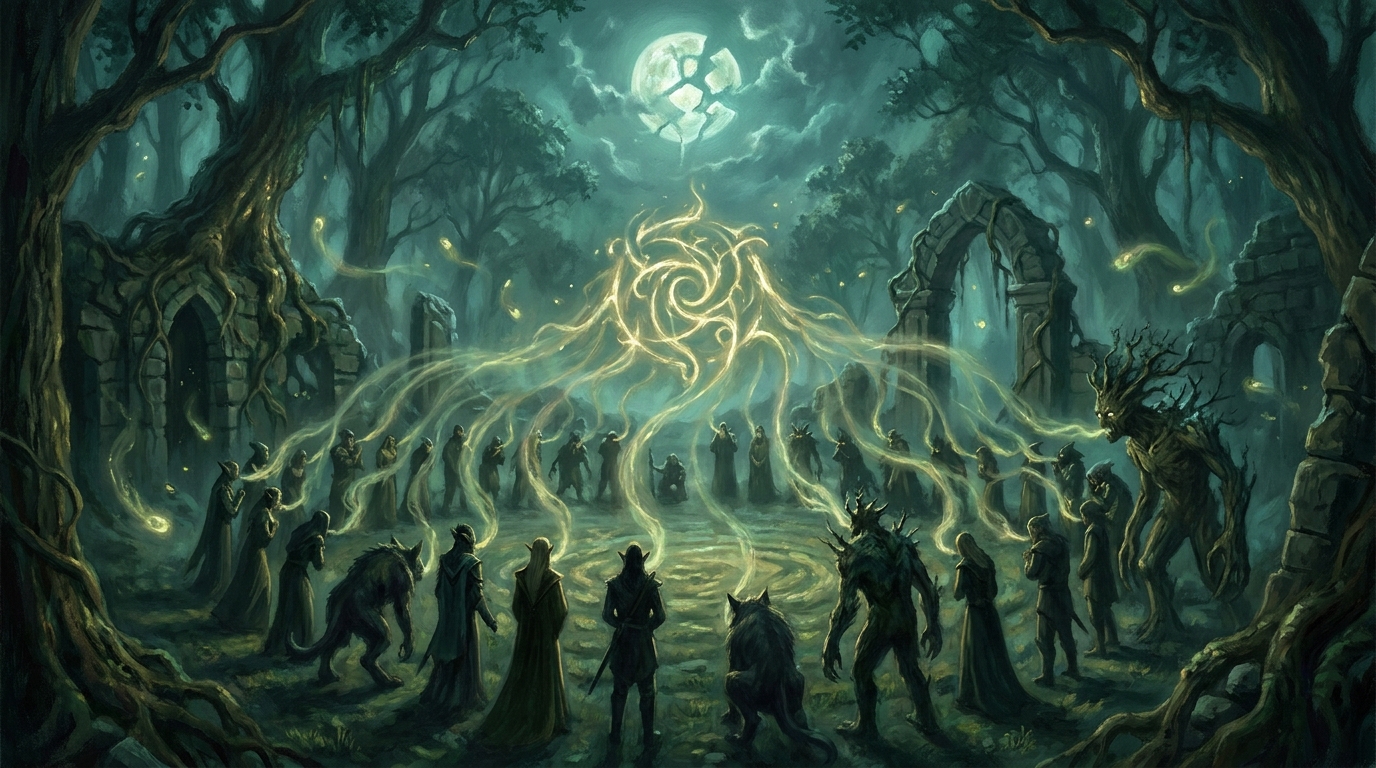
What convoke does
Every card with convoke carries the same reminder text:
Convoke (Your creatures can help cast this spell. Each creature you tap while casting this spell pays for {1} or one mana of that creature’s color.)
The formal version, rule 702.51a of the Comprehensive Rules, is more precise and worth reading once:
Convoke is a static ability that functions while the spell with convoke is on the stack. “Convoke” means “For each colored mana in this spell’s total cost, you may tap an untapped creature of that color you control rather than pay that mana. For each generic mana in this spell’s total cost, you may tap an untapped creature you control rather than pay that mana.”
Three details in that sentence do all the work. Convoke is a static ability, not a triggered one — nobody can respond to it, because nothing goes on the stack. Tapping happens rather than pay that mana, which makes it a method of paying a cost, not a discount. And a creature pays for {1} or one mana of that creature’s color, so a green creature can pay a generic {1} or a {G}, but never a {W}.
How casting a convoke spell actually works
The order matters, and it is the source of most convoke arguments at the table. Casting any spell follows a fixed sequence: you put it on the stack, choose modes and targets, choose the value of X, then the game calculates the total cost — mana cost, plus additional costs, plus or minus any cost modifiers. Only after all of that do you activate mana abilities and pay.
Convoke lives in that final payment step. So the practical sequence is:
- Announce the spell and choose X if it has one.
- Let the game work out the total cost, including any taxes like an opposing Thalia effect.
- Tap creatures for convoke and pay the rest with mana.
That ordering is confirmed by the official ruling on Chord of Calling, and the example is worth memorising:
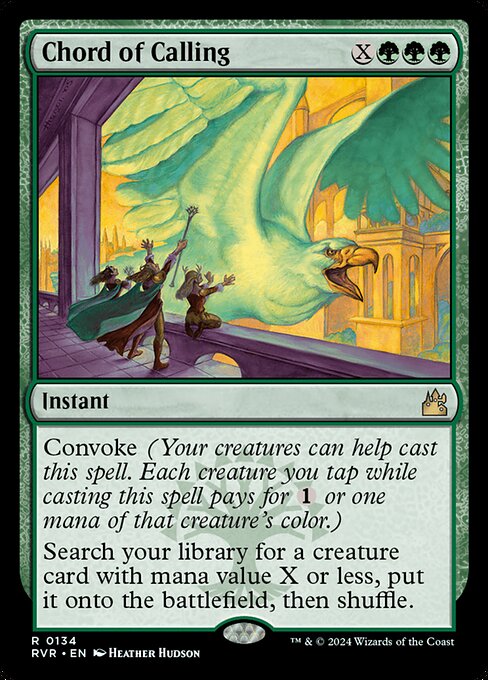
When using convoke to cast a spell with {X} in its mana cost, first choose the value for X. That choice, plus any cost increases or decreases, will determine the spell’s total cost. Then you can tap creatures you control to help pay that cost. For example, if you cast Chord of Calling (a spell with convoke and mana cost {X}{G}{G}{G}) and choose X to be 3, the total cost is {3}{G}{G}{G}. If you tap two green creatures and two red creatures, you’ll have to pay {1}{G}.
Read that last line carefully. Two red creatures could not pay the {G} symbols, so they were spent on generic mana instead — and one generic and one green were left over for the player to pay with actual mana.
The seven rules that decide games
These are the rulings that change outcomes. Every one is from the official Oracle rulings, not from folklore.
| Rule | What it means at the table |
|---|---|
| Convoke is not a cost reduction | It changes how you pay, not what you pay. The spell’s mana value never changes. |
| Summoning sickness is irrelevant | A creature that entered this turn can convoke immediately. |
| Attackers and blockers can convoke | Tapping a creature that is attacking or blocking does not remove it from combat. |
| Tapping for mana costs you the convoke | A creature tapped for mana is already tapped, so it cannot also be tapped for convoke. |
| Colored pips need matching colors | A creature pays {1}, or one mana of a color it actually is — nothing else. |
| Multicolored creatures choose | A Selesnya creature can pay {W} or {G} or {1}, your choice, one symbol per creature. |
| Convoke stacks with alternative costs | Because convoke is not itself an alternative cost, the two combine freely. |
Summoning sickness does not apply — and that is the whole trick
This is the single most valuable thing to know about convoke. The official ruling:
You can tap any untapped creature you control to convoke a spell, even one you haven’t controlled continuously since the beginning of your most recent turn.
Summoning sickness only stops a creature from attacking and from using abilities with {T} in the cost. Convoke is neither. It is a cost payment written on the spell, not an ability of the creature, so the creature’s history is irrelevant.
The consequence is enormous for token decks. Make three 1/1 Soldiers with Triplicate Spirits, and those Soldiers can convoke your next spell the same turn they arrive. Tokens are convoke’s natural fuel precisely because they arrive in bulk and their summoning sickness does not matter — which is why a token engine and a convoke shell are effectively the same deck. Our guide to the best token generators in MTG is the other half of this article.
You can convoke with your blockers
Here is the play almost nobody makes. The ruling reads:
Tapping an untapped creature that’s attacking or blocking to convoke a spell won’t cause that creature to stop attacking or blocking.
Blocking creatures are not tapped when they block. So the sequence is: your opponent attacks, you declare blockers, and then — with blockers declared and still untapped — you convoke an instant using the very creatures that are mid-combat. They still block. They still deal and receive damage. You simply got a free spell out of them on the way.
That turns Chord of Calling from a five-mana tutor into a near-free one on a stalled board, and it makes Devouring Light at {1}{W}{W} a genuine blowout: block with three creatures, tap all three to convoke, exile the attacker for zero mana, and keep your blocks. Attackers work too if they have vigilance, since a vigilant attacker never taps in the first place.
The mana-dork trap
This one costs games quietly, and it is worth reading twice:
If a creature you control has a mana ability with {T} in the cost, activating that ability while casting a spell with convoke will result in the creature being tapped before you pay the spell’s costs. You won’t be able to tap it again for convoke. Similarly, if you sacrifice a creature to activate a mana ability while casting a spell with convoke, that creature won’t be on the battlefield when you pay the spell’s costs, so you won’t be able to tap it for convoke.
In other words, a Llanowar Elves can give you one green mana or convoke for one green mana. Never both. Players routinely count their mana dorks twice when working out whether a big convoke spell is castable, and it is always off by exactly the number of dorks on the battlefield.
The sacrifice clause matters just as much: crack a creature for mana mid-cast and it is gone before the payment step, so it convokes nothing.
Convoke and {X}: six cards, one rule
X-cost convoke spells are the mechanic’s best payoff, because convoke scales exactly as fast as your board does. Choose X first, then tap the team. Every card below is Commander-legal, priced at its cheapest printing.
| Card | Mana cost | Type | What it does | Price |
|---|---|---|---|---|
| Chord of Calling | {X}{G}{G}{G} | Instant | Search your library for a creature card with mana value X or less and put it onto the battlefield | $5.78 |
| March of the Multitudes | {X}{G}{W}{W} | Instant | Creates X 1/1 Soldier tokens with lifelink — the tokens can convoke your next spell | $0.61 |
| Return to the Ranks | {X}{W}{W} | Sorcery | Returns X creature cards with mana value 2 or less from your graveyard to the battlefield | $0.63 |
| Transcendent Message | {X}{U}{U}{U}{U} | Instant | Four blue pips make this nearly uncastable without a wide blue board | $0.35 |
| Wildfire Awakener | {X}{1}{R}{W} | Creature — Human Wizard | Creates X 1/1 Elementals that ping a player whenever they become tapped | $3.22 |
| Worldsoul Colossus | {X}{G}{W} | Creature — Elemental | A 0/0 that enters with X +1/+1 counters | $0.08 |
Wildfire Awakener deserves a note, because its tokens ping “whenever this token becomes tapped” — and convoking taps them. The Elementals it makes can convoke your next spell and deal damage for doing it.
Convoke never changes a spell’s mana value
A rule players get wrong constantly:
When calculating a spell’s total cost, include any alternative costs, additional costs, or anything else that increases or reduces the cost to cast the spell. Convoke applies after the total cost is calculated. Convoke doesn’t change a spell’s mana cost or mana value.
Cast Chord of Calling for X=3 and convoke every pip, paying literally no mana. The spell still has mana value 6, and it still finds only a creature with mana value 3 or less. Anything that cares about mana value — cascade, storm counts, an opposing Chalice of the Void, a bracket-defining stax piece — sees the full printed cost, not the discount you felt. If you want the deeper version of how mana value interacts with free-spell mechanics, our cascade guide covers the same trap from the other direction.
Convoke is a white mechanic, not a green one
Ask a table which colors get convoke and you will hear “Selesnya” — the Conclave printed the first ones, and the flavor is green-white communal magic. The card pool disagrees. Of the 105 cards with convoke, here is where they actually live by color identity:
| Color | Cards with it in their color identity | Share of the 105 |
|---|---|---|
| White | 42 | 40% |
| Green | 28 | 27% |
| Blue | 20 | 19% |
| Black | 15 | 14% |
| Red | 11 | 10% |
| Colorless identity | 3 | 3% |
White has half again as many convoke cards as green. The mechanic drifted decisively toward white as it was reprinted through March of the Machine, Duskmourn and Lorwyn Eclipsed, and the practical consequence is that a mono-white token deck has a deeper convoke pool than a mono-green one. Percentages sum past 100 because multicolored cards count once per color in their identity.
By card type the split is: 46 creatures, 33 instants, 16 sorceries, 7 enchantments, 2 artifacts and 1 Kindred sorcery. That instant count is the underrated number — a third of all convoke cards can be cast on your opponent’s turn, which is what makes the blocker trick above so repeatable.
Nine cards that hand convoke to spells that never had it
This is convoke’s least-known corner. Nine cards grant convoke to other spells, and each one targets a different slice of your deck. Bolt one of these onto a wide board and every relevant spell you own suddenly costs creatures instead of mana.
| Card | Mana cost | Grants convoke to | Set | Price |
|---|---|---|---|---|
| Chief Engineer | {1}{U} | Artifact spells | Commander 2016 | $0.88 |
| Dazzling Theater | {3}{W} | Creature spells | Duskmourn | $0.87 |
| Eirdu, Carrier of Dawn | {3}{W}{W} | Creature spells | Lorwyn Eclipsed | $3.18 |
| Fallaji Wayfarer | {2}{G} | Multicolored spells | Dominaria United Commander | $4.13 |
| Hoarding Broodlord | {5}{B}{B}{B} | Spells cast from exile | March of the Machine | $4.82 |
| Invasion of Segovia | {2}{U} | Noncreature spells, once flipped | March of the Machine | $1.23 |
| Party Thrasher | {1}{R} | Noncreature spells cast from exile | Modern Horizons 3 | $0.40 |
| We Ride at Dawn | {2}{W} | Legendary creature spells | Outlaws of Thunder Junction Commander | $0.38 |
Two of these are quietly excellent and badly underplayed.
Dazzling Theater // Prop Room is a Room, and its two halves combine into an engine. The front half gives all your creature spells convoke; the back half, Prop Room, untaps each creature you control during each other player’s untap step. In a four-player Commander game that is three extra untaps per turn cycle, and convoke does not care whose turn it is. Unlock both doors and your board convokes creature spells on every single turn of the table.
Invasion of Segovia is a {2}{U} Battle that makes two 1/1 Kraken tokens on the way in — and when it is defeated it flips into Caetus, Sea Tyrant of Segovia, which grants all your noncreature spells convoke and untaps up to four creatures at the beginning of your end step. Untapping at end step means those four creatures are available to convoke instants on the opponents’ turns, then untap again on yours.
The ninth granter, Mothlight Processionist, grants convoke to enchantment spells but exists only in Alchemy — it is a digital-only card, not legal in Commander, and has no paper printing to buy. It is listed here for completeness and deliberately left out of the table above.
Six cards that care which creatures convoked
A third category almost no one assembles: cards that remember the specific creatures you tapped. These reward you twice for the same tap, and they are the reason convoke decks can win from a board that looks purely defensive.
| Card | Mana cost | Payoff for convoking | Price |
|---|---|---|---|
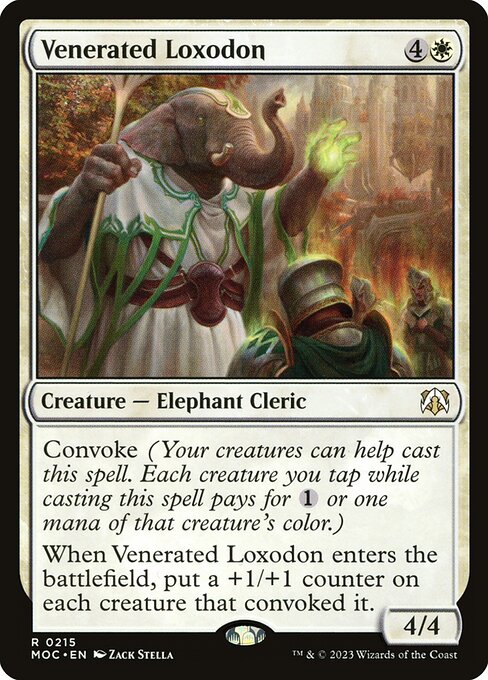
| Venerated Loxodon | {4}{W} | Puts a +1/+1 counter on each creature that convoked it — five 1/1s become five 2/2s and the Loxodon costs nothing | $0.25 |
| Ancient Imperiosaur | {5}{G}{G} | Enters with two +1/+1 counters for each creature that convoked it, plus trample and ward {2} | $0.39 |
| Lethal Scheme | {2}{B}{B} | Destroys a creature or planeswalker, and each creature that convoked it connives | $0.23 |
| Everything Comes to Dust | {7}{W}{W}{W} | Exiles all creatures except those sharing a creature type with a creature that convoked it — a one-sided wrath | $5.41 |
| Knight-Errant of Eos | {4}{W} | Digs six deep and grabs up to two creatures with mana value X or less, where X is how many creatures convoked it | $0.29 |
| Zephyr Singer | {2}{U}{U} | Puts a flying counter on each creature that convoked it | $0.24 |
Everything Comes to Dust is the standout and the most quietly devastating card in the mechanic. It is a ten-mana board wipe that a wide typal board casts for free, and it spares exactly the creatures that share a type with your convokers. Point a board of Elves at it and every Elf survives while the rest of the table is exiled — artifacts and enchantments included.
Ancient Imperiosaur is the efficiency king: convoke it with five creatures and it enters as a 16/16 trampling ward {2} threat for zero mana. Venerated Loxodon at 25 cents is the best value card in the entire mechanic — a free 4/4 that permanently upgrades your whole team.
Lethal Scheme is the only one of the six whose payoff is a keyword of its own: each creature that convoked it connives, which means each one draws a card, discards a card, and gets a +1/+1 counter if the discard was a nonland card. Two rules make it better than it reads. You cannot tap more creatures than it takes to pay the total cost, so normally no more than four creatures can pay for it — but four connives off a four-mana removal spell is four fresh cards and up to four counters. And per the official ruling, the creatures connive one at a time in the order you choose, each draw landing before the next discard, so the fourth creature to connive decides its discard with three more cards of information than the first.
The best convoke cards in Commander
Ranked by EDHREC inclusion, with prices at the cheapest printing. These are the cards that actually show up in decks.
| Card | Mana cost | Type | Why it is played | Price |
|---|---|---|---|---|
| Chord of Calling | {X}{G}{G}{G} | Instant | Instant-speed creature tutor straight to the battlefield; the mechanic’s flagship | $5.78 |
| Clever Concealment | {2}{W}{W} | Instant | Gives your permanents hexproof and indestructible — a free fog against a wrath | $4.81 |
| City on Fire | {5}{R}{R}{R} | Enchantment | Triples all damage; an eight-drop a red token board casts for nearly nothing | $11.46 |
| Hour of Reckoning | {4}{W}{W}{W} | Sorcery | Destroys all nontoken creatures — token decks convoke it and lose nothing | $0.21 |
| Bennie Bracks, Zoologist | {3}{W} | Legendary Creature | Draws a card whenever you create a token; the token engine’s payoff | $10.68 |
| Hoarding Broodlord | {5}{B}{B}{B} | Creature — Dragon | A 7/6 flier that tutors and then gives your exiled spells convoke too | $4.82 |
| Obelisk of Urd | {6} | Artifact | A colorless +2/+2 typal anthem any deck can convoke out on turn three | $2.48 |
| Impervious Greatwurm | {7}{G}{G}{G} | Creature — Wurm | A 16/16 indestructible body for ten mana you never actually pay | $4.78 |
| The Wandering Rescuer | {3}{W}{W} | Legendary Creature | Flash plus convoke — ambush a blocker and protect the team | $1.95 |
| Sprout Swarm | {1}{G} | Instant | Buyback plus convoke: with enough Saprolings it makes a token every turn, forever | $4.94 |
| Conclave Tribunal | {3}{W} | Enchantment | Free unconditional removal for any nonland permanent | $0.12 |
| Selfless Safewright | {3}{G}{G} | Creature — Elf Warrior | Flash, convoke, and hexproof plus indestructible for a creature type you choose | $0.63 |
Sprout Swarm is the one to understand if you like engines. Buyback {3} plus convoke means that once you have roughly six Saprolings, you can tap them to convoke the whole thing — buyback included — make another Saproling, and return the card to your hand. It is a hard lock on token production that costs no mana at all, and it has been legal since Future Sight in 2007.
Convoke in Lorwyn Eclipsed
Convoke is not a historical curiosity. Lorwyn Eclipsed, released 23 January 2026, printed 15 convoke cards — the largest single-set convoke run since March of the Machine, and the reason the mechanic is showing up in Standard again.
| Card | Mana cost | Type | Rarity | Price |
|---|---|---|---|---|
| Protective Response | {2}{W} | Instant | Uncommon | $0.14 |
| Appeal to Eirdu | {3}{W} | Instant | Common | $0.10 |
| Temporal Cleansing | {3}{U} | Sorcery | Common | $0.17 |
| Collective Inferno | {3}{R}{R} | Enchantment | Rare | $1.60 |
| Disruptor of Currents | {3}{U}{U} | Creature — Merfolk Wizard | Rare | $0.32 |
| Lofty Dreams | {3}{U}{U} | Enchantment — Aura | Uncommon | $0.11 |
| Merrow Skyswimmer | {3}{W/U}{W/U} | Creature — Merfolk Soldier | Common | $0.15 |
| Omni-Changeling | {3}{U}{U} | Creature — Shapeshifter | Uncommon | $0.34 |
| Selfless Safewright | {3}{G}{G} | Creature — Elf Warrior | Rare | $0.63 |
| Unexpected Assistance | {3}{U}{U} | Instant | Common | $0.22 |
| Harmonized Crescendo | {4}{U}{U} | Instant | Rare | $1.41 |
| Sun-Dappled Celebrant | {4}{W}{W} | Creature — Treefolk Cleric | Common | $0.14 |
| Winnowing | {4}{W}{W} | Sorcery | Rare | $0.33 |
| Wanderwine Farewell | {5}{U}{U} | Kindred Sorcery — Merfolk | Uncommon | $0.18 |
| Bloodline Bidding | {6}{B}{B} | Sorcery | Rare | $2.09 |
Note how blue that list is. Seven of the fifteen are blue, which is the clearest sign yet that convoke has drifted well outside its Selesnya origins. Wanderwine Farewell is also the only Kindred sorcery ever printed with convoke — a Merfolk-typed spell in a Merfolk set, cast by tapping Merfolk.
Convoke versus the other cost mechanics
Magic has printed several “pay with something other than mana” mechanics. Convoke is by a distance the most-printed of them.
| Mechanic | Cards | What you spend | Key difference from convoke |
|---|---|---|---|
| Convoke | 105 | Tapping untapped creatures | Can pay colored pips; ignores summoning sickness |
| Affinity | 75 | Nothing — it is a discount | A true cost reduction, so it does reduce what you pay generically only |
| Cascade | 38 | Nothing — it is a trigger | Casts a different spell for free rather than helping pay for this one |
| Delve | 28 | Exiling cards from your graveyard | Pays generic mana only; the resource is finite and never returns |
| Improvise | 24 | Tapping untapped artifacts | Pays generic mana only — artifacts have no color to contribute |
| Emerge | 15 | Sacrificing a creature | Consumes the creature permanently instead of just tapping it |
The line that matters is the colored-pip one. Improvise, delve and affinity can only ever pay generic mana. Convoke is the only one of the group that can pay a colored symbol, which is why it supports triple-pip costs like Hour of Reckoning‘s {4}{W}{W}{W} and delve never could.
A budget convoke package for $4.22
Fifteen cards, every one Commander-legal and verified against Scryfall at the cheapest available printing. This is a Selesnya token shell — the tokens arrive, ignore summoning sickness, and convoke the next spell immediately.
Budget Convoke Token Package
15 cards — one click loads the full list into a TCGplayer cart so you can check real prices and grab the whole deck at once.
Buy this deck on TCGplayerAffiliate link — buying through it supports KrakenTheMeta at no extra cost to you.One clarification worth making, because it is the most common mistake about this deck: Emmara, Soul of the Accord does not have convoke. Her text reads “whenever Emmara becomes tapped, create a 1/1 white Soldier creature token with lifelink” — she is the best convoke payoff in Magic precisely because convoking taps her. Tap Emmara to help cast a spell, and she hands you a Soldier for it. Because that trigger keys on becoming tapped rather than on a {T} ability, summoning sickness never stops it either.
The loop is: cast a token maker, convoke the next spell with the tokens plus Emmara, get another token from Emmara’s trigger, repeat. Hour of Reckoning at 21 cents is the finisher — it destroys all nontoken creatures, your board of tokens survives untouched, and you convoke it with the very creatures it spares. To price the whole thing against your own collection, our card pricing tool checks live market data, and you can browse full builds on the public deck gallery.
Two convoke cards you cannot play in Commander
Of the 105 cards with convoke, 103 are Commander-legal. The two exceptions are both Alchemy cards — digital-only rebalances that exist on MTG Arena and have no paper printing at all:
- Buxton, Decorated Host — a Legendary Rabbit Noble from Alchemy: Bloomburrow.
- Emmara, Voice of the Conclave — from Alchemy: Murders at Karlov Manor, and not to be confused with the paper Emmara, Soul of the Accord above.
Neither has a market price, because there is nothing physical to sell. If a deckbuilding tool suggests either one for a paper Commander deck, it is reading Arena data. If you want to sanity-check a list for exactly this kind of problem, the deck analyzer flags illegal cards before you sleeve them up.
Frequently asked questions
Does convoke work with summoning sickness?
Yes. A creature that entered the battlefield this turn can convoke immediately. Summoning sickness only restricts attacking and abilities with {T} in the cost, and convoke is neither — it is a cost payment on the spell, not an ability of the creature.
Can you tap creatures for convoke and mana at the same time?
No. If a creature taps to produce mana, it is already tapped and cannot convoke. You get one or the other from each creature, never both. This is the single most common mana-counting error in convoke decks.
Does convoke reduce a spell’s mana value?
No. Convoke changes how you pay a cost, not what the cost is. A Chord of Calling cast with X=3 has mana value 6 whether you paid with lands or convoked every symbol, and effects that check mana value see 6.
Can convoke pay for colored mana?
Yes, but only matching colors. Each creature you tap pays for {1} or one mana of a color that creature is. A white creature can pay a {W} or a generic {1}; it can never pay a {G}. Multicolored creatures let you choose any one of their colors.
Does convoke stack? What if a spell has convoke twice?
Convoke does not stack in any meaningful way. It is a static ability that lets you substitute taps for mana payments; having it listed twice grants no extra taps. You can never tap more creatures than there are mana symbols left to pay.
Can you over-convoke to generate extra mana?
No. Convoke pays specific mana symbols in a cost. Once every symbol in the total cost is paid, there is nothing left to tap creatures for, and convoke never produces floating mana.
Can attacking or blocking creatures convoke?
Yes, and this is convoke’s best trick. Tapping a creature that is attacking or blocking does not remove it from combat. Blockers are not tapped when they block, so you can declare blocks and then convoke an instant with those same creatures — they still block and still deal damage.
Does convoke work with X spells?
Yes. Choose X first, let the game calculate the total cost, then tap creatures to help pay it. This makes X-cost convoke spells scale directly with your board size.
Can you convoke a creature spell with the creature it is casting?
No. The spell is on the stack, not on the battlefield, so it is not a creature you control and cannot tap itself.
Does convoke work on your opponent’s turn?
Yes, on any convoke spell you can legally cast then — which means the 33 convoke instants, plus anything with flash such as The Wandering Rescuer or Selfless Safewright. Your creatures untap on your untap step, so holding them up for an opponent’s turn costs you only the attack.
Is convoke an alternative cost?
No, and that matters. Because convoke is not an alternative cost, it combines freely with actual alternative costs — you can cast a spell for its alternative cost and still convoke whatever mana that cost requires.
What is the best convoke card in Magic?
Chord of Calling is the most-played by a wide margin — an instant-speed tutor that puts the creature directly onto the battlefield. For pure value per dollar, Venerated Loxodon at 25 cents is hard to beat: a free 4/4 that leaves a +1/+1 counter on every creature that helped cast it.
Which colors get the most convoke cards?
White, despite the mechanic’s green-white Selesnya reputation. Of the 105 convoke cards, 42 have white in their color identity against 28 for green, 20 blue, 15 black and 11 red.
The short version
Convoke rewards going wide, and it rewards it twice — once when your creatures pay for a spell, and again when that spell is a Venerated Loxodon or an Everything Comes to Dust that cares who did the paying. Build a board that makes tokens, remember that summoning sickness does not apply, and hold your instants up on other players’ turns so your blockers can pay for them mid-combat. The mechanic has been legal for nearly 21 years and got 15 new cards this January, so anything you learn about it stays useful.
Build your next deck with AI
KrakenTheMeta’s AI deck builder researches the current meta and writes you a complete, format-legal decklist in about a minute — free to try.
Build a Deck with AIor browse community decks


3 Comments
Comments are closed.