
MTG Flash Explained: The Keyword, the Banned Card, and How Priority and the Stack Actually Work (2026)
Search “MTG flash” and Google hands you two completely different answers stacked on top of each other. Half the results explain a keyword ability. The other half are shop pages for a $1.80 blue instant from 1999 that is banned in Commander. If you are new, that is genuinely confusing, and none of the top results tell you they are talking about different things.
So this guide does both. It sorts out the two Flashes in about thirty seconds, then answers the question that actually sends people searching: when am I allowed to do things? That question is not really about flash at all. It is about priority and the stack — the two rules that decide every “wait, can I respond to that?” argument at your table.
Every rule below is quoted from the current Comprehensive Rules document (the 7 August 2026 update), and every card is verified against live Scryfall oracle text and legality.
Two different things are called “Flash”
Before anything else, work out which one you are looking at.
| What you found | What it actually is | Does it matter to you? |
|---|---|---|
| A card that says “Flash” on its type line as an ability word | The keyword ability — appears on hundreds of cards | Yes. This is what 99% of people mean. |
| A single blue instant named Flash, {1}{U}, from Mirage | A specific card, banned in Commander and Legacy, restricted in Vintage | Almost certainly not. |
The card named Flash does not have flash
This is the part that makes the confusion worse rather than better. The card Flash reads:
You may put a creature card from your hand onto the battlefield. If you do, sacrifice it unless you pay its mana cost reduced by {2}.
That is it. No keyword. It is an Instant, so it is already castable at instant speed by virtue of its card type — the keyword ability was later named after this card, not printed on it. Its job is putting an enormous creature onto the battlefield for two mana and then finding a way to keep it, which is exactly why it does not get to stay in your Commander deck.
| Format | Status of the card Flash |
|---|---|
| Commander | Banned |
| Legacy | Banned |
| Vintage | Restricted |
| Modern / Standard | Not legal (never printed in a legal set) |
If that is the card you were reading about, you are done — do not build around it. Everything below is about the keyword.
What the flash keyword actually does
The rules text is short and worth reading exactly as written, because two words in it matter:
702.8a. Flash is a static ability that functions in any zone from which you could play the card it’s on. “Flash” means “You may play this card any time you could cast an instant.”
Two things fall out of that sentence that most explanations skip.
It says “play”, not “cast”. Flash functions in any zone from which you could play the card. If some other effect lets you cast a flash creature out of your graveyard or from exile, it is still instant-speed from there. Flash is not tied to your hand.
It is a static ability. It is not a trigger and it does not use the stack, so there is no window in which an opponent can “respond to the flash”. By the time anything is on the stack, the spell has already been legally cast.
The rule flash is actually breaking
Flash makes sense only once you know the restriction it removes. Here is the default:
117.1a. A player may cast an instant spell any time they have priority. A player may cast a noninstant spell during their main phase any time they have priority and the stack is empty.
Read that second sentence again. Casting a creature normally requires three things at once, not one:
- It has to be your main phase.
- You have to have priority.
- The stack has to be empty.
Nearly everyone remembers the first condition and forgets the third. That is why you cannot cast a creature “in response” to a removal spell in a normal game — not because it is not your turn, but because the stack is not empty. Flash deletes all three restrictions at once and replaces them with the instant rule: any time you have priority.
Priority: the thing you were really asking about
Priority is the game’s turn-taking system for doing things, as distinct from whose turn it is.
117.1. Unless a spell or ability is instructing a player to take an action, which player can take actions at any given time is determined by a system of priority. The player with priority may cast spells, activate abilities, and take special actions.
The active player — the person whose turn it is — gets priority first in each step and phase. When they are finished, they pass. Then the next player gets it. Nothing resolves while anyone still wants to act:
117.4. If all players pass in succession (that is, if all players pass without taking any actions in between passing), the spell or ability on top of the stack resolves or, if the stack is empty, the phase or step ends.
The detail that gets misplayed at every table
After something resolves, priority does not go back to the person who cast it. It goes to the active player:
117.3b. The active player receives priority after a spell or ability (other than a mana ability) resolves.
In a four-player Commander game this matters constantly. You cast a removal spell on your own turn, it resolves, and you get priority again before anyone else — so you can immediately cast a second spell without giving opponents a window in between. On someone else’s turn, they get that window instead of you.
The stack: last in, first out
When you cast a spell it does not just happen. It goes somewhere and waits.
405.2. The stack keeps track of the order that spells and/or abilities were added to it. Each time an object is put on the stack, it’s put on top of all objects already there.
117.7. If a player with priority casts a spell or activates an activated ability while another spell or ability is already on the stack, the new spell or ability has been cast or activated “in response to” the earlier spell or ability. The new spell or ability will resolve first.
That is the whole thing. Last in, first out — a stack of plates, not a queue at a shop. Whatever went on most recently comes off first, and only one object resolves at a time, with a fresh round of priority in between each one.
A worked example
Your opponent casts a removal spell targeting your commander. Here is what the stack looks like as the exchange plays out, top of the stack first:
| Step | What happens | Stack, top first |
|---|---|---|
| 1 | Opponent casts removal targeting your commander | Removal |
| 2 | You respond with an instant-speed protection spell | Protection, Removal |
| 3 | They respond by countering your protection spell | Counter, Protection, Removal |
| 4 | Everyone passes. Top object resolves. | Protection (countered), Removal |
| 5 | Everyone passes again. Next object resolves. | Removal |
| 6 | Removal resolves. Your commander dies. | (empty) |
Note step 4: after the counterspell resolves, everyone gets priority again before the protection spell would have resolved. That is your last chance to do something else. If you have a second answer in hand, this is the window — and if it is a creature without flash, you cannot use it, because the stack is not empty.
What does not use the stack — and therefore cannot be responded to
This is where most rules arguments actually come from. Plenty of things in Magic never touch the stack at all, which means there is no window to respond to them.
405.6. Some things that happen during the game don’t use the stack.
| Action | Uses the stack? | What that means in practice |
|---|---|---|
| Casting a spell | Yes | Can be countered and responded to. |
| Activated abilities (non-mana) | Yes | Can be responded to, and countered by things like Stifle. |
| Triggered abilities | Yes | Go on the stack the next time a player would get priority. |
| Mana abilities | No | You cannot respond to someone tapping a rock for mana (605.3a). |
| Playing a land | No | A special action (116.2a). Nothing to respond to. |
| Turning a face-down creature face up | No | Also a special action (116.2b). |
| State-based actions | No | The game just does them. See below. |
| Static abilities | No | Always on. Flash itself is one of these. |
State-based actions are why you “couldn’t respond” to your creature dying
The single most common misunderstanding in Magic is thinking you get a chance to save a creature after it takes lethal damage. You do not, and the reason is a timing rule most players have never read:
117.5. Each time a player would get priority, the game first performs all applicable state-based actions as a single event, then repeats this process until no state-based actions are performed. Then triggered abilities are put on the stack. These steps repeat in order until no further state-based actions are performed and no abilities trigger. Then the player who would have received priority does so.
State-based actions happen before anyone gets priority. A creature with lethal damage is already in the graveyard by the time you are allowed to act. The same applies to a player at 0 life (704.5a) and to the legend rule. If you want to save something, you have to do it during the window before the damage or the effect resolves — which, again, is what instant speed and flash are for.
This is also the boundary that makes indestructible behave the way it does: indestructible survives the state-based action for lethal damage, but nothing survives being put into the graveyard by an effect that does not destroy.
Every window in a turn where you can cast a flash spell
“Instant speed” is not one window. It is a dozen of them. Here is where the good ones are.
| Step or phase | Can you act? | Why you would |
|---|---|---|
| Untap step | No | No player receives priority during the untap step. |
| Upkeep | Yes | Respond to upkeep triggers before they resolve. |
| Draw step | Yes | The classic window for draw-hate effects. |
| Precombat main | Yes | Punish a tapped-out opponent who just committed. |
| Beginning of combat | Yes | Flash in a blocker before attackers are declared — they still have to attack into it. |
| Declare attackers | Yes | After attackers are locked in. Now they cannot change their minds. |
| Declare blockers | Yes | Too late to add a blocker, but the window for combat tricks. |
| Combat damage | Yes (before damage) | Last chance to change the maths. |
| Postcombat main | Yes | Rebuild, or answer what they cast post-combat. |
| End step | Yes | The best default window in Commander — see below. |
| Cleanup | Rarely | Only if a state-based action or trigger occurs (704.3). |
Why “end step” is the default answer
If you flash a creature in on the turn before yours — during the end step of the player to your right — it has been under your control since before your untap step, so it is not summoning sick and can attack immediately on your turn. You get the surprise blocker window and a full attack, for the price of one card. That interaction between flash and summoning sickness is the single strongest reason flash creatures cost more than their vanilla equivalents.
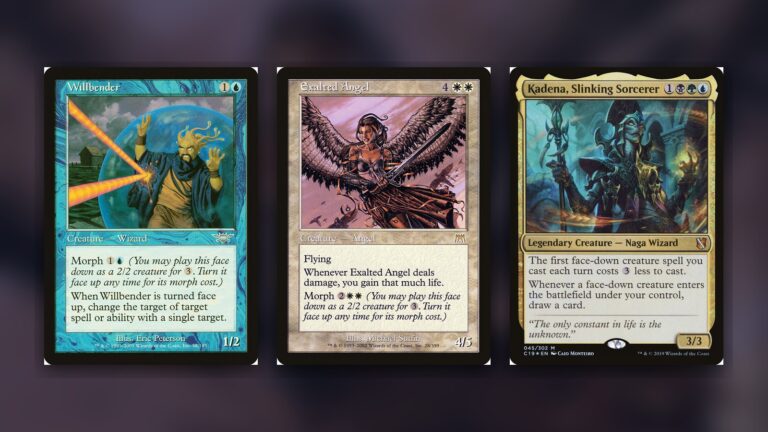
The other special action in that table is the one that matters most in games with old cards: turning a face-down creature face up. A morph or disguise flip never uses the stack, so it cannot be responded to, and because it is a special action rather than a spell or an activated ability it can be taken while a spell with split second is on the stack — the rulings on Willbender and Mischievous Quanar say so. What does use the stack is whatever the card does when it flips, so the trigger can still be countered even though the flip cannot.
Split second: the keyword that switches the stack off
There is exactly one mechanic in Magic designed to stop the back-and-forth entirely.
702.61a. Split second is a static ability that functions only while the spell with split second is on the stack. “Split second” means “As long as this spell is on the stack, players can’t cast other spells or activate abilities that aren’t mana abilities.”
The trap: split second does not stop everything
The next rule down is the one that catches people, and it is worth memorising before you rely on a split-second card as protection:
702.61b. Players may activate mana abilities and take special actions while a spell with split second is on the stack. Triggered abilities trigger and are put on the stack as normal while a spell with split second is on the stack.
So split second stops casting and stops activating. It does nothing at all about triggers. If your opponent’s permanent has “when this is put into a graveyard…”, pointing a Krosan Grip at it does not stop the trigger — the trigger still goes on the stack and still resolves. It also does not stop state-based actions, since the game performs those automatically rather than a player taking an action.
One small wording note: the reminder text printed on the cards says “players can’t cast spells”, while the Comprehensive Rules say “can’t cast other spells”. The rules text is the precise one — the split-second spell itself has obviously already been cast.
| Card | Cost | What it does | Price |
|---|---|---|---|
| Krosan Grip | {2}{G} | Destroy target artifact or enchantment. The default answer to a combo piece that would otherwise be protected. | $1.59 |
| Trickbind | {1}{U} | Counter target activated or triggered ability — and that permanent’s activated abilities cannot be activated again this turn. | $12.35 |
| Sudden Spoiling | {1}{B}{B} | Creatures target player controls lose all abilities and become 0/2 until end of turn. Blanks an entire attack or a whole combo board. | $7.25 |
| Extirpate | {B} | Exile every copy of a card from a graveyard, hand and library. One mana, and they cannot respond. | $1.09 |
| Wipe Away | {1}{U}{U} | Bounce any permanent at instant speed, through protection-style responses. | $0.28 |
| Sudden Death | {1}{B}{B} | Target creature gets −4/−4. Kills through most instant-speed saves. | $0.13 |
| Sudden Shock | {1}{R} | 2 damage to any target, uncounterable in practice. | $0.13 |
Note that Trickbind is the only split-second card that answers a triggered ability — because it does so by countering the trigger after it is already on the stack, not by preventing it.
The best flash creatures in Commander
Several of the cards below are not really combat creatures at all — they are disruption pieces that happen to have flash, held specifically for the moment an opponent taps out or reaches for a tutor. Notion Thief and Opposition Agent both belong to that family, and the reason they are printed with flash is so they can be deployed in response to the thing they punish. If that style appeals, our guide to stax and resource denial maps out the whole archetype.
Everything here is Commander-legal and verified against current oracle text, with one deliberate exception, flagged.
| Creature | Cost | Why it earns the slot | Price |
|---|---|---|---|
| Snapcaster Mage | {1}{U} | Flash. On entry, an instant or sorcery in your graveyard gains flashback until end of turn — a second copy of your best answer, at instant speed. | $18.80 |
| Torrential Gearhulk | {4}{U}{U} | Flash. On entry, cast an instant from your graveyard for free. A 5/6 body plus a free counterspell in one card. | $1.17 |
| Brazen Borrower | {1}{U}{U} | Flash, flying, and an Adventure half that bounces a nonland permanent for {1}{U} first. Two cards in one slot. | $0.55 |
| Restoration Angel | {3}{W} | Flash, flying, and blinks one of your own non-Angel creatures on entry — an instant-speed way to dodge removal and re-trigger an enter-the-battlefield ability. | $0.38 |
| Notion Thief | {2}{U}{B} | Flash. Every extra draw an opponent takes is skipped and you draw instead. Flash it in response to a group-draw spell. | $1.39 |
| Ambush Viper | {1}{G} | Flash plus deathtouch for two mana. The cheapest “your attack is cancelled” card in green. | $0.21 |
| Yeva, Nature’s Herald | {2}{G}{G} | Has flash and gives every green creature spell you cast flash. A creature that is also an enabler. | $1.71 |
| Shimmer Myr | {3} | Flash, and every artifact spell you cast gains flash. Colourless, so it slots into any deck. | $0.36 |
Honesty flag: Hullbreacher is banned in Commander. It is a {2}{U} flash Merfolk that turns opponents’ extra draws into Treasure tokens for you, it shows up constantly in “best flash creatures” lists written before its ban, and it is still legal in Legacy and Vintage. It is not a legal option for your EDH deck. Notion Thief is the legal card that does nearly the same job.
Four creatures in Magic have both flash and foretell: Cosmos Charger, Glorious Protector, Green Slime and Jarl of the Forsaken. That combination matters because a foretold card can be cast from exile as soon as the next player’s turn begins, and flash lets a creature be cast whenever you have priority — so a Glorious Protector foretold for {2} on your turn is a {2}{W} instant-speed answer to a board wipe on theirs, with the card safely out of reach of discard in between. Cosmos Charger goes one further and lets you foretell on any player’s turn while it is on the battlefield.
Seven of the best flash creatures are also evoke creatures, which makes them instants that happen to be creatures when you have the mana. Solitude, Subtlety and Endurance can be cast for nothing by exiling a card of their colour from your hand; Briarhorn is a two-mana Giant Growth, Cloudthresher a four-mana sweeper for fliers, Dawnfluke and Offalsnout one-mana tricks. Our evoke guide has all seven, the sacrifice trigger you can respond to, and the rest of the 35.
Flash enablers: giving your whole deck flash
The keyword gets far more interesting when it stops being a property of one card and becomes a property of your hand.
| Enabler | Cost | What it grants | Price |
|---|---|---|---|
| Vedalken Orrery | {4} | “You may cast spells as though they had flash.” Everything. Colourless, so any deck can run it. The gold standard. | $18.93 |
| Leyline of Anticipation | {2}{U}{U} | The same effect, and it can start the game on the battlefield from your opening hand for free. | $6.81 |
| Vivien, Champion of the Wilds | {2}{G} | Creature spells only, but at three mana with a +1 and a card-advantage minus attached. | $0.87 |
| Alchemist’s Refuge | Land | {G}{U}, {T}: cast spells this turn as though they had flash. A land slot instead of a spell slot. | $0.43 |
| Winding Canyons | Land | {2}, {T}: creature spells only, but colourless activation — it works in any deck. | $33.51 |
| Teferi, Time Raveler | {1}{W}{U} | His +1 gives sorceries flash until your next turn — and his static ability locks opponents to sorcery speed at the same time. | $7.12 |
| Seedborn Muse | {3}{G}{G} | Not flash, but the payoff card for it: untaps all your permanents during every other player’s untap step, so you always have mana available for the window. | $17.18 |
The trap: Aluren is symmetric. It reads “Any player may cast creature spells with mana value 3 or less without paying their mana costs and as though they had flash.” It is a famous combo enabler, but in a four-player game you have just handed three opponents free instant-speed creatures. Read it before you sleeve it.
Instant-speed answers worth holding up
Flash creatures are only half of playing at instant speed. The other half is the removal and protection you keep in hand instead of committing on your own turn. Some protection sits on the permanent instead of in your hand, and it plays by these same rules: ward is a triggered ability, not a static one, so it uses the stack and can be responded to like anything else here.
| Spell | Cost | Role | Price |
|---|---|---|---|
| Heroic Intervention | {1}{G} | All your permanents gain hexproof and indestructible until end of turn. Two mana against a board wipe. | $15.73 |
| Teferi’s Protection | {2}{W} | Your life total cannot change, you gain protection from everything, and all your permanents phase out. The most complete “no” in the format. | $50.35 |
| Cyclonic Rift | {1}{U} | Overloaded at end of turn, it bounces every nonland permanent you do not control. The reason people fear an untapped blue player. | $40.33 |
| Fierce Guardianship | {2}{U} | Free counterspell for noncreature spells as long as you control your commander. | $56.09 |
| Deflecting Swat | {2}{R} | Free redirection — change the targets of a spell or ability. Turns their removal into yours. | $67.36 |
| Swan Song | {U} | One mana to counter an enchantment, instant or sorcery. They get a 2/2 flier; you get the game. | $10.05 |
| Mystic Confluence | {3}{U}{U} | Three modes from counter, bounce and draw — flexible enough to always be live. | $1.03 |
| Stifle | {U} | Counter target activated or triggered ability. The answer to the things counterspells cannot touch. | $13.51 |
Instant-Speed Core Package
18 cards — one click loads the full list into a TCGplayer cart so you can check real prices and grab the whole deck at once.
Buy this deck on TCGplayerView it on KrakenTheMetaAffiliate link — buying through it supports KrakenTheMeta at no extra cost to you.How to shut flash off
If an opponent is holding up mana every turn and you would rather they did not, these are the cards that take the window away.
| Card | Cost | What it stops | Price |
|---|---|---|---|
| Teferi, Time Raveler | {1}{W}{U} | “Each opponent can cast spells only any time they could cast a sorcery.” The cleanest full answer in the format — it stops flash creatures, instant-speed removal and counterspells in one static ability. | $7.12 |
| Grand Abolisher | {W}{W} | During your turn, opponents cannot cast spells or activate abilities of artifacts, creatures or enchantments. Two mana, and your turn is yours. | $19.77 |
| Dragonlord Dromoka | {4}{G}{W} | Cannot be countered, and opponents cannot cast spells during your turn at all. A commander that is also a lock. | $2.09 |
| Silence | {W} | One mana: opponents cannot cast spells this turn. The classic combo-protection card. | $8.94 |
| Orim’s Chant | {W} | One target player cannot cast spells this turn; kicked for {W}, creatures also cannot attack. | $5.74 |
| Rhystic Study | {2}{U} | Does not stop anything, but taxes every spell they cast — including the ones they were saving for your end step. | $70.04 |
Note the asymmetry between the first three. Grand Abolisher and Dragonlord Dromoka protect only your turn; Teferi, Time Raveler works on every turn including theirs. If your problem is being countered while comboing off, the first two are cheaper. If your problem is an opponent flashing in blockers and killing you at instant speed, only Teferi actually addresses it.
Six mistakes players make with flash and the stack
| Mistake | What actually happens |
|---|---|
| “I’ll save my creature after it takes lethal damage.” | State-based actions run before anyone gets priority (117.5). It is already dead. Act before damage. |
| “I’ll respond to them tapping lands for mana.” | Mana abilities do not use the stack (605.3a). There is no window. |
| “I’ll counter their land drop.” | Playing a land is a special action (116.2a). It never goes on the stack. |
| “Split second protects my combo from their trigger.” | It does not. Triggers still trigger and still resolve (702.61b). Only Trickbind or Stifle answer a trigger. |
| “I’ll flash in a blocker after blockers are declared.” | Too late. The creature has to be on the battlefield by the declare-blockers step to block. Flash it in during beginning of combat or declare attackers. |
| “I cast my spell first, so it resolves first.” | Last in, first out (117.7). The spell cast last resolves first. |
Where flash fits in the rest of your deck
Flash is a timing keyword, so it interacts with almost everything else. A few of the most useful crossovers:
- Blink and flicker. Instant-speed blink effects dodge removal by exiling the creature in response, and re-trigger its enter-the-battlefield ability on the way back. That is the engine behind most blink commanders, and Restoration Angel does it on a flash body.
- Cascade. Cascade is a triggered ability, so it uses the stack — which means it can be responded to, and the free spell it finds is cast during the trigger’s resolution. Worth reading alongside how cascade actually works.
- Counters and proliferate. Proliferate at instant speed on an opponent’s end step is one of the cleanest uses of a flash enabler — see the proliferate guide.
- Protection keywords. Whether your instant-speed answer actually works often comes down to hexproof, ward and protection — the differences are covered in the keyword breakdown.
- Combat maths. Flashing in a deathtouch blocker only works if you know how combat damage is assigned — first strike in particular can make your ambush blocker die for nothing.
If you want to see how many of your instants and flash creatures you can actually hold up on a given turn, run your list through the deck analyzer and check the curve — instant-speed decks want a lower curve than they usually end up with. You can also browse public Commander decks for flash shells that already work, and check current prices on any of the cards above with the card price tool.
Frequently asked questions
What does flash mean in MTG?
Flash is a static ability that reads “You may play this card any time you could cast an instant” (CR 702.8a). It removes the normal restrictions on casting a noncreature-type spell — your main phase, and an empty stack — leaving only the requirement that you have priority.
Is flash the same as an instant?
Not quite. A card with flash keeps its own card type. A flash creature is still a creature: it is affected by creature removal, it enters the battlefield with summoning sickness, and it stays on the battlefield after it resolves. Flash only changes when you may cast it.
Can a flash creature block the turn it comes down?
Yes, as long as it is on the battlefield before blockers are declared. Blocking does not require the creature to be untapped-since-your-upkeep the way attacking does — summoning sickness only stops attacking and abilities with the tap symbol. That same exemption is why a creature which entered the battlefield this turn can still convoke a spell — convoke is a cost payment, not a tap ability.
Can a flash creature attack the turn it comes down?
No, unless it has haste. Flash gets it onto the battlefield early; it does not remove summoning sickness. The standard line is to flash it in during the end step of the turn before yours, so it is ready to attack on your turn.
Why is the card Flash banned in Commander?
The card Flash ({1}{U}, Instant) puts any creature from your hand onto the battlefield for two mana, with a sacrifice clause you can dodge or simply accept. It enables two-card combos far too cheaply for a 100-card singleton format, so it is banned in Commander and Legacy and restricted in Vintage.
Can you respond to a creature dying?
No. Creatures are put into the graveyard by state-based actions, which the game performs before any player receives priority (CR 117.5, 704.3). Once a creature has lethal damage marked on it, the window has already closed — your response had to happen before the damage.
Can you respond to someone playing a land?
No. Playing a land is a special action that does not use the stack (CR 116.2a). The same is true of activating a mana ability (CR 605.3a) and of turning a face-down creature face up (CR 116.2b).
Does split second stop triggered abilities?
No, and this is the most common misreading of the keyword. CR 702.61b states plainly that triggered abilities still trigger and are still put on the stack while a split-second spell is on the stack. Split second stops players from casting spells and activating non-mana abilities, nothing else. To answer a trigger you need Trickbind or Stifle.
Which spell resolves first if we both cast something?
The one cast most recently. The stack resolves last in, first out (CR 117.7, 405.2), and each object gets a fresh round of priority before the next one resolves.
What is the best flash enabler in Commander?
Vedalken Orrery, because it is colourless, affects every spell rather than just creatures, and has no activation cost. Leyline of Anticipation does the same job and can be free in your opening hand, but it needs double blue. If you only care about creatures, Vivien, Champion of the Wilds is the cheapest entry at three mana.
Build your next deck with AI
KrakenTheMeta’s AI deck builder researches the current meta and writes you a complete, format-legal decklist in about a minute — free to try.
Build a Deck with AIor browse community decks

4 Comments
Comments are closed.