
MTG Ward Explained: Every Ward Cost, All 189 Cards, and the Rules Players Get Wrong (2026)
Ward is the most-printed protection keyword of the last five years and the most misunderstood. It looks like a shield. It is actually a toll booth — and the difference between those two mental models is why so many players get it wrong at the table.
We pulled every paper card with ward from the Scryfall API — 189 of them — and read the Comprehensive Rules entry alongside the official rulings. Four things came out of that pass that almost nothing written about ward mentions: more than half of all ward cards share a single cost, ward is a blue mechanic rather than the green one everyone assumes, killing the creature that has ward does not save you once ward has triggered, and two ward costs in the game can be literally impossible to pay — which makes them, situationally, stronger than hexproof.
What ward actually does
Here is the rule, quoted exactly from the Comprehensive Rules dated 7 August 2026:
702.21a Ward is a triggered ability. Ward [cost] means “Whenever this permanent becomes the target of a spell or ability an opponent controls, counter that spell or ability unless that player pays [cost].”
That is the whole rule. Ward has exactly two subrules in the entire Comprehensive Rules — 702.21a above and 702.21b, which handles ward costs containing X. For a keyword this common, that is a remarkably short entry, and every argument players have about ward comes from what those two sentences imply rather than from anything ambiguous in the text.
Four things follow directly from that one sentence, and all four are places people go wrong:
- Ward does not stop anything from being targeted. Your opponent may target a creature with ward freely. Ward only asks them to pay afterwards.
- Ward only triggers on spells and abilities an opponent controls. Your own auras, equipment, pump spells and blink effects target your warded creature for free.
- Ward triggers on abilities, not just spells. An opposing activated or triggered ability that targets your creature triggers ward exactly the same way a removal spell does.
- Ward is a triggered ability, so it uses the stack. It goes on the stack above the spell that triggered it, and it resolves first. If you want the full mechanics of how that ordering works, our guide to flash, priority and the stack walks through it step by step.
That last point is the one that separates ward from its neighbours. Hexproof and shroud are static abilities — rule 702.11a says “Hexproof is a static ability,” and rule 702.18a says the same of shroud. A static ability just sits there changing what is legal. Ward is a triggered ability that fires, goes on the stack, and resolves. That structural difference drives almost every interaction below.
Ward vs hexproof vs shroud vs protection
These four keywords are constantly confused because they all read as “my creature is harder to kill.” They work nothing alike.
| Keyword | Rule type | What it does to targeting | Can the opponent get through? |
|---|---|---|---|
| Ward | Triggered (702.21a) | Targeting is legal; a trigger then taxes it | Yes — pay the cost |
| Hexproof | Static (702.11a) | Opponents cannot target it at all | No |
| Shroud | Static (702.18a) | Nobody can target it, including you | No |
| Protection | Static (702.16) | Cannot be damaged, enchanted, blocked or targeted by the stated quality | No, from that quality |
The design intent behind that difference is on the record. When Wizards introduced ward in Strixhaven, the preview article framed hexproof as the problem ward was built to solve: hexproof creatures stacked with auras gave opponents nothing to do, and the designers wanted removal to be less effective rather than switched off entirely. Ward keeps the interaction and charges for it.
If you want the full four-way breakdown — including which one shuts off your own targeted pump spells and why that matters in a Voltron deck — that is the job of our dedicated hexproof vs shroud vs ward vs protection comparison. This page is about ward on its own.
Every ward cost ever printed
Here is the finding that reframes the whole keyword. Across all 189 paper cards with ward:
| Ward cost | Cards | Notes |
|---|---|---|
| Ward {2} | 96 | More than every other ward cost combined (93) |
| Ward {3} | 21 | The “this one really matters” tier |
| Ward {1} | 19 | Mostly cheap creatures and typal lords |
| Ward — Pay N life | 18 | N ranges from 2 up to 9 |
| Ward — Discard a card | 14 | Brutal against a topdecking opponent |
| Ward — Sacrifice | 7 | Sacrifice a creature, a permanent, a Food, a legend… |
| Ward {4} | 7 | Effectively unpayable in the early game |
| Ward — Pay life equal to power | 2 | Phyrexian Fleshgorger, Raubahn |
| Ward {X} | 1 | Minthara, Merciless Soul |
| Ward {8} | 1 | Octavia, Living Thesis — the largest fixed cost |
| Ward — Blight 2 | 1 | Auntie Ool — two -1/-1 counters on their own creature |
| Ward — Collect evidence 4 | 1 | Axebane Ferox — exile 4+ mana value from their graveyard |
| Ward — Get five poison counters | 1 | The Serpent Society — half a lethal poison total |
| Ward — Waterbend {4} | 1 | The Unagi — {4}, or tap four of their own permanents |
Ward {2} appears on 96 of 189 cards — 50.8% — and outnumbers every other ward cost put together. When a player says “it has ward,” ward {2} is the coin-flip default, and building around that assumption is usually correct.
But the more interesting number is the other one. 144 cards charge mana. 45 charge something else. No card does both. That 45 is what makes ward structurally different from every other keyword in Magic: ward’s cost is an open slot, and the designers have filled it with life, cards, creatures, Food tokens, poison counters, graveyard exile and — on one Avatar card — bending water. Hexproof has no dial — it is either on or off, and our full hexproof guide counts all 95 paper cards that carry it. Shroud has no dial. Ward is the only protection keyword that can be tuned card by card.
The rules people actually get wrong
These are the interactions worth knowing, each checked against the Comprehensive Rules or an official Scryfall ruling rather than table folklore.
| Interaction | What actually happens | Source |
|---|---|---|
| A board wipe hits your ward creature | Ward never triggers. Wraths do not target | CR 115.10a |
| An edict (“each player sacrifices”) | Ward never triggers — no target | CR 115.10a |
| You target your own ward creature | No trigger. Ward reads “an opponent controls” | CR 702.21a |
| An opponent’s ability targets it | Ward triggers exactly as it would on a spell | CR 702.21a |
| They kill the ward creature in response | They still owe the cost. The trigger is independent | Bronze Guardian ruling |
| One spell targets two of your ward creatures | Both trigger. Fail to pay either and the spell is countered | Sedgemoor Witch ruling |
| The creature has ward twice | Both trigger, and both must be paid separately | No redundancy rule exists |
| Ward {X} where X changes | X is locked in on resolution, not when it triggers | CR 702.21b |
| The spell says “can’t be countered” | Ward triggers, they decline to pay, nothing happens | CR 702.21a |
Board wipes ignore ward completely
This is the single most valuable thing to internalise. Rule 115.10a is explicit:
115.10a Just because an object or player is being affected by a spell or ability doesn’t make that object or player a target of that spell or ability. Unless that object or player is identified by the word “target” in the text of that spell or ability, or the rule for that keyword ability, it’s not a target.
Ward triggers on becoming the target. A wrath that destroys all creatures never uses the word “target,” so ward does nothing at all. Neither does hexproof. If your entire protection plan is ward, you have protected yourself against exactly one category of removal — and it is not the category that kills your whole board. Our rundown of the best removal spells in Commander is mostly a list of cards ward cannot stop.
Killing the creature does not refund the toll
This one wins games and almost nobody knows it. The official ruling on Bronze Guardian, published 16 April 2021, is unambiguous:
Once a ward ability has triggered, it doesn’t matter if the artifact loses ward (most likely because Bronze Guardian leaves the battlefield in response) before the ability resolves. The controller of the spell or ability will still have to pay {2} or the spell or ability will be countered.
So the intuitive play — “I’ll respond by killing the lord that grants ward, then my removal resolves for free” — does not work. The ward trigger is already on the stack and independent of its source. You pay, or your spell gets countered, even though nothing on the battlefield has ward anymore.
Multi-target spells are all-or-nothing
The Sedgemoor Witch ruling from the same date covers the case players argue about most:
If a player casts a spell that targets multiple permanents their opponent controls with ward, each of those ward abilities will trigger. If that player doesn’t pay for all of them, the spell will be countered.
There is no partial payment. A spell targeting two of your ward {2} creatures costs an extra {4} in total, and paying {2} of it achieves nothing — the spell is countered anyway and that mana is wasted. Two cheap ward creatures can tax a sweeper-adjacent targeted spell harder than one expensive one.
Ward is not redundant with itself
This is a rules fact you can read out of the Comprehensive Rules by what is missing. Eight keywords carry an explicit redundancy clause — deathtouch (702.2f), first strike (702.7d), flying (702.9c), lifelink (702.15f), shroud (702.18b), trample (702.19g), vigilance (702.20c) and menace (702.111c) all state that multiple instances are redundant.
Ward has no such clause, and that omission is deliberate: each instance of ward is a separate triggered ability that fires and must be paid separately. Stack Chaplain of Alms’ granted ward {1} onto a creature that already has ward {2} and your opponent owes {3} across two triggers — and must pay both or lose the spell.
The ward costs that cannot be paid at all
Here is a category nobody assembles. Ward is supposed to be the payable keyword — that is its entire design brief. But a handful of ward costs become literally impossible to pay depending on the opponent’s board, and against those opponents ward is strictly better than hexproof, because it stops the spell outright rather than merely making it illegal to cast.
Two of them are guaranteed by rule text, not by inference. On Auntie Ool, Cursewretch’s Ward — Blight 2, rule 701.68b states that a player who cannot put two -1/-1 counters on a creature they control — usually because they control none — cannot choose to blight at all. On Axebane Ferox’s Ward — Collect evidence 4, rule 701.59b says the same about a graveyard that does not hold four mana value of cards.
So a turn-two Axebane Ferox, played into an empty graveyard, has functional hexproof. An Auntie Ool facing a board that has just been wiped cannot be targeted at any price. Both revert to ordinary taxes a few turns later — which makes them stronger early and weaker late, the exact opposite of how most ward is priced.
Two more are situational rather than guaranteed:
- Saruman of Many Colors asks the opponent to discard an enchantment, instant or sorcery specifically. A hand of lands and creatures cannot pay.
- Sauron, the Dark Lord asks for a legendary artifact or legendary creature. In Commander, a great many opponents control exactly one legendary creature — their commander. Sauron’s ward often reads “sacrifice your commander,” which is why it is so rarely paid.
And one card solves the problem by rewriting the board. Ygra, Eater of All has Ward — Sacrifice a Food, which would be dead against most opponents — except Ygra’s second line makes every other creature a Food artifact. The card manufactures its own ward currency, converting an unpayable cost into “sacrifice a creature.” Remove that second line and Ygra would be near-untargetable; with it, the ward is honest.
The most-played ward cards in Commander
Ranked by EDHREC inclusion. Prices are the cheapest available printing, checked against the Scryfall API on 12 August 2026 — several of these are dramatically cheaper than their default printing suggests.
| Card | Cost | Ward | EDHREC | Price |
|---|---|---|---|---|
| Roaming Throne | {4} | Ward {2} | 133 | $44.43 |
| Hexing Squelcher | {1}{R} | Pay 2 life | 701 | $21.57 |
| Kappa Cannoneer | {5}{U} | Ward {4} | 941 | $0.39 |
| Valgavoth, Terror Eater | {6}{B}{B}{B} | Sacrifice three nonlands | 1315 | $14.32 |
| Adrix and Nev, Twincasters | {2}{G}{U} | Ward {2} | 1412 | $6.58 |
| Miirym, Sentinel Wyrm | {3}{G}{U}{R} | Ward {2} | 1429 | $4.92 |
| Ulamog, the Defiler | {10} | Sacrifice two permanents | 1584 | $16.04 |
| Bronze Guardian | {4}{W} | Ward {2} | 1882 | $0.31 |
| Maha, Its Feathers Night | {3}{B}{B} | Discard a card | 1901 | $21.31 |
| Hulking Raptor | {2}{G}{G} | Ward {2} | 1936 | $2.60 |
| Sire of Seven Deaths | {7} | Pay 7 life | 2147 | $18.21 |
| Koma, World-Eater | {3}{G}{G}{U}{U} | Ward {4} | 2176 | $0.50 |
Roaming Throne sits at EDHREC rank 133 — more than five times more played than the next ward card on the list — and essentially nobody plays it for the ward. It is in decks because it doubles triggered abilities of a chosen creature type. Ward {2} is a footnote on its own most successful card, which tells you something about how the keyword is actually valued: it is a rider, not a reason.
Note how many of these have cheaper printings than you would expect. Bronze Guardian’s default printing lists at $1.57; its cheapest is $0.31. Ratadrabik of Urborg drops from $1.81 to $0.73. If you are buying, always check the printing — our MTG card price tool shows every printing side by side.
Ward is a blue mechanic
Ask a table which colour ward belongs to and most players will say green — big creatures, Voltron, the traditional home of hexproof. The data says otherwise. Counting colour identity across all 189 cards:
| Color | Cards with it in color identity | Share of all ward cards |
|---|---|---|
| Blue | 92 | 48.7% |
| Green | 58 | 30.7% |
| Black | 45 | 23.8% |
| White | 37 | 19.6% |
| Red | 31 | 16.4% |
| Colorless | 9 | 4.8% |
Blue appears in nearly half of every ward card ever printed and beats green by 34 cards. Restricted to mono-coloured cards the gap is wider still: 49 mono-blue against 28 mono-green, 18 mono-black, 15 mono-white and just 6 mono-red. Red is the ward-poorest colour in Magic by a distance, which makes Hexing Squelcher — a red rare that hands ward to your whole board — genuinely anomalous.
The keyword’s home plane confirms it. Ward debuted in Strixhaven: School of Mages on 23 April 2021 with four cards in the main set. Its single largest printing in any set is Secrets of Strixhaven, released 24 April 2026 with 11 ward cards — five years and one day after its debut, on the same plane. Ward went home.
There is one more source of ward that no card count shows: a creature cast face down with disguise is a 2/2 with ward {2} for as long as it stays face down. Forty-three cards have disguise, so every one of them is a ward {2} creature until it flips, and Aurelia’s Vindicator is the only one that keeps ward once it is face up. Turning face up is a special action that does not use the stack, so the ward disappears at a moment nobody can respond to — which is exactly when the flipped creature gets targeted.
The ten cards that grant ward to something else
Out of 189 ward cards, only ten hand ward to other permanents — and six of those ten are narrow typal effects. Ward is almost never given away broadly.
| Card | Cost | Grants | To what | Price |
|---|---|---|---|---|
| Hexing Squelcher | {1}{R} | Ward — Pay 2 life | Other creatures you control | $21.57 |
| Chaplain of Alms // Chapel Shieldgeist | {W} | Ward {1} | Each creature you control (back face only) | $0.17 |
| Storvald, Frost Giant Jarl | {4}{G}{W}{U} | Ward {3} | Other creatures you control | $1.82 |
| Bronze Guardian | {4}{W} | Ward {2} | Other artifacts you control | $0.31 |
| Winter, Cursed Rider | {U}{B} | Ward — Pay 2 life | Artifacts you control | $0.16 |
| Giant Ankheg | {6}{G}{G} | Trample and ward {2} | Other creatures you control | $0.31 |
| Rith, Liberated Primeval | {2}{R}{G}{W} | Ward {2} | Other Dragons you control | $1.65 |
| Shelob, Child of Ungoliant | {4}{B}{G} | Deathtouch and ward {2} | Other Spiders you control | $2.07 |
| Long River Lurker | {2}{U} | Ward {1} | Other Frogs you control | $0.31 |
| Invasion of Pyrulea // Gargantuan Slabhorn | {G}{U} | Trample and ward {2} | Other transformed permanents | $0.17 |
Chaplain of Alms carries a trap worth flagging. The front face is a one-mana white first-striker with ward {1} for itself only. It is the back face, Chapel Shieldgeist, cast from the graveyard for its disturb cost of {3}{W}, that gives each creature you control ward {1}. Plenty of budget lists describe the front face as a one-mana anthem. It is not.

Hexing Squelcher builds the wall and carries the ladder
This card deserves its own section because it is doing two opposite things at once. Hexing Squelcher, a {1}{R} rare from Lorwyn Eclipsed, reads:
- This spell can’t be countered.
- Ward — Pay 2 life.
- Spells you control can’t be countered.
- Other creatures you control have “Ward — Pay 2 life.”
The third line is the one that matters. Ward’s entire function is to counter a spell if the cost goes unpaid. If your spells cannot be countered, then every opposing ward on the board is switched off — the trigger still goes on the stack, you decline to pay, and the counter simply fails to do anything. For two mana, Hexing Squelcher gives your board a ward tax and simultaneously makes you immune to everyone else’s. In a pod where two other decks lean on ward, it is close to a one-sided answer.
The strangest ward costs in Magic

| Card | Cost | Ward cost | Why it stands out | Price |
|---|---|---|---|---|
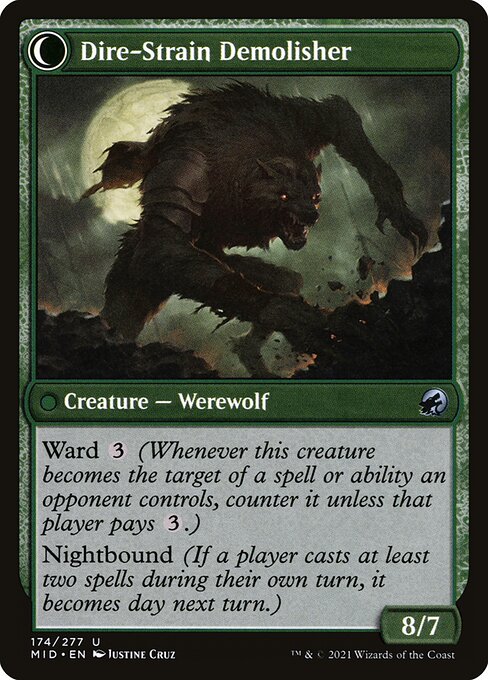
| Burly Breaker // Dire-Strain Demolisher | {3}{G}{G} | Ward {1} / Ward {3} | The only ward cost that changes on its own — daybound/nightbound | $0.15 |
| Octavia, Living Thesis | {8}{U}{U} | Ward {8} | The largest fixed ward cost ever printed | $0.76 |
| Minthara, Merciless Soul | {2}{W}{B} | Ward {X} | X = your experience counters, so it only grows | $0.12 |
| The Serpent Society | {1}{B}{G} | Get five poison counters | Half a lethal poison total to remove one creature | $0.66 |
| Axebane Ferox | {2}{G}{G} | Collect evidence 4 | Unpayable against a graveyard under 4 mana value | $0.17 |
| The Unagi of Kyoshi Island | {3}{U}{U} | Waterbend {4} | {4}, or tap four of their own artifacts and creatures | $1.43 |
| Auntie Ool, Cursewretch | {1}{B}{R}{G} | Blight 2 | Unpayable against an empty board (CR 701.68b) | $0.39 |
| Phyrexian Fleshgorger | {7} | Pay life equal to its power | Scales with pump; uses last-known power if it dies | $1.81 |
| Nine-Fingers Keene | {1}{B}{G}{U} | Pay 9 life | The largest flat life payment on a ward card | $0.28 |
| Titania, Rugged Rumbler | {2}{B/G} | Discard a card or pay {2} | The only modal ward cost in the game | $0.11 |
Burly Breaker is the genuine oddity. As a daybound/nightbound werewolf it has ward {1} during the day and ward {3} at night — the same permanent, two different ward costs, flipping with the day/night cycle without anyone choosing to change it. No other card in Magic has a ward cost that moves on its own, and it means the correct time for your opponent to remove it is during your spell-heavy turn, not theirs.
How to beat ward
Ward is a tax, and taxes have counterplay. Ranked roughly by how reliably they work:
- Do not target it. Board wipes, edicts and “each player sacrifices” effects walk straight past ward. This is the answer, and it is not close.
- Make your spells uncounterable. Ward’s only teeth are the counter clause. Hexing Squelcher and Tyrranax Rex both carry “can’t be countered” text that blanks opposing ward entirely.
- Pay it early. Ward {2} is a real cost on turn four and a rounding error on turn nine. Removing a ward creature is a mana problem that solves itself with time.
- Kill it with combat or damage-based sweepers. A pyroclasm-style effect that damages every creature never targets.
- Counter the ward trigger. Ward is a triggered ability, so Stifle-style effects that counter triggered abilities remove the tax before it resolves. Niche, but it works — and it does not work against hexproof, which has no trigger to counter.
Point five is the practical payoff of the triggered-vs-static distinction. Everything that answers a trigger answers ward. Nothing that answers a trigger touches hexproof or shroud. If you want to see how this plays out across a full 100-card list, our indestructible guide covers the same “what actually kills this” question for the other headline protection keyword.
Ward in The Hobbit
The Hobbit arrives on 14 August 2026 and brings two ward cards, both blue — which is exactly what the colour data above would predict.
| Card | Cost | Type | Ward |
|---|---|---|---|
| Gandalf, Wandering Wizard | {4}{U} | Legendary Creature — Avatar Wizard | Ward {3} |
| Lake-town Mariners // Gone Fishing | {4}{U}{U} // {3}{U} | Creature — Human Citizen // Instant — Adventure | Ward {2} |
Gandalf’s ward {3} puts him in the 21-card tier rather than the 96-card ward {2} default — a meaningful bump on a five-mana legend you intend to keep. Note that neither card is Constructed-legal until release day, so treat both as previews rather than as pickups today.
A $2.50 budget ward package
Twelve ward cards at their cheapest printings, totalling $2.50 — the same twelve cards cost $4.15 if you buy the default printings, so the printing check is worth more than the discount on most of them.
| Card | Cost | Ward | Price |
|---|---|---|---|
| Owlin Shieldmage | {3}{W}{B} | Pay 3 life | $0.07 |
| Titania, Rugged Rumbler | {2}{B/G} | Discard a card or pay {2} | $0.11 |
| Minthara, Merciless Soul | {2}{W}{B} | Ward {X} | $0.12 |
| Winter, Cursed Rider | {U}{B} | Pay 2 life + grants to artifacts | $0.16 |
| Chaplain of Alms // Chapel Shieldgeist | {W} | Ward {1}, grants on the back face | $0.17 |
| Axebane Ferox | {2}{G}{G} | Collect evidence 4 | $0.17 |
| Patchwork Automaton | {2} | Ward {2} | $0.18 |
| Wilson, Refined Grizzly | {1}{G} | Ward {2} | $0.24 |
| Abuelo, Ancestral Echo | {1}{W}{U} | Ward {2} | $0.27 |
| Bronze Guardian | {4}{W} | Ward {2}, grants to artifacts | $0.31 |
| Long River Lurker | {2}{U} | Ward {1}, grants to Frogs | $0.31 |
| Kappa Cannoneer | {5}{U} | Ward {4} | $0.39 |
Budget Ward Package
12 cards — one click loads the full list into a TCGplayer cart so you can check real prices and grab the whole deck at once.
Buy this deck on TCGplayerAffiliate link — buying through it supports KrakenTheMeta at no extra cost to you.The two artifact-granters are the value engines here. Winter, Cursed Rider costs {U}{B} and gives every artifact you control “Ward — Pay 2 life”; Bronze Guardian does the same for {2} in an artifact-heavy list. In a deck with fifteen artifacts, either one turns a whole board into taxed targets for under 35 cents. You can test that shell against a real list in our deck analyzer, or browse what other players have built on the public decks page.
Ward FAQ
Is ward the same as hexproof?
No. Hexproof stops opponents targeting the permanent at all and is a static ability. Ward allows the targeting and then taxes it with a triggered ability. An opponent who wants your ward creature dead can always pay; an opponent facing hexproof cannot target it at any price.
Does ward stop board wipes?
No. Rule 115.10a says being affected by a spell is not the same as being targeted by it. Wraths, edicts and damage-based sweepers never target, so ward never triggers. This is the single biggest hole in ward as a protection plan.
Does ward trigger on my own spells?
No. Rule 702.21a specifies “a spell or ability an opponent controls.” Your own auras, equipment and pump spells target your ward creature for free.
Does ward work against abilities, or only spells?
Both. The rule says “spell or ability,” so an opponent’s targeted activated or triggered ability triggers ward exactly like a removal spell does.
What happens if a creature has ward twice?
Both instances trigger and both must be paid separately. Unlike shroud, flying, deathtouch and six other keywords, ward has no rule stating that multiple instances are redundant — that omission is intentional.
Can I kill the ward creature in response to avoid paying?
No. Per the official Bronze Guardian ruling, once the ward ability has triggered it resolves independently of its source. You still pay or your spell is countered.
What if my spell targets two creatures that both have ward?
Both trigger, and it is all-or-nothing. Per the Sedgemoor Witch ruling, failing to pay for even one of them counters the entire spell.
Does ward stop counterspells?
Only if the counterspell targets your permanent, which it does not — a counterspell targets a spell on the stack. Ward on a creature does nothing while that creature is still a spell being cast.
What is the most common ward cost?
Ward {2}, on 96 of 189 paper cards — more than every other ward cost combined.
What is the biggest ward cost ever printed?
Octavia, Living Thesis has ward {8}, the largest fixed mana cost. Nine-Fingers Keene’s “Pay 9 life” is the largest flat life payment, and Valgavoth, Terror Eater’s “Sacrifice three nonland permanents” is arguably the harshest of all.
Can ward be countered?
Yes. Ward is a triggered ability, so effects that counter triggered abilities will remove it before it resolves. This is a real advantage attackers have against ward that they do not have against hexproof or shroud.
Does ward stop a spell that “can’t be countered”?
No. Ward’s only effect is to counter the spell if the cost is unpaid. Against an uncounterable spell the opponent simply declines to pay and nothing happens.
How many cards have ward?
189 paper cards carry ward, of which 184 have already been released as of 12 August 2026. Two more arrive with The Hobbit on 14 August and three with Star Trek on 13 November. 186 of the 189 are Commander-legal — the three that are not are the Star Trek cards, which are not legal until they release.
Is there a ward cost that cannot be paid?
Yes. Auntie Ool, Cursewretch’s Ward — Blight 2 cannot be paid by an opponent who controls no creatures (rule 701.68b), and Axebane Ferox’s Ward — Collect evidence 4 cannot be paid from a graveyard holding less than four mana value of cards (rule 701.59b). Against those boards, ward is functionally stronger than hexproof.
Build your next deck with AI
KrakenTheMeta’s AI deck builder researches the current meta and writes you a complete, format-legal decklist in about a minute — free to try.
Build a Deck with AIor browse community decks

2 Comments
Comments are closed.