
MTG Madness: All 62 Cards, Rules + Best Discard Outlets
Madness is the keyword that turns a discard into a spell. Discard a card with madness, and instead of hitting your graveyard it detours through exile, where you get one window to cast it for a different, usually cheaper cost. It is one of the most misunderstood mechanics in Magic — partly because it does nothing at all on its own, and partly because the claim everyone repeats about it — that madness makes your spells cheaper — is only true four times out of five.
So we checked. Every madness card printed on paper was pulled from Scryfall, audited against its own oracle text, priced at its cheapest paper printing, and cross-referenced against the Comprehensive Rules effective 7 August 2026. There are 62 of them. The whole mechanic — one copy of every card — costs $33.26. And 12 of the 62 give you no discount whatsoever, including three that cost you more mana through madness than through the mana cost printed in the corner.
What madness actually does
Rule 702.35a is unusually blunt about this: madness is not one ability, it is two. There is a static ability that works while the card sits in your hand, and a triggered ability that fires when the static one applies.
The static half changes what discarding means. Normally, per rule 701.9a, discarding moves a card from your hand to your graveyard. Madness replaces the destination: the card is still discarded, but it goes to exile instead. That distinction matters more than it sounds — see the rulings section below.
The triggered half is the part you care about at the table. When the card is exiled this way, a trigger goes on the stack. When that trigger resolves, its owner may cast the card by paying the madness cost instead of its mana cost. Decline, and the card goes to the graveyard.
Two consequences fall straight out of that structure, and they are the reason madness is good:
- You cast it during the resolution of a trigger, so timing restrictions don’t apply. A sorcery with madness can be cast on your opponent’s end step. A creature with madness can be cast in response to a removal spell.
- The owner casts it, not the discarder. If an opponent points a Mind Rot at you and you pitch a madness card, you get the trigger and you get to cast it. Forced discard becomes a free spell.
Rule 702.35b confirms the madness cost is an alternative cost, handled the same way as any other alternative cost. That means a madness spell is cast normally — it uses the stack, it can be countered, and any additional costs still have to be paid.
Madness does nothing without a discard outlet
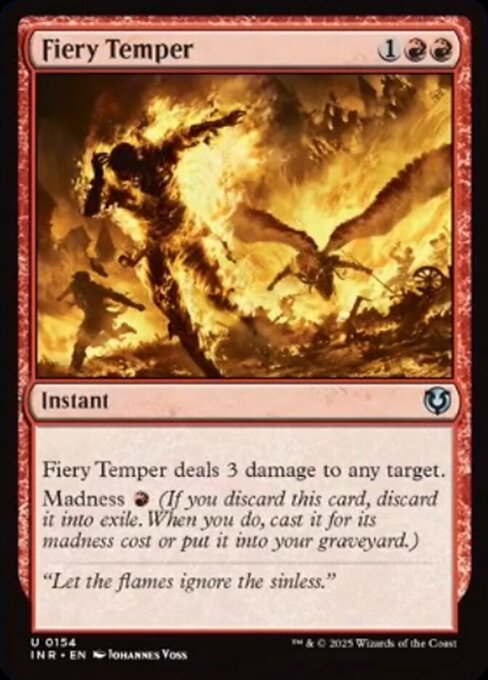
This is the sentence most madness guides bury. A hand full of madness cards with no way to discard them is a hand of overcosted spells. Fiery Temper’s madness cost is a single red mana; its actual mana cost is {1}{R}{R}. If you can’t discard it, you are paying three mana for a Lightning Bolt.
So we counted the outlets. Restricting to paper cards that are legal in at least one format and that are not lands, 200 cards have an activated ability whose cost includes discarding a card. But most of those charge mana on top. The ones that matter for madness are the 48 cards whose entire activation cost is “Discard a card:” — no mana, no tap, nothing else. Of those 48, 20 sit inside a black-red colour identity, which is where the mechanic actually lives.
There is a second, quieter class of outlet that costs you nothing at all: the cleanup step. Rule 514.3a says that if a triggered ability is waiting to go on the stack during cleanup, players get priority. Discarding down to seven at end of turn triggers madness, so you get a priority window and cast the spell — on an empty board, with all your mana untapped. Every madness deck should be counting its excess cards as fuel, not as a problem.
There is a third class of outlet, and it is the newest: connive. Fifty paper cards draw a card and then discard one, and put a +1/+1 counter on the conniving creature if the discard was a nonland card. The discard is a real discard, so a madness card pitched to a connive is cast for its madness cost exactly as if you had pitched it to Anje — and unlike Anje’s ability, the creature that connived gets bigger for it. Ledger Shredder connives off any player’s second spell in a turn, Raffine, Scheming Seer connives one attacker for X where X is your number of attackers, and the keyword lives in blue and black (31 of the 50 have blue in their identity, 28 black, none green), which is why connive and madness’s black-red core have rarely shared a deck. In Dimir or Esper, though, connive is the cheapest repeatable outlet printed since Shadows over Innistrad.
All 62 madness cards in Magic
Every card in Magic that prints the madness keyword, grouped by colour identity, sorted by mana value. The “Saved” column is the difference between the card’s mana value and its madness cost — negative numbers are a discount, positive numbers mean madness costs you more. Prices are the cheapest paper printing at time of writing.
Black (29 cards)
| Card | Mana cost | Madness cost | Saved | Type | Debut set | Price |
|---|---|---|---|---|---|---|
| Call to the Netherworld | {B} | {0} | −1 | Sorcery | Time Spiral | $0.40 |
| Asylum Visitor | {1}{B} | {1}{B} | 0 | Vampire Wizard | Shadows over Innistrad | $0.23 |
| Murderous Compulsion | {1}{B} | {1}{B} | 0 | Sorcery | Shadows over Innistrad | $0.17 |
| Strength of Lunacy | {1}{B} | {B} | −1 | Ench. — Aura | Torment | $0.36 |
| Alms of the Vein | {2}{B} | {B} | −2 | Sorcery | Shadows over Innistrad | $0.36 |
| Big Game Hunter | {1}{B}{B} | {B} | −2 | Human Rebel Assassin | Planar Chaos | $0.38 |
| Ichor Slick | {2}{B} | {3}{B} | +1 | Sorcery | Future Sight | $0.09 |
| Markov Baron | {2}{B} | {2}{B} | 0 | Vampire Noble | March of the Machine: The Aftermath | $0.30 |
| Psychotic Episode | {1}{B}{B} | {1}{B} | −1 | Sorcery | Time Spiral | $0.09 |
| Biting Rain | {2}{B}{B} | {2}{B} | −1 | Sorcery | Shadows over Innistrad | $0.12 |
| Brain Gorgers | {3}{B} | {1}{B} | −2 | Zombie | Planar Chaos | $0.13 |
| Gisa’s Bidding | {2}{B}{B} | {2}{B} | −1 | Sorcery | Shadows over Innistrad | $0.18 |
| Grave Scrabbler | {3}{B} | {1}{B} | −2 | Zombie | Future Sight | $0.11 |
| Hell Mongrel | {3}{B} | {2}{B} | −1 | Nightmare Dog | Modern Horizons 2 | $0.25 |
| Kitchen Imp | {3}{B} | {B} | −3 | Imp | Modern Horizons 2 | $0.20 |
| Nightshade Assassin | {2}{B}{B} | {1}{B} | −2 | Human Assassin | Time Spiral | $0.13 |
| Psychotic Haze | {2}{B}{B} | {1}{B} | −2 | Instant | Torment | $0.21 |
| Weirded Vampire | {3}{B} | {2}{B} | −1 | Vampire Horror | Eldritch Moon | $0.09 |
| From Under the Floorboards | {3}{B}{B} | {X}{B}{B} | −3 | Sorcery | Shadows over Innistrad | $0.31 |
| Gorgon Recluse | {3}{B}{B} | {B}{B} | −3 | Gorgon | Time Spiral | $0.13 |
| Muck Drubb | {3}{B}{B} | {2}{B} | −2 | Beast | Planar Chaos | $0.19 |
| Necrogoyf | {3}{B}{B} | {1}{B}{B} | −2 | Lhurgoyf | Modern Horizons 2 Promos | $0.33 |
| Twins of Maurer Estate | {4}{B} | {2}{B} | −2 | Vampire | Shadows over Innistrad | $0.12 |
| Voldaren Pariah // Abolisher of Bloodlines | — | {B}{B}{B} | −2 | Vampire Horror | Eldritch Moon | $0.44 |
| Curse of Fool’s Wisdom | {4}{B}{B} | {3}{B} | −2 | Ench. — Aura Curse | Commander 2019 | $4.98 |
| Dark Withering | {4}{B}{B} | {B} | −5 | Instant | Time Spiral | $0.14 |
| Gibbering Descent | {4}{B}{B} | {2}{B}{B} | −2 | Enchantment | Future Sight | $2.76 |
| Archfiend of Spite | {5}{B}{B} | {3}{B}{B} | −2 | Demon | Commander 2019 | $0.91 |
| Shadowgrange Archfiend | {6}{B} | {2}{B} + 8 life | −4 | Demon | Crimson Vow Commander | $6.28 |
Red (19 cards)
| Card | Mana cost | Madness cost | Saved | Type | Debut set | Price |
|---|---|---|---|---|---|---|
| Blazing Rootwalla | {R} | {0} | −1 | Lizard | Modern Horizons 2 | $0.23 |
| Avacyn’s Judgment | {1}{R} | {X}{R} | −1 | Sorcery | Shadows over Innistrad | $0.23 |
| Distemper of the Blood | {1}{R} | {R} | −1 | Sorcery | Eldritch Moon | $0.08 |
| Senseless Rage | {1}{R} | {1}{R} | 0 | Ench. — Aura | Shadows over Innistrad | $0.08 |
| Abandon Reason | {2}{R} | {1}{R} | −1 | Instant | Eldritch Moon | $0.11 |
| Anje’s Ravager | {2}{R} | {1}{R} | −1 | Vampire Berserker | Commander 2019 | $0.36 |
| Blast from the Past | {2}{R} | {R} | −2 | Instant | Unhinged | $0.23 |
| Bloodmad Vampire | {2}{R} | {1}{R} | −1 | Vampire Berserker | Shadows over Innistrad | $0.06 |
| Fiery Temper | {1}{R}{R} | {R} | −2 | Instant | Torment | $0.18 |
| Skophos Reaver | {2}{R} | {1}{R} | −1 | Minotaur Warrior | Modern Horizons 2 | $0.20 |
| Stensia Masquerade | {2}{R} | {2}{R} | 0 | Enchantment | Shadows over Innistrad | $0.25 |
| Stromkirk Occultist | {2}{R} | {1}{R} | −1 | Vampire Horror | Eldritch Moon | $0.14 |
| Insatiable Gorgers | {2}{R}{R} | {3}{R} | 0 | Vampire Berserker | Eldritch Moon | $0.18 |
| Malevolent Whispers | {3}{R} | {3}{R} | 0 | Sorcery | Shadows over Innistrad | $0.16 |
| Violent Eruption | {1}{R}{R}{R} | {1}{R}{R} | −1 | Instant | Torment | $0.11 |
| Alchemist’s Greeting | {4}{R} | {1}{R} | −3 | Sorcery | Eldritch Moon | $0.05 |
| Incorrigible Youths | {3}{R}{R} | {2}{R} | −2 | Vampire | Shadows over Innistrad | $0.20 |
| Reckless Wurm | {3}{R}{R} | {2}{R} | −2 | Wurm | Planar Chaos | $0.10 |
| Revolutionist | {5}{R} | {3}{R} | −2 | Human Wizard | Modern Horizons 2 | $0.18 |
Blue, green, white, gold and colourless (14 cards)
| Card | Mana cost | Madness cost | Saved | Type | Debut set | Price |
|---|---|---|---|---|---|---|
| Basking Rootwalla | {G} | {0} | −1 | Lizard | Torment | $0.20 |
| Obsessive Search | {U} | {U} | 0 | Instant | Torment | $0.20 |
| Just the Wind | {1}{U} | {U} | −1 | Instant | Shadows over Innistrad | $0.09 |
| Nagging Thoughts | {1}{U} | {1}{U} | 0 | Sorcery | Shadows over Innistrad | $0.05 |
| Strength of Isolation | {1}{W} | {W} | −1 | Ench. — Aura | Torment | $0.26 |
| Broken Concentration | {1}{U}{U} | {3}{U} | +1 | Instant | Shadows over Innistrad | $0.12 |
| Chilling Grasp | {2}{U} | {3}{U} | +1 | Instant | Eldritch Moon | $0.10 |
| Circular Logic | {2}{U} | {U} | −2 | Instant | Torment | $0.27 |
| Frantic Purification | {2}{W} | {W} | −2 | Instant | Torment | $0.18 |
| Bloodhall Priest | {2}{B}{R} | {1}{B}{R} | −1 | Vampire Cleric | Eldritch Moon | $0.10 |
| Terminal Agony | {2}{B}{R} | {B}{R} | −2 | Sorcery | Modern Horizons 2 | $0.15 |
| Welcome to the Fold | {2}{U}{U} | {X}{U}{U} | −2 | Sorcery | Shadows over Innistrad | $0.16 |
| Arrogant Wurm | {3}{G}{G} | {2}{G} | −2 | Wurm | Torment | $2.24 |
| Emrakul, the World Anew | {12} | Pay six {C} | −6 | Legendary Eldrazi | Modern Horizons 3 | $5.62 |
The colour split is lopsided even by Magic’s standards. Black holds 29 of the 62 and red another 19 — 48 of 62 cards, 77%, live in one two-colour pair. Blue has seven, and green and white have two each. There is exactly one colourless madness card and exactly two gold ones, both black-red.
By card type: 29 creatures, 15 sorceries, 12 instants, 6 enchantments. No artifacts, no lands, no planeswalkers. By rarity: 27 common, 22 uncommon, 12 rare and a single mythic.
We measured every madness cost — and 12 of them aren’t a discount
The universal claim about madness is that it makes spells cheaper. Across all 62 cards the mean saving is 1.45 mana, which is real but smaller than the reputation. More interestingly, the saving is not universal:
| Relationship | Cards | Share |
|---|---|---|
| Madness cost is cheaper than the mana cost | 50 | 80.6% |
| Madness cost is identical to the mana cost | 9 | 14.5% |
| Madness cost is more than the mana cost | 3 | 4.8% |
The nine cards where madness saves nothing — Asylum Visitor, Insatiable Gorgers, Malevolent Whispers, Markov Baron, Murderous Compulsion, Nagging Thoughts, Obsessive Search, Senseless Rage and Stensia Masquerade — are still fine cards. What you are buying there is not a rate, it is a timing conversion: a discarded sorcery becomes an instant, and a dead card in a discard-heavy hand becomes a live one. But you are not saving mana, and nobody says so.
The three that charge you extra are stranger — and the one black card among them turns out not to be a mistake at all:
| Card | Mana cost | Madness cost | Saved | Type | Debut set | Price |
|---|---|---|---|---|---|---|
| Broken Concentration | {1}{U}{U} | {3}{U} | +1 | Instant | Shadows over Innistrad | $0.12 |
| Chilling Grasp | {2}{U} | {3}{U} | +1 | Instant | Eldritch Moon | $0.10 |
| Ichor Slick | {2}{B} | {3}{B} | +1 | Sorcery | Future Sight | $0.09 |
Two of the three are blue, and that is not a coincidence — blue is the only colour where madness is regularly a penalty. Of the seven blue madness cards, two cost more, two cost the same and only three are cheaper. Compare that to black (25 of 29 cheaper, one dearer) and red (15 of 19 cheaper, none dearer). Green, white, the two gold cards and the one colourless card are cheaper without exception.
Ichor Slick is different, and it is the most interesting card on the list. It is the only card in tournament-legal Magic that prints both cycling and madness. Cycling {2} says “{2}, Discard this card: Draw a card” — and that discard is a discard, so it triggers Ichor Slick’s own madness. The card is its own outlet. Pay {2}, draw a card, then pay {3}{B} to give something -3/-3. Six mana total for a removal spell and a cantrip, from a card that needs no other support in the deck at all. The inflated madness cost is the price of that self-sufficiency.
The three cards that cast for free
Three madness cards have a madness cost of {0}:
| Card | Mana cost | Madness cost | Saved | Type | Debut set | Price |
|---|---|---|---|---|---|---|
| Basking Rootwalla | {G} | {0} | −1 | Lizard | Torment | $0.20 |
| Blazing Rootwalla | {R} | {0} | −1 | Lizard | Modern Horizons 2 | $0.23 |
| Call to the Netherworld | {B} | {0} | −1 | Sorcery | Time Spiral | $0.40 |
These are the engine pieces. Basking Rootwalla and Blazing Rootwalla are one-mana creatures that cost nothing when discarded, which makes them free bodies for every sacrifice and graveyard deck ever built — this is why Basking Rootwalla shows up in Legacy lists that have no interest in madness as a theme. Call to the Netherworld returns a black creature card from your graveyard to your hand for zero mana, repeatedly, as long as you can keep discarding it.
Note that “free” still means cast. You put the spell on the stack and it can be countered. It is not a free permanent, it is a free casting.
And three cards that get better, not cheaper
Avacyn’s Judgment, From Under the Floorboards and Welcome to the Fold all have {X} in their madness cost, and all three explicitly do something bigger when the madness cost was paid. Avacyn’s Judgment deals 2 damage hard-cast and X damage through madness. From Under the Floorboards makes three Zombies hard-cast and X Zombies through madness. For this trio, madness isn’t a discount — it’s a different, scaling card.
Where madness came from, and the nine-year hole
Madness debuted in Torment on 4 February 2002 with ten cards, as the mechanical expression of that block’s black-matters theme. It came back for the Time Spiral block in 2006–07 — five cards in Time Spiral, four in Planar Chaos, three in Future Sight — and then stopped dead.
| Set | Released | New madness cards |
|---|---|---|
| Torment | 4 Feb 2002 | 10 |
| Unhinged | 19 Nov 2004 | 1 |
| Time Spiral | 6 Oct 2006 | 5 |
| Planar Chaos | 2 Feb 2007 | 4 |
| Future Sight | 4 May 2007 | 3 |
| Shadows over Innistrad | 8 Apr 2016 | 17 |
| Eldritch Moon | 22 Jul 2016 | 9 |
| Commander 2019 | 23 Aug 2019 | 3 |
| Modern Horizons 2 | 18 Jun 2021 | 7 |
| Crimson Vow Commander | 19 Nov 2021 | 1 |
| March of the Machine: The Aftermath | 12 May 2023 | 1 |
| Modern Horizons 3 | 14 Jun 2024 | 1 |
Between Future Sight on 4 May 2007 and Shadows over Innistrad on 8 April 2016, Magic printed zero new madness cards for eight years and eleven months. Then Innistrad’s second visit brought it back at full volume: Shadows over Innistrad and Eldritch Moon together added 26 cards — 42% of the entire mechanic — inside fifteen weeks.
Since then it has been a trickle: three in Commander 2019, seven across Modern Horizons 2 (one of them, Necrogoyf, technically debuting six weeks early as a promo on 6 May 2021), one in Crimson Vow Commander, one in March of the Machine: The Aftermath, and one in Modern Horizons 3. Nothing new since 14 June 2024 — a gap of over two years as of today.
That curve makes madness the mirror image of lifelink, whose three biggest years are its three most recent, and a close cousin of regenerate, which also went quiet for the better part of a decade. Unlike infect, though, madness is not finished — it has come back from a longer silence than the one it’s in now.
What madness is legal in
| Format | Legal madness cards | Banned |
|---|---|---|
| Standard | 0 | 0 |
| Pioneer | 28 | 0 |
| Modern | 48 | 0 |
| Pauper | 31 | 0 |
| Legacy | 61 | 0 |
| Vintage | 61 | 0 |
| Commander | 61 | 0 |
Three things worth noting there.
Zero madness cards are Standard-legal, purely by the calendar — the most recent one is from Modern Horizons 3, a set that has never been Standard-legal, and the most recent madness card that was ever Standard-legal is Markov Baron, from March of the Machine: The Aftermath in May 2023, which rotated out long ago.
Not one madness card is banned in any format. That includes Legacy and Vintage, where the free Rootwallas have been legal for over twenty years.
The 62nd card is legal nowhere. Blast from the Past, from Unhinged in 2004, is a silver-bordered joke card that prints madness {R}, cycling {1}{R}, kicker {2}{R}, flashback {3}{R} and buyback {4}{R} on a single line. It genuinely has the keyword and it is genuinely a paper card, so it belongs in the count — but it is not legal in any sanctioned format, which is why the other rows read 61 rather than 62.
The 20 free discard outlets in black-red
These are the cards whose entire activation cost is “Discard a card:” — no mana attached — inside a black-red colour identity and legal in Commander. If you are building around madness, this is your enabler list.
| Enabler | Mana cost | Type | Price |
|---|---|---|---|
| Ravenous Bloodseeker | {1}{R} | Vampire Berserker | $0.06 |
| Trespasser il-Vec | {2}{B} | Human Rogue | $0.06 |
| Olivia’s Dragoon | {1}{B} | Vampire Berserker | $0.08 |
| Patchwork Gnomes | {3} | Artifact Gnome | $0.12 |
| Inner Demons Gangsters | {3}{B} | Human Rogue Villain | $0.14 |
| Earsplitting Rats | {3}{B} | Rat | $0.21 |
| Grotesque Hybrid | {4}{B} | Zombie | $0.21 |
| Thunderhead Gunner | {4}{R} | Shark Pirate | $0.22 |
| Cabal Initiate | {1}{B} | Human Warlock | $0.23 |
| Hell Mongrel | {3}{B} | Nightmare Dog | $0.25 |
| Stromkirk Condemned | {B}{B} | Vampire Horror | $0.26 |
| Iron-Shield Elf | {1}{B} | Elf Warrior | $0.27 |
| Skirge Familiar | {4}{B} | Phyrexian Imp | $0.27 |
| Songbird, Sonic Screamer | {1}{B} | Legendary Human Villain | $0.28 |
| Volrath’s Dungeon | {2}{B}{B} | Enchantment | $0.30 |
| Oona’s Prowler | {1}{B} | Faerie Rogue | $0.32 |
| Chainer, Nightmare Adept | {2}{B}{R} | Legendary Human Minion | $0.73 |
| Land’s Edge | {1}{R}{R} | World Enchantment | $0.97 |
| Putrid Imp | {B} | Zombie Imp | $1.73 |
| Witch-king of Angmar | {3}{B}{B} | Legendary Wraith Noble | $8.16 |
Read them carefully, because what the discard actually buys varies a lot. Ravenous Bloodseeker gets +2/-2 — it grows, but it shrinks its own toughness too, so there is a hard limit on how many cards you can dump through it in one turn. Olivia’s Dragoon and Putrid Imp both just gain flying, which means the ability is effectively pure text: you pay nothing and get nothing, which is exactly what you want from an outlet. Putrid Imp costs a single black mana and has been the default free outlet since Torment. Chainer, Nightmare Adept is the outlier — discarding a card also lets you cast a creature spell out of your graveyard that turn, so it is the only one here that turns the discard into card advantage rather than merely enabling it. That is why it costs nearly three times the median price on this list.
Note that Hell Mongrel appears on both this list and the madness list — it is one of the very few cards that is both a madness card and a free discard outlet in its own right.
Anje Falkenrath, and the only legendary creature with madness
There is exactly one legendary creature in Magic that has madness, and it costs twelve mana: Emrakul, the World Anew, from Modern Horizons 3. Its madness cost is “Pay six {C}” — a six-mana discount, the largest in the mechanic by a distance, on a card that gains control of all creatures a player controls when you cast it. It is a colourless card, so it slots into any deck that can produce colourless mana and discard it.
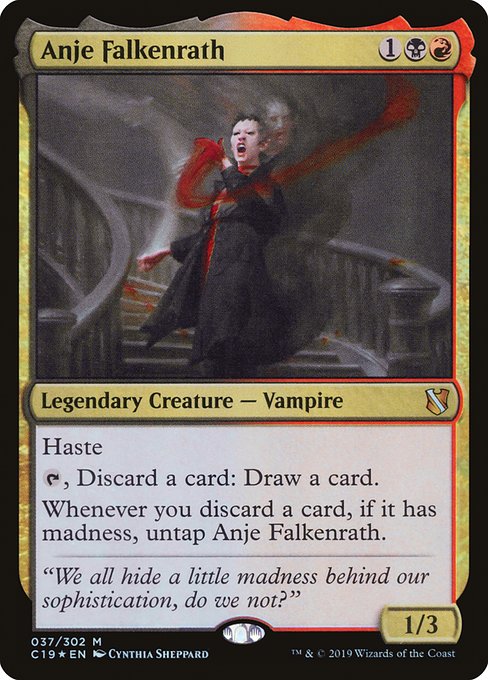
But Emrakul is not the commander you build around, because Anje Falkenrath does not have madness — she cares about it. Her text is three lines: haste; “{T}, Discard a card: Draw a card”; and “Whenever you discard a card, if it has madness, untap Anje Falkenrath.”
Read those two abilities together and the loop is obvious. Tap Anje, discard a madness card, draw. The discard triggers madness (you may cast the card) and untaps Anje. Repeat. With enough madness density she is a free, repeatable looting engine that also deploys the cards it loots away.
This is the trap that catches most first-time madness builders, and it is worth naming explicitly. Anje untaps only when the discarded card has madness. Filling her deck with generically good black-red cards and a handful of madness spells produces a commander who taps once per turn. Of the 62 madness cards, 50 fit inside a black-red colour identity and are Commander-legal — that pool is deep enough to build the density she needs, and she is the only legendary creature in Magic whose text names the keyword.
Across the whole card pool, only two other cards mention madness without having it. Falkenrath Gorger gives every Vampire card you own that isn’t on the battlefield madness, at a madness cost equal to its mana cost — so it buys you the timing and the free cast, never a discount. And Bloodboil Sorcerer is a false positive: its “Crown of Madness” ability has nothing to do with the keyword, it just happens to contain the word.
Eleven of the 62 madness cards are Vampires, which is why madness and vampire tribal decks keep colliding, and why Falkenrath Gorger — which turns your whole Vampire subtheme into madness cards — is a genuine build-around rather than a curiosity.
A budget Anje Falkenrath madness deck
Here is a complete 100-card Commander deck built to one stated rule, so you can reproduce it: Anje Falkenrath as commander, plus every black-red-identity, Commander-legal madness card whose madness cost is a genuine discount (42 cards), plus all 20 free black-red discard outlets, plus three colourless ramp staples, plus basic lands to 100. No hand-picking, no pet cards.
Budget Anje Falkenrath Madness
100 cards — one click loads the full list into a TCGplayer cart so you can check real prices and grab the whole deck at once.
Buy this deck on TCGplayerAffiliate link — buying through it supports KrakenTheMeta at no extra cost to you.The list runs 64 nonland cards and 35 basics — 24 Swamp, 11 Mountain, split by the deck’s coloured pips. It totals $47.01 at cheapest paper printings, and a single card, Witch-king of Angmar at $8.16, is 17% of that; cut it if you want the list under $40. The raw average mana value is 3.80, which looks far too high for 35 lands — but if every madness spell is cast for its madness cost instead, the effective average falls to 2.55. Across the 42 madness cards the deck saves 80 mana in total. That gap is the entire thesis of the deck, and it is why the land count works.
The deck is deliberately unsubtle: it is a density experiment. Every nonland card either discards something or wants to be discarded, which is what makes Anje untap. If you’d rather start from a list someone has already tuned, the public deck gallery is full of black-red builds you can copy and edit, and our AI deck builder will take “budget Anje Falkenrath madness” as a prompt and produce a full 100 with a current-meta pass over it.
What madness costs to collect
Almost nothing. One copy of every madness card ever printed, taking the cheapest paper printing of each, comes to $33.26.
| Measure | Value |
|---|---|
| All 62 cards, cheapest printings | $33.26 |
| Median card price | $0.18 |
| Cards under $1 | 57 of 62 (91.9%) |
| Most expensive | Shadowgrange Archfiend, $6.28 |
| Cards above $2 | 5 |
Only five cards clear $2: Shadowgrange Archfiend ($6.28), Emrakul, the World Anew ($5.62), Curse of Fool’s Wisdom ($4.98), Gibbering Descent ($2.76) and Arrogant Wurm ($2.24). Everything else is bulk. Arrogant Wurm is the odd one — a Torment uncommon whose original printing now runs $6.89, cheaper only because it was reprinted onto The List.
If you want to check current numbers before you buy — prices on old uncommons move more than people expect — our card price tool pulls live figures.
Eight madness rulings that decide games
1. A madness card is still discarded. Rule 702.35a replaces the destination, not the event. Every “whenever you discard a card” trigger — Anje’s untap, Bone Miser’s Zombie — sees it. This is the single most important interaction in the mechanic.
2. But graveyard-recursion payoffs miss it entirely. Containment Construct triggers on the discard and then says “exile that card from your graveyard.” A madness card is not in your graveyard — it is in exile. The trigger fires and finds nothing. Any discard payoff that reaches into the graveyard for the card you just pitched does nothing against your own madness cards, and this is the interaction most likely to cost you a game you thought you had won.
3. You cast it, so it can be countered. Madness spells go on the stack like any other. A free Basking Rootwalla is a free cast, not a free permanent.
4. If the madness trigger is countered, the card is stuck in exile. The instruction that moves an uncast madness card to the graveyard lives inside the trigger. Counter the trigger and that instruction never happens — the card stays exiled permanently.
5. Forced discard still benefits you. The trigger says the card’s owner may cast it. Opponent-controlled discard hands you the spell.
6. Sorcery-speed restrictions do not apply. Because you cast during a trigger’s resolution, a madness sorcery can be cast on an opponent’s turn. This also means madness ignores the timing rules that would otherwise apply to the card type — the same reason a cascaded spell can hit the stack outside its normal window.
7. Cleanup-step discards work. Rule 514.3a gives players priority during cleanup when a trigger is waiting. Discarding to hand size at end of turn is a free outlet you already own.
8. You pay when the trigger resolves, or not at all. There is no holding the card in exile for later. Decline once, and rule 702.35a puts the card into your graveyard — where, helpfully, rules 702.35c and 400.7k confirm that effects referencing the discarded card can still find it. If you are building around reanimation, declining madness is often correct.
All of the above is about the stack and priority, which is the part of Magic that most madness disputes actually turn on. If any of it felt shaky, our guide to flash, priority and the stack covers the underlying machinery in detail.
Frequently asked questions
How does madness work in MTG?
When you discard a card with madness, it goes to exile instead of your graveyard, and a trigger goes on the stack. When that trigger resolves you may cast the card for its madness cost instead of its mana cost. If you don’t, it goes to your graveyard.
How many madness cards are there in Magic?
62 on paper. 61 of them are legal in at least one sanctioned format; the 62nd, Blast from the Past, is a silver-bordered Unhinged card.
Is madness always cheaper than the card’s mana cost?
No. 50 of the 62 are cheaper, 9 cost exactly the same, and 3 — Broken Concentration, Chilling Grasp and Ichor Slick — cost one mana more through madness. The average saving across all 62 is 1.45 mana.
Do I need a discard outlet to use madness?
Yes, unless you’re relying on discarding to hand size at end of turn or on an opponent making you discard. Without an outlet, madness cards are just cards with their printed mana cost.
Does discarding a madness card trigger “whenever you discard” abilities?
Yes. Rule 702.35a changes where the card goes, not whether it was discarded. This is why Anje Falkenrath untaps.
Can a madness spell be countered?
Yes. Casting through madness is still casting — the spell uses the stack normally.
What happens if the madness trigger itself is countered?
The card stays in exile. The instruction to move it to the graveyard is part of the trigger, so if the trigger never resolves the card never leaves.
Can I cast a madness sorcery on my opponent’s turn?
Yes. You cast it during the resolution of a triggered ability, which bypasses the normal timing restrictions on sorceries.
If my opponent makes me discard a madness card, who gets to cast it?
You do. The trigger specifies the card’s owner.
Which madness cards are free?
Three have a madness cost of {0}: Basking Rootwalla, Blazing Rootwalla and Call to the Netherworld.
Is madness legal in Standard?
No. Zero madness cards are currently Standard-legal. 28 are Pioneer-legal, 48 are Modern-legal, and 61 are legal in Legacy, Vintage and Commander.
Are any madness cards banned?
None, in any format.
What’s the best commander for a madness deck?
Anje Falkenrath. She’s a free repeatable looter who untaps every time you discard a card with madness, and 50 of the 62 madness cards fit her black-red colour identity.
Is there a legendary creature with madness?
One: Emrakul, the World Anew, from Modern Horizons 3. Its mana cost is {12} and its madness cost is six colourless — the biggest discount in the mechanic.
What does a full set of madness cards cost?
$33.26 for one copy of all 62 at their cheapest paper printings. The median card is $0.18, and 57 of 62 are under a dollar.
If you want to test how well you actually know black-red legends after all that, Guess That Commander is unkind about it.
Build your next deck with AI
KrakenTheMeta’s AI deck builder researches the current meta and writes you a complete, format-legal decklist in about a minute — free to try.
Build a Deck with AIor browse community decks
4 Comments
Comments are closed.