MTG Stax Explained: How Resource Denial Works, Which Pieces Cost You a Bracket, and How to Build It (2026)
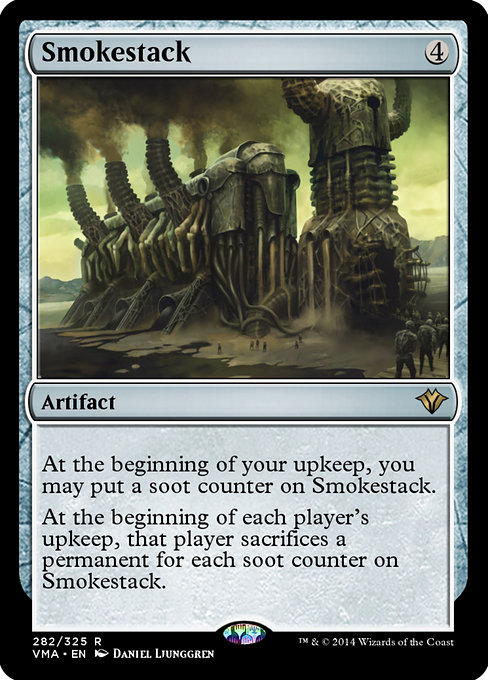
Stax is the Magic: The Gathering archetype built on resource denial — cards that stop opponents untapping, tax every spell they cast, and shrink what they are allowed to do until you are the only player still functionally playing the game. It is named after Smokestack, the Urza’s Saga artifact that forces every player to sacrifice permanents on their own upkeep.
That much you can get from any of the results currently ranking for this term. The problem is that the top of Google for “mtg stax” is a Reddit thread from 2015, a forum primer from January 2013, and a one-sentence wiki definition — and Commander has changed more since 2025 than it did in the decade before it. The single most important thing about building a stax deck in 2026 is not on any of those pages, because it did not exist when they were written.
This guide covers what stax actually is, the five families of stax pieces, and the part that matters now: which stax cards sit on Wizards’ official Game Changers list, what that does to your deck’s bracket, and the genuinely counterintuitive answer to “how oppressive am I allowed to be?”
Every card below was verified against the Scryfall API on 6 August 2026 — oracle text, mana cost, Commander legality, Game Changer status, and market price. Bracket definitions are quoted from Wizards’ own Commander Brackets documentation.
What stax actually means (and what page one gets wrong)
Stax is not a color, a card type, or a single combo. It is a posture: you deliberately lower the ceiling on what everyone at the table can do, then win inside the narrow band that remains. The critical half — the half most explanations skip — is that a stax piece is only good if you can break the symmetry. Winter Orb stops everyone untapping, including you. If you have no answer to your own lock, you have not built a stax deck; you have built a slow draw.
| Myth | What’s actually true |
|---|---|
| “Stax means land destruction.” | Land denial is one family of five. Most modern stax decks play zero mass land destruction — and as of the bracket system, they largely can’t below Bracket 4. |
| “Stax is the same as cEDH.” | Unrelated axes. Stax is a strategy; cEDH is a power level. Plenty of stax decks are casual, and plenty of cEDH decks play no stax at all. |
| “Stax pieces are symmetrical, so they’re fair.” | Symmetry is the cost, not the point. A stax deck is built specifically to ignore the symmetry it imposes — that’s the deckbuilding challenge. |
| “If a card isn’t on the Game Changers list, it’s fine for casual tables.” | Flatly false, and it’s the most expensive mistake in this article. See the bracket section below — mass land denial is barred from Brackets 1–3 by a separate rule, and almost none of it is on the Game Changers list. |
| “Stax is just ‘making people not have fun.'” | A fair criticism of stax played badly — i.e. without a win condition. Locking a table into a 40-minute draw is a deckbuilding failure, not a strategy. Covered at the end. |
The 2026 change: stax is now a bracket question
Commander’s bracket system is the framework Wizards introduced to replace the old, unwinnable “what’s your power level, 1 to 10?” conversation. It sorts decks into five tiers, and it is the context every stax conversation now happens inside. Here are the official constraints that matter for this archetype:
| Bracket | Game Changers allowed | Mass land denial | Two-card infinite combos |
|---|---|---|---|
| 1 — Exhibition | None | No | No intentional two-card infinite combos |
| 2 — Core | None | No | No intentional two-card infinite combos |
| 3 — Upgraded | Up to three | No | No intentional early-game two-card infinite combos |
| 4 — Optimized | Unlimited | Allowed | No restrictions beyond the banned list |
| 5 — cEDH | Unlimited | Allowed | No restrictions beyond the banned list |
The Game Changers list is a curated set of high-impact cards maintained by the Commander Format Panel. As of the 9 February 2026 update it contains exactly 53 cards — that update added Farewell and moved Biorhythm off the banned list and onto Game Changers. Every card on the list is fully legal in Commander; the list governs bracket placement, not legality.
The bracket paradox: the Game Changers list is not a stax list
Here is the finding that should change how you build. Of the 84 stax and stax-adjacent cards checked for this article, only 17 are Game Changers. The classic hard-lock pieces — the ones that actually stop a table dead — are almost all absent from the list:
Not Game Changers: Winter Orb, Static Orb, Stasis, Smokestack, Trinisphere, Tangle Wire, Blood Moon, Back to Basics, Contamination, Rule of Law, Thalia, Sphere of Resistance, Thorn of Amethyst, Grand Abolisher, Linvala, Sanctum Prelate, Ethersworn Canonist, Void Winnower.
Count that honestly and the consequence is strange: a deck that assembles Winter Orb + Static Orb + Stasis + Smokestack + Trinisphere has zero Game Changers and, on that axis alone, reads as a Bracket 2 “Core” deck. Meanwhile a genuinely durdly casual deck running Rhystic Study and Smothering Tithe has already spent two of the three Game Changer slots that Bracket 3 allows.
Two things follow, and both are worth stating plainly:
- The Game Changers list is not a proxy for “how miserable is this to play against.” It is a list of cards that warp games in specific ways — tutoring, resource explosion, lockout-by-a-single-card. Grinding soft locks aren’t on it.
- Bracket 1–3 legality still bars the worst of stax through a different door. Mass land denial is prohibited in Brackets 1, 2 and 3 outright — no Game Changer status required. So “it’s not a Game Changer” is never the same claim as “it’s fine here.” Armageddon is not a Game Changer. It is also not a Bracket 3 card.
The practical read: use the Game Changers list to count your bracket, and use judgement plus the mass-land-denial rule for everything else. If you are deliberately playing a grinding lock at a Bracket 2 table, the rules may technically be on your side, and you will still be having a conversation about it afterwards. Say what you’re doing before you shuffle.
The 17 stax-relevant Game Changers
These are the cards from this archetype that consume a bracket slot. Prices are Scryfall market as of 6 August 2026.
| Card | Cost | What it does | Price |
|---|---|---|---|
| Braids, Cabal Minion | {2}{B}{B} | Each player sacrifices an artifact, creature or land on their own upkeep. The archetypal stax engine on a body. | $0.94 |
| Drannith Magistrate | {1}{W} | Opponents can’t cast spells from anywhere but their hands — shuts off commanders, flashback, escape, foretell. | $14.46 |
| Opposition Agent | {2}{B} | Flash. You control opponents while they search; they exile what they find and you may play it. Punishes fetchlands and tutors alike. | $18.08 |
| Grand Arbiter Augustin IV | {2}{W}{U} | Your white and blue spells cost {1} less; opponents’ spells cost {1} more. A two-sided tax. | $18.58 |
| Narset, Parter of Veils | {1}{U}{U} | Each opponent can’t draw more than one card each turn. | $1.60 |
| Notion Thief | {2}{U}{B} | Flash. Opponents’ extra draws are skipped and you draw instead. | $1.42 |
| Tergrid, God of Fright | {3}{B}{B} | Whenever an opponent sacrifices or discards a permanent, you may put it onto the battlefield under your control. The payoff half of a sacrifice lock. | $21.26 |
| Humility | {2}{W}{W} | All creatures lose all abilities and are 1/1. Turns off every creature-based engine at the table simultaneously. | $69.02 |
| The Tabernacle at Pendrell Vale | Land | All creatures have “at the beginning of your upkeep, destroy this creature unless you pay {1}.” The single most punishing stax land ever printed. | $2,899.99 |
| Glacial Chasm | Land | Prevents all damage that would be dealt to you. Cumulative upkeep of 2 life and it eats a land on entry. | $19.52 |
| Seedborn Muse | {3}{G}{G} | Untaps all your permanents during every other player’s untap step — the definitive way to break a Winter Orb. | $17.41 |
| Ancient Tomb | Land | Two colorless for two life. Powers out turn-two lock pieces. | $134.69 |
| Mishra’s Workshop | Land | Three mana for artifact spells only. The reason artifact stax exists in Vintage. | $3,000.97 |
| Teferi’s Protection | {2}{W} | Phases out everything you control and freezes your life total — lets you fire a symmetrical wipe and keep your board. | $50.21 |
| Aura Shards | {1}{G}{W} | Every creature you play destroys an artifact or enchantment. The best answer to opposing stax in the game. | $28.33 |
| Rhystic Study | {2}{U} | A soft tax that draws you cards when opponents refuse to pay. Counts as a Game Changer despite being in thousands of casual decks. | $69.23 |
| Smothering Tithe | {3}{W} | Taxes every opponent draw for {2} or hands you a Treasure. Same note as Rhystic Study. | $62.93 |
Worth noticing: the cheapest card in that table is Braids, Cabal Minion at 94 cents, and the most expensive is Mishra’s Workshop at roughly three thousand dollars. Bracket cost and dollar cost are completely unrelated. Braids is also a card that spent most of Commander’s history on the banned list — it is legal now, and it is a Game Changer, which is precisely the sort of thing a 2013 primer cannot tell you.
The five families of stax
1. Taxers — make everything cost more
The gentlest family and the most bracket-friendly: nothing here is a Game Changer except Grand Arbiter. Taxers don’t stop anything outright, they just make every turn slightly worse for a table of three opponents while you build your deck around the cost.
| Card | Cost | Effect | Price |
|---|---|---|---|
| Thalia, Guardian of Thraben | {1}{W} | First strike. Noncreature spells cost {1} more. | $0.41 |
| Thorn of Amethyst | {2} | Noncreature spells cost {1} more. Colorless, so any deck can run it. | $1.24 |
| Sphere of Resistance | {2} | All spells cost {1} more — including yours. Harsher and fully symmetrical. | — |
| Trinisphere | {3} | While untapped, every spell that would cost less than three mana costs three. Devastating against cheap interaction. | $35.75 |
| Lodestone Golem | {4} | Nonartifact spells cost {1} more — one-sided in an artifact deck. | $0.32 |
| Archon of Emeria | {2}{W} | Flying. One spell per player per turn, and opponents’ nonbasics enter tapped. Two stax effects on one body. | $1.92 |
| Thalia, Heretic Cathar | {2}{W} | Opponents’ creatures and nonbasic lands enter tapped. | $2.38 |
| Vryn Wingmare | {2}{W} | Flying. Noncreature spells cost {1} more — a Thalia on a flier. | $0.23 |
| Gaddock Teeg | {G}{W} | Noncreature spells with mana value 4+ can’t be cast, nor can any with {X}. Shuts off most board wipes cold. | $2.05 |
| Sanctum Prelate | {1}{W}{W} | Name a number; noncreature spells of that mana value can’t be cast at all. Naming 1 or 2 blanks most removal. | $1.50 |
| Ward of Bones | {6} | Opponents with more creatures, artifacts, enchantments or lands than you can’t add more. Asymmetric by design. | $28.13 |
| Damping Sphere | {2} | Lands that tap for 2+ produce {C} instead, and each extra spell per turn costs {1} more. Hoses ramp and storm at once. | $0.74 |
Sphere of Resistance’s default printing has no listed market price; check current listings before buying.
2. Untap locks and resource denial
The historic core of the archetype, and the family that most needs a parity-breaker. If you play Winter Orb without a plan to untap, you have handed everyone at the table the same problem and given yourself no advantage.
| Card | Cost | Effect | Price |
|---|---|---|---|
| Winter Orb | {2} | While untapped, players can’t untap more than one land during their untap steps. | $16.98 |
| Static Orb | {3} | While untapped, players can’t untap more than two permanents — broader than Winter Orb. | $14.97 |
| Stasis | {1}{U} | Players skip their untap steps entirely. You sacrifice it each upkeep unless you pay {U}, so it needs a mana engine. | $9.50 |
| Rising Waters | {3}{U} | Lands don’t untap; each player untaps one on their upkeep. | $2.05 |
| Hokori, Dust Drinker | {2}{W}{W} | Identical text to Rising Waters, on a legendary body. | $1.61 |
| Tangle Wire | {3} | Fading 4. Each player taps permanents equal to the fade counters remaining — a four-turn clock that buys the game. | $35.83 |
| Root Maze | {G} | Artifacts and lands enter tapped. One mana, quietly brutal against ramp. | $4.72 |
| Blood Moon | {2}{R} | Nonbasic lands are Mountains. In Commander, where mana bases are almost entirely nonbasic, this is close to a lock. | $8.34 |
| Magus of the Moon | {2}{R} | The same effect on a 2/2 — easier to remove, but also tutorable with creature tutors. | $4.10 |
| Back to Basics | {2}{U} | Nonbasic lands don’t untap. The blue equivalent, and arguably harsher. | $6.59 |
| Contamination | {2}{B} | All lands produce {B} only. Requires sacrificing a creature every upkeep, so it wants tokens. | $17.42 |
| Smokestack | {4} | The card the archetype is named for. Soot counters accumulate; every player sacrifices that many permanents each upkeep. | $1.10 |
3. Hate pieces — switch off one mechanic entirely
Narrow, cheap, and the most bracket-friendly way to play disruption. A hate piece does nothing at all against a table that isn’t doing the thing — which is exactly why they read as fair.
| Card | Cost | Shuts off | Price |
|---|---|---|---|
| Null Rod | {2} | Activated abilities of artifacts. Hits mana rocks, Sol Ring, equipment, the lot. | $113.84 |
| Stony Silence | {1}{W} | Word-for-word identical to Null Rod, in white. | $2.04 |
| Collector Ouphe | {1}{G} | Same text again, on a green 2/2. | $3.63 |
| Cursed Totem | {2} | Activated abilities of creatures. Blanks most infinite creature combos. | $1.04 |
| Linvala, Keeper of Silence | {2}{W}{W} | Opponents’ creature abilities only — one-sided, which is why she costs four. | $21.11 |
| Torpor Orb | {2} | Creatures entering don’t trigger abilities. Kills an entire deckbuilding strategy. | $4.97 |
| Hushbringer | {1}{W} | Creatures entering or dying don’t trigger — broader than Torpor Orb, on a 2/1 flying lifelink for less money. | $0.70 |
| Elesh Norn, Mother of Machines | {4}{W} | Your enter-the-battlefield triggers happen twice; opponents’ don’t happen at all. | $25.19 |
| Aven Mindcensor | {2}{W} | Flash, flying. Opponents searching a library see only the top four cards. | $1.33 |
| Grand Abolisher | {W}{W} | On your turn, opponents can’t cast spells or activate abilities. Protects your whole combo turn. | $19.96 |
| Ethersworn Canonist | {1}{W} | One nonartifact spell per player per turn. The classic storm answer. | $5.79 |
| Rule of Law | {2}{W} | One spell per player per turn, full stop. | $0.44 |
| Arcane Laboratory | {2}{U} | Identical to Rule of Law, in blue. | $0.77 |
| Deafening Silence | {W} | One noncreature spell per turn, for a single mana — the creature-deck version. | $2.10 |
| Chalice of the Void | {X}{X} | Counters every spell of the chosen mana value. Set to 1 it erases a huge slice of Commander. | $15.89 |
| Void Winnower | {9} | Opponents can’t cast even-costed spells or block with even-costed creatures. | $17.83 |
| Sen Triplets | {2}{W}{U}{B} | Each upkeep, lock one opponent out of casting entirely and play from their hand. | $10.20 |
| Karn, the Great Creator | {4} | Opponents’ artifact abilities can’t be activated, plus a wishboard. | $4.94 |
| Kataki, War’s Wage | {1}{W} | All artifacts need {1} paid each upkeep or they’re sacrificed. | $1.61 |
| Lavinia, Azorius Renegade | {W}{U} | Opponents can’t cast noncreature spells above their land count, and free spells get countered. | $0.53 |
4. Pillowfort — tax attacking you specifically
The most socially acceptable stax family, because it is purely defensive: it doesn’t stop anyone playing Magic, it just makes you an inconvenient target. Nothing in this table is a Game Changer.
| Card | Cost | Effect | Price |
|---|---|---|---|
| Ghostly Prison | {2}{W} | Creatures can’t attack you unless their controller pays {2} each. | $5.97 |
| Propaganda | {2}{U} | Word-for-word identical to Ghostly Prison, in blue — and less than half the price. | $2.38 |
| Windborn Muse | {3}{W} | The same effect stapled to a 2/3 flier. | $0.63 |
| Baird, Steward of Argive | {2}{W}{W} | Same idea at {1} per creature, and it protects your planeswalkers too. | $0.26 |
| Norn’s Annex | {3}{W/P}{W/P} | Attackers pay {W} or 2 life each. Castable for two life in any deck thanks to Phyrexian mana. | $5.64 |
| Sphere of Safety | {4}{W} | Attackers pay {X} where X is your enchantment count. In an enchantment deck this is simply “no.” | $4.85 |
| Crawlspace | {3} | No more than two creatures can attack you each combat. Colorless, so it fits anywhere. | $9.93 |
| Silent Arbiter | {4} | One attacker and one blocker per combat, table-wide. | $12.00 |
| Dueling Grounds | {1}{G}{W} | Identical text to Silent Arbiter, as an enchantment — harder to remove in most metas. | $7.74 |
| Orbs of Warding | {5} | You gain hexproof and prevent 1 damage from each creature. | $0.59 |
| Glacial Chasm | Land | Prevents all damage to you outright. Costs a land on entry and 2 life per turn, escalating. Game Changer. | $19.52 |
Pillowfort has a natural payoff: the monarch. The crown draws a card at your end step and moves only when a creature deals combat damage to you, so Ghostly Prison, Propaganda and Crawlspace are not just protection — they are what keeps a Phyrexian Arena that nobody can destroy pointed at you. Our monarch guide has all 63 monarch cards, the fourteen fort pieces checked against their oracle text, and the cards that take the crown back.
5. Sacrifice engines and mass land denial ⚠ Bracket 4+
Read the bracket note before playing anything in this table. Mass land denial is explicitly prohibited in Brackets 1, 2 and 3. None of these cards is a Game Changer, and that does not make them casual-legal — this is exactly the trap described earlier.
| Card | Cost | Effect | Price |
|---|---|---|---|
| Armageddon | {3}{W} | Destroy all lands. The defining mass land denial card. Bracket 4+ only. | $14.52 |
| Ravages of War | {3}{W} | Identical to Armageddon. Bracket 4+ only. | $23.76 |
| Catastrophe | {4}{W}{W} | Destroy all lands or all creatures — flexible, which makes it playable as a wipe. Bracket 4+ if used on lands. | $3.47 |
| Pox | {B}{B}{B} | Every player loses a third of their life, hand, creatures and lands. Bracket 4+ only. | $2.55 |
| Braids, Cabal Minion | {2}{B}{B} | A sacrifice every upkeep, chosen by its controller — grinding rather than explosive. Game Changer. | $0.94 |
| Smokestack | {4} | The scalable version: you choose how fast the counters climb. | $1.10 |
| Tergrid, God of Fright | {3}{B}{B} | Turns every opponent sacrifice into a permanent you keep. Game Changer. | $21.26 |
⚠ One card in this space is outright banned: Limited Resources — a one-mana white enchantment that makes each player sacrifice down to five lands and stops land plays entirely — is banned in Commander, confirmed against Scryfall. It shows up in older stax primers written before the ban and is not legal in any bracket. It is deliberately kept out of the table above.
Breaking parity: the half of stax everyone forgets
A stax piece you can’t ignore is a stax piece that beats you too. This is the actual skill of the archetype, and it is where most first attempts fail. The four standard approaches:
| Approach | How it works | Example cards |
|---|---|---|
| Untap outside your untap step | Winter Orb and Static Orb only restrict the untap step. Untap effects at other times ignore them completely. | Seedborn Muse, Wilderness Reclamation, Derevi |
| Stop needing the resource | If your deck functions off two lands and cheap permanents, a table-wide mana lock costs your opponents far more than it costs you. | Low curve, Ancient Tomb, one-mana hate pieces |
| Make the symmetry one-sided | Some effects only tax opponents by construction. | Linvala, Grand Arbiter, Elesh Norn, Lodestone Golem in artifacts |
| Sidestep the lock on your turn only | Phase out, protect, or shut opponents off during your own window. | Teferi’s Protection, Grand Abolisher |
| Card | Cost | Why it breaks parity | Price |
|---|---|---|---|
| Seedborn Muse | {3}{G}{G} | Untaps everything you control on every other player’s untap step — Winter Orb becomes entirely one-sided. Game Changer. | $17.41 |
| Derevi, Empyrial Tactician | {G}{W}{U} | Taps or untaps a permanent on combat damage, and re-enters from the command zone for {1}{G}{W}{U} rather than paying commander tax. | $7.19 |
| Wilderness Reclamation | {3}{G} | Untaps all your lands at your end step — outside the restricted untap step. | $3.44 |
| Teferi’s Protection | {2}{W} | Phase your board out, let a symmetrical effect resolve, phase back in intact. Game Changer. | $50.21 |
| Grand Abolisher | {W}{W} | Locks opponents out of interacting during your turn so your lock actually sticks. | $19.96 |
| Aura Shards | {1}{G}{W} | Lets you dismantle opposing stax at instant speed off your own creatures. Game Changer. | $28.33 |
Budget stax: identical text, wildly different prices
One genuinely useful thing falls out of checking every card’s oracle text rather than its reputation: several of the most expensive stax pieces have word-for-word identical, far cheaper twins. You are frequently paying for a color, not an effect.
| Effect | Expensive version | Cheaper twin | You save |
|---|---|---|---|
| Artifact abilities can’t be activated | Null Rod — $113.84 | Stony Silence — $2.04, or Collector Ouphe — $3.63 | ~$112 |
| Attackers pay {2} each | Ghostly Prison — $5.97 | Propaganda — $2.38, or Windborn Muse — $0.63 | ~$5 |
| One spell per player per turn | Ethersworn Canonist — $5.79 | Rule of Law — $0.44, or Arcane Laboratory — $0.77 | ~$5 |
| One attacker and one blocker | Silent Arbiter — $12.00 | Dueling Grounds — $7.74 | ~$4 |
| Lands don’t untap; untap one on upkeep | Rising Waters — $2.05 | Hokori, Dust Drinker — $1.61 | ~$0.45 |
| Creature ETBs don’t trigger | Torpor Orb — $4.97 | Hushbringer — $0.70 (and it catches deaths too) | ~$4 |
Null Rod versus Stony Silence is the standout: the same sentence for fifty-five times the money. Null Rod’s only advantage is that it’s colorless, so a deck with no white or green can play it. If you’re in either color, there is no argument.
Stax commanders
| Commander | Colors | Why it leads a stax deck | Price |
|---|---|---|---|
| Grand Arbiter Augustin IV | {W}{U} | A tax in the command zone that also discounts your own half of the game. Game Changer. | $18.58 |
| Derevi, Empyrial Tactician | {G}{W}{U} | Recurs from the command zone without commander tax and untaps your lock pieces. The classic Bant stax general. | $7.19 |
| Tergrid, God of Fright | {B} | Converts symmetrical sacrifice into one-sided value. Game Changer. | $21.26 |
| Gaddock Teeg | {G}{W} | A two-mana lock on board wipes and {X} spells — protects a fragile stax board better than anything else. | $2.05 |
| Sen Triplets | {W}{U}{B} | Locks out a different opponent every turn while playing their cards. | $10.20 |
| Lavinia, Azorius Renegade | {W}{U} | Caps opponents’ spells at their land count and counters free spells — the cEDH stax staple, for 53 cents. | $0.53 |
| Winter, Misanthropic Guide | {B}{R}{G} | Ward {2}. Everyone draws two each upkeep, but delirium shrinks opponents’ maximum hand size — draw becomes discard. | $0.22 |
| Braids, Cabal Minion | {B} | An upkeep sacrifice engine in the command zone. Game Changer. | $0.94 |
If you want to see what any of these look like as a finished list, our public deck gallery has thousands of community-built Commander decks, and the MTG deck analyzer will tell you your curve, ramp count and interaction density before you sleeve anything up.
A Bracket 3 stax core package
This is a 34-card disruption shell rather than a full 100 — the mana base and win conditions depend on your commander. It is built to sit legally in Bracket 3: exactly three Game Changers (Braids, Drannith Magistrate, Seedborn Muse), and zero mass land denial. Swap in different colors as needed.
Bracket 3 Stax Core Package
34 cards — one click loads the full list into a TCGplayer cart so you can check real prices and grab the whole deck at once.
Buy this deck on TCGplayerAffiliate link — buying through it supports KrakenTheMeta at no extra cost to you.Note what is deliberately not in there: no Armageddon, no Pox, no Stasis, and no Trinisphere. The first two are barred from Bracket 3 as mass land denial; Stasis and Trinisphere are legal at that bracket but change a game so completely that they belong in a deck built around them, not a core package.
How to play stax without being hated
The fair criticism of this archetype is not that it’s strong. It’s that a badly-built stax deck produces a game nobody finishes. Four rules that fix most of it:
- Bring a win condition, and make it fast once the lock is up. The failure mode of stax is a 40-minute soft lock with no clock. If your deck cannot close within a few turns of establishing control, you are not playing to win — you are just extending the game.
- Declare your bracket before the game. That is the entire point of the system. “I’m playing a Bracket 3 stax deck” takes four seconds and prevents every downstream argument.
- Count your Game Changers honestly, then apply judgement on top. As shown above, the list undercounts grinding lock pieces badly. A deck can be technically Bracket 2 by the count and still play like something well above it.
- Don’t lock out one player. Effects that hose the whole table are the archetype. Effects that single out one person for the rest of the game are how you get a reputation.
Answering stax is worth knowing too — the fastest outs are enchantment and artifact removal, which is why the right removal package and a couple of board wipes earn their slots in every Commander deck. Aura Shards, Nature’s Claim and Return to Dust answer most of this article for one or two mana.
Frequently asked questions about stax in MTG
What does “stax” mean in MTG?
Stax is a deck archetype built on resource denial — taxing, restricting and stripping what opponents can do, then winning inside the constrained game state. It’s named after Smokestack, the Urza’s Saga artifact that forces repeated sacrifices.
Is stax banned in Commander?
No. Stax is a strategy, not a card, and almost every classic stax piece is fully legal. One notable exception is Limited Resources, which is banned outright. Mass land destruction is legal but restricted to Brackets 4 and 5.
How many Game Changers can a stax deck play?
Zero in Brackets 1 and 2, up to three in Bracket 3, and unlimited in Brackets 4 and 5. Of 84 stax-relevant cards checked for this guide, only 17 are Game Changers — so a heavily disruptive deck can sit surprisingly low on that count.
Is Winter Orb a Game Changer?
No. Neither is Static Orb, Stasis, Smokestack, Trinisphere, Blood Moon or Back to Basics. This is the single most surprising thing about building stax under the bracket system, and it means the Game Changer count alone is not a good measure of how oppressive a stax deck feels.
What’s the difference between stax and pillowfort?
Pillowfort is a defensive subset of stax. It taxes attacking you specifically — Ghostly Prison, Propaganda, Sphere of Safety — without restricting what opponents can otherwise do. It’s much easier to play at casual tables.
Is Braids, Cabal Minion still banned?
No. Braids is legal in Commander and now sits on the Game Changers list — verified against Scryfall. Older stax primers still list it as banned, which is one reason not to trust a 2013 forum post on this subject.
What’s the cheapest way to build stax?
Play the cheap twins. Stony Silence ($2.04) does exactly what Null Rod ($113.84) does. Rule of Law ($0.44) matches Ethersworn Canonist ($5.79). Propaganda ($2.38) matches Ghostly Prison ($5.97). A functional disruption shell costs well under $50 if you avoid the reserved-list versions.
Does pillowfort work with goad?
It is the best partner goad has. A goaded creature must attack each combat if able, but rule 508.1d says a player is never required to pay a cost to attack — so a goaded creature facing Ghostly Prison or Propaganda simply attacks one of your opponents instead. That pairing is the core of EDHREC’s Forced Combat archetype, 16,773 decks strong. Our goad guide covers the rule, the payoffs and the commanders.
Does pillowfort protect the initiative?
Yes. The initiative only changes hands when a creature deals combat damage to its holder (or another player casts their own initiative card), so Propaganda and Ghostly Prison tax exactly the attacks that would take it. Our initiative guide covers the rule, the Undercity dungeon, all 26 initiative cards and a budget Sefris deck.
Does stax work in a two-player game?
Better than in Commander, in some ways — with only one opponent, symmetrical effects are far easier to build around and there are fewer players who can answer your lock pieces. In multiplayer you’re taxing three opponents at once, which is stronger in absolute terms but draws three players’ worth of removal.
Do stax pieces stop my own commander?
Usually yes, and that’s the point to plan around. Note that several stax pieces interact with legendary permanents in ways worth understanding — our guide to the legend rule covers what happens when copies and clones enter the picture.
Why do Opposition Agent and Notion Thief have flash?
So you can deploy them in response to the thing they punish — an opponent’s tutor or draw spell. That’s a priority interaction; if the timing rules there are fuzzy, our flash and priority guide walks through exactly when each player gets to act.
Where to go next
Stax touches almost every other part of deckbuilding. If you’re assembling one, three related guides do the heavy lifting: the Commander mana base guide matters more than usual here, because Blood Moon and Back to Basics punish exactly the greedy nonbasic mana bases most decks default to; the tutor guide is worth reading from the other direction, since Opposition Agent and Aven Mindcensor exist specifically to punish it; and the enchantment guide covers a large share of the pieces above, since Stasis, Ghostly Prison, Rule of Law, Blood Moon and Back to Basics are all enchantments.
To check current prices on anything in this article before you buy, our card pricing tool pulls live market data.
All card data — oracle text, mana costs, Commander legality, Game Changer status and prices — verified against the Scryfall API on 6 August 2026. Bracket definitions from Wizards of the Coast’s official Commander Brackets documentation; Game Changers list current as of the 9 February 2026 update (53 cards). Prices fluctuate; check before buying.
Build your next deck with AI
KrakenTheMeta’s AI deck builder researches the current meta and writes you a complete, format-legal decklist in about a minute — free to try.
Build a Deck with AIor browse community decks