MTG Prerelease Guide: How to Build a 40-Card Sealed Deck (The Hobbit, August 2026)
Every guide to Magic prereleases explains what a prerelease is. Almost none of them tell you the thing you actually need at 6pm on a Friday, sitting in front of eighty-odd cards you have never seen before, with a round starting in twenty minutes: how many lands, how many creatures, and which four of your five colours to throw away.
This guide does the maths. It covers the rules of Sealed, the deckbuilding numbers that work in almost every set, and then the specifics of Magic: The Gathering | The Hobbit, whose prerelease weekend runs 7–13 August 2026 ahead of the set’s full release on 14 August. Every card and every mechanic below was checked against the live Scryfall database, not against memory.
What a prerelease actually is
A prerelease is a Sealed Deck event held at a local game store in the week before a set goes on general sale. You buy a Prerelease Pack, open it at the table, build a minimum-40-card deck out of what is inside plus as many basic lands as you want, and play a handful of casual rounds. You keep everything you open.
Three things make it the single best event for a newer player. It is played at Regular Rules Enforcement Level, the most relaxed tier — judges are there to help you, not to punish a misplay. Everyone is equally unfamiliar with the cards, so a two-year veteran has a far smaller edge than in Constructed. And your deck costs one entry fee rather than a collection.
| Date (2026) | What happens |
|---|---|
| Friday 7 August | Prerelease events can begin, from 12pm local time |
| 7–13 August | The full prerelease window — stores run events all week |
| Friday 14 August | The Hobbit releases worldwide; boosters go on general sale |
| Monday 17 August | The Hobbit Secret Lair drop |
What is in a Prerelease Pack
The Hobbit Prerelease Pack contains six Play Boosters of fourteen cards each, one traditional foil rare or mythic rare promo card, and a spindown life counter. That is roughly eighty-five cards to build from.
Each Play Booster is built to a published distribution, which is what makes the maths in the next section predictable:
| What’s inside one Play Booster | Count |
|---|---|
| Rare or mythic rare | 1–3 (two 26% of the time, three 2%) |
| Uncommon | 3–5 |
| Common | 7–9 |
| A land card | 1 |
| A traditional foil of any rarity | 1 |
Across six boosters you should expect roughly six to nine rares and something like twenty-five uncommons. If you have never opened Play Boosters before, our explainer on how Magic booster packs are put together covers the rest of the product line.
The 40-card maths nobody writes down
Here is the part that decides your record. A Sealed deck is forty cards, not sixty, and the ratios are not the same as Constructed. The default that works in the overwhelming majority of sets:
| Slot | How many | Why |
|---|---|---|
| Lands | 17 | The single most-tested number in Limited. 17 in 40 is proportionally more land than 24 in 60, because Sealed games go long and you need to hit your fifth and sixth land drop. |
| Creatures | 15–17 | Sealed is won on the battlefield. Decks that dip below about fourteen creatures lose to opponents who simply keep attacking. |
| Removal and tricks | 4–7 | Play essentially every playable removal spell you open. There is no such thing as too much. |
| Everything else | 0–2 | Card draw, an artifact, a situational enchantment. Two is plenty. |
17 + 23 = 40. Build to that and adjust afterwards, not before. If your curve tops out at four mana you can go to sixteen lands; if you are casting six- and seven-drops, go to eighteen.
The curve matters as much as the count. A Sealed deck full of five-drops loses to a deck full of three-drops even when the five-drops are individually better cards, because you are dead before they matter.
| Mana value | Target number of cards |
|---|---|
| 1–2 | 5–7 |
| 3 | 5–6 |
| 4 | 4–5 |
| 5 | 3–4 |
| 6+ | 1–3 |
How to choose your two colours
You will open playable cards in all five colours. You are going to play two. The mistake almost every new player makes is choosing colours by their best single card; the right method is to choose by depth.
Sort your pool into five colour piles plus a colourless pile, then count the cards in each pile you would actually be happy to cast. That number — your playables — is what matters. You need roughly twenty-three playables across two colours, so a colour giving you eleven or twelve good cards is a real colour, and a colour giving you six is not, no matter what the bomb rare in it does.
When two colours are close, break the tie in this order:
| Priority | What to look for |
|---|---|
| 1. Bombs | A card that wins the game on its own if unanswered. Sealed has less removal per deck than Draft, so bombs are at their most powerful here. |
| 2. Removal | Cheap, unconditional, instant-speed. This is what answers their bomb. |
| 3. Evasion | Sealed boards gum up. Flying, menace and trample are how games actually end — see our guide to how attacking and blocking really work. |
| 4. Curve | The colour that fills your gaps at two and three mana beats the colour that gives you a fourth six-drop. |
A splash — a third colour for one or two cards — is only worth it for a genuine bomb, and only if you have fixing. Two clean colours beat three greedy ones almost every time.
Sealed rules that differ from Constructed
| Rule | In Sealed |
|---|---|
| Minimum deck size | 40 cards, and you should play exactly 40 — every card over the minimum dilutes your best ones |
| Basic lands | Unlimited and free; the store provides them, and they do not come out of your pool |
| Sideboard | Your entire unused pool. Every card you opened and did not play is legal to swap in between games |
| Four-of limit | Does not apply — if you open five copies of a common, play all five |
| Rules enforcement | Regular REL: friendly, and judges are there to explain rather than penalise |
That sideboard rule is the most underused thing at any prerelease. Lost game one to a flier you could not block? Between games, dig out the reach creature and the artifact removal you cut, and put them in.
The Hobbit’s five mechanics, and what each does in Sealed
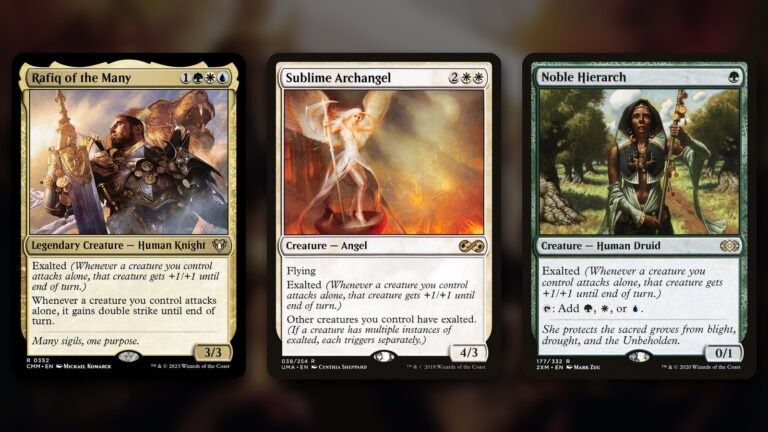
The Hobbit brings three new mechanics — storied, recruit and hone counters — plus amass returning to build Goblin armies and Adventure returning from Throne of Eldraine. Each of the descriptions below is quoted from live Scryfall oracle text.
| Mechanic | What it does | Why it matters in Sealed |
|---|---|---|
| Storied | “If you control three or more artifacts, legendaries, and/or Sagas, you have an enduring story for the rest of the game.” | The threshold is permanent once met — see below. Nine cards in the revealed set have it. |
| Recruit | “Draw a card, then discard a card. If you discarded a nonland card, create a 1/1 white Human Soldier creature token.” | Card selection plus a body — but only if you discard a real card. Ten cards revealed. |
| Hone counters | “Each hone counter on an Equipment grants +1/+0 to equipped creature.” | Rare in the revealed pool (two cards) — treat as a bonus, not a plan. |
| Amass Goblins | Put +1/+1 counters on an Army you control; if you have none, create a 0/0 black Goblin Army first. | Fourteen cards revealed. Everything stacks on one creature — see the trap below. |
| Adventure | A permanent with a second, cheaper spell on the same card; cast the spell, exile it, then cast the permanent later. | Seventeen cards revealed. Two cards’ worth of value in one slot — exactly what wins long Sealed games. |

Storied turns on once and never turns off
This is the detail worth reading the reminder text twice for. Threshold mechanics in Magic usually check continuously — lose your third artifact and metalcraft switches off. Storied does not work that way. The text reads “you have an enduring story for the rest of the game.” Hit three artifacts, legendaries and/or Sagas once, even for a single turn, even if all three die on the spot, and every storied card you draw for the remainder of the game is switched on permanently.
Two consequences for building. First, storied cards are themselves legendary, so each one counts toward its own threshold — Balin, Loremaster ({3}{R}{R}, rare) is a Legendary Creature with storied, so he is one of the three. Second, a cheap throwaway artifact is worth playing in a storied deck purely as a switch: it does not need to survive, it only needs to arrive.
Recruit punishes the obvious discard
Recruit reads “draw a card, then discard a card. If you discarded a nonland card, create a 1/1.” The instinctive play — pitch the spare land you do not need — is precisely the one that gets you nothing. Recruit rewards you for discarding a real card, which means it is at its best when you are flooded on spells you cannot cast, not when you are flooded on lands. Esgaroth Garrison ({4}{W}, common) is the card most players will see this on, and its power equals the number of creatures you control, so the token it makes also pumps it.
The amass trap
Amass puts all its counters on a single Army token. That makes an Army the most efficient removal target on the board: one kill spell undoes six turns of amassing. Play amass cards for value, but do not build a deck whose only win condition is one large creature that dies to a common. Along the Crooked Way ({2}{B}, rare) is the payoff that makes it work — it grants your Goblins and Orcs menace for {1}{B}, which turns the Army from a blockable lump into something that actually connects.
The common removal you are hoping to open
In Sealed, commons decide games because you see so many of them. These are the removal commons confirmed in The Hobbit so far, verified card by card against Scryfall:
| Card | Cost | Type | What it does |
|---|---|---|---|
| Bilbo’s Deadly Slice | {1}{B}{B} | Instant | Destroy target creature. Unconditional, instant speed, three mana — the best common in the set for Sealed. |
| Stir Up Trouble | {B} | Sorcery | Destroy target creature, but you must sacrifice an artifact or creature or pay {4}. One mana when you have a spare body. |
| Pinecone Strike | {1}{R} | Instant | Choose one or both: 3 damage to a creature (exiling it if it would die), and/or destroy target artifact token. |
| Magnificent End | {4}{W} | Instant | 5 damage to a creature, and costs {3} less if the target is tapped — so effectively {1}{W} against anything that attacks you. |
| Quarrel | {1}{G} | Instant | Your creature deals damage equal to its power to theirs. Needs a big creature already in play. |
| Warg Tactics | {1}{G} | Instant | Destroy target creature with flying, or pump with trample and hexproof. Green’s answer to the fliers it cannot block. |
One honest caveat: preview-season data is provisional. At the time of writing, Scryfall lists at least one seven-mana legendary dragon at common rarity, which is plainly a placeholder that will change before release. Rarities above are the ones that are consistent with the cards themselves; treat any rarity you read anywhere this week as subject to correction on 14 August.
Note how many of these are conditional. Black gets the clean answer; green’s removal needs a creature already on board; white’s is cheap only against attackers. That asymmetry is a real reason to weight black higher when your playable counts are close. If you want the broader picture of what separates good removal from bad, our guide to the best removal spells in MTG covers the principles that carry from Limited into every other format.
Six mistakes that lose prerelease matches
| Mistake | The fix |
|---|---|
| Playing three or four colours because the cards are good | Two colours, twenty-three playables. Consistency beats power in a forty-card deck. |
| Playing 45 cards “because I couldn’t cut them” | Play exactly 40. Every extra card makes you less likely to draw your bomb. |
| Cutting to 15 lands to fit one more spell | 17. Missing land drops loses more games than any single card wins. |
| Not sideboarding between games | Your whole unused pool is legal. Swap in the answer you were missing. |
| Holding removal for something better | Something better may never come. Kill the thing that is beating you now. |
| Ignoring the tokens and counters | Bring dice or ask for tokens. Amass and recruit both make permanents you have to track. |
After the prerelease
You leave with roughly eighty-five new cards. Two useful next steps: check what you actually opened on our card price tool before you trade any of it away, and if you want to turn the good ones into a real deck, our AI deck builder will build around a commander or a card you liked, and the deck analyzer will tell you whether your curve and mana base hold up.
If The Hobbit is where you are starting, the rest of our coverage is here: the full set guide for release dates, products and confirmed cards, every Hobbit legend ranked as a commander for when you move to Commander, and the Scene Boxes breakdown if you are deciding what else to buy. For the format most prerelease cards eventually end up in, start with how to build a Commander deck.
Prerelease FAQ
How much does an MTG prerelease cost?
Entry is set by the store, typically in the $30–$45 range in the US, and includes the Prerelease Pack you build from and keep. Prize support is usually additional boosters.
Do I need to bring anything?
A deck box and sleeves if you have them, dice or counters for tracking amass Armies and +1/+1 counters, and a pen. Basic lands are provided. You do not need to bring any cards.
How many lands should a prerelease deck have?
Seventeen in a forty-card deck. Go to sixteen only if your curve stops at four mana, and to eighteen if you are casting multiple six-drops.
Can I play cards from other sets?
No. Sealed uses only the cards from your Prerelease Pack, plus unlimited basic lands.
What is the minimum deck size in Sealed?
Forty cards, and there is no four-copy limit — if you open five copies of a common, all five are legal.
Is a prerelease good for beginners?
It is the best event in Magic for a beginner. Everyone is seeing the cards for the first time, the rules enforcement is deliberately relaxed, and one entry fee gets you both a deck and cards to keep.
When is The Hobbit prerelease?
Events can start from 12pm local time on Friday 7 August 2026 and run through 13 August. The set releases worldwide on 14 August 2026.
Are prerelease promo cards worth anything?
The date-stamped foil rare or mythic is usually worth slightly less than the standard printing of the same card, because collectors generally prefer the unstamped version. Check the specific card rather than assuming.
Build your next deck with AI
KrakenTheMeta’s AI deck builder researches the current meta and writes you a complete, format-legal decklist in about a minute — free to try.
Build a Deck with AIor browse community decks