Vanishing MTG: How It Works, All 20 Cards, Keep or Let It Vanish, and a $75 Brago Deck (2026)
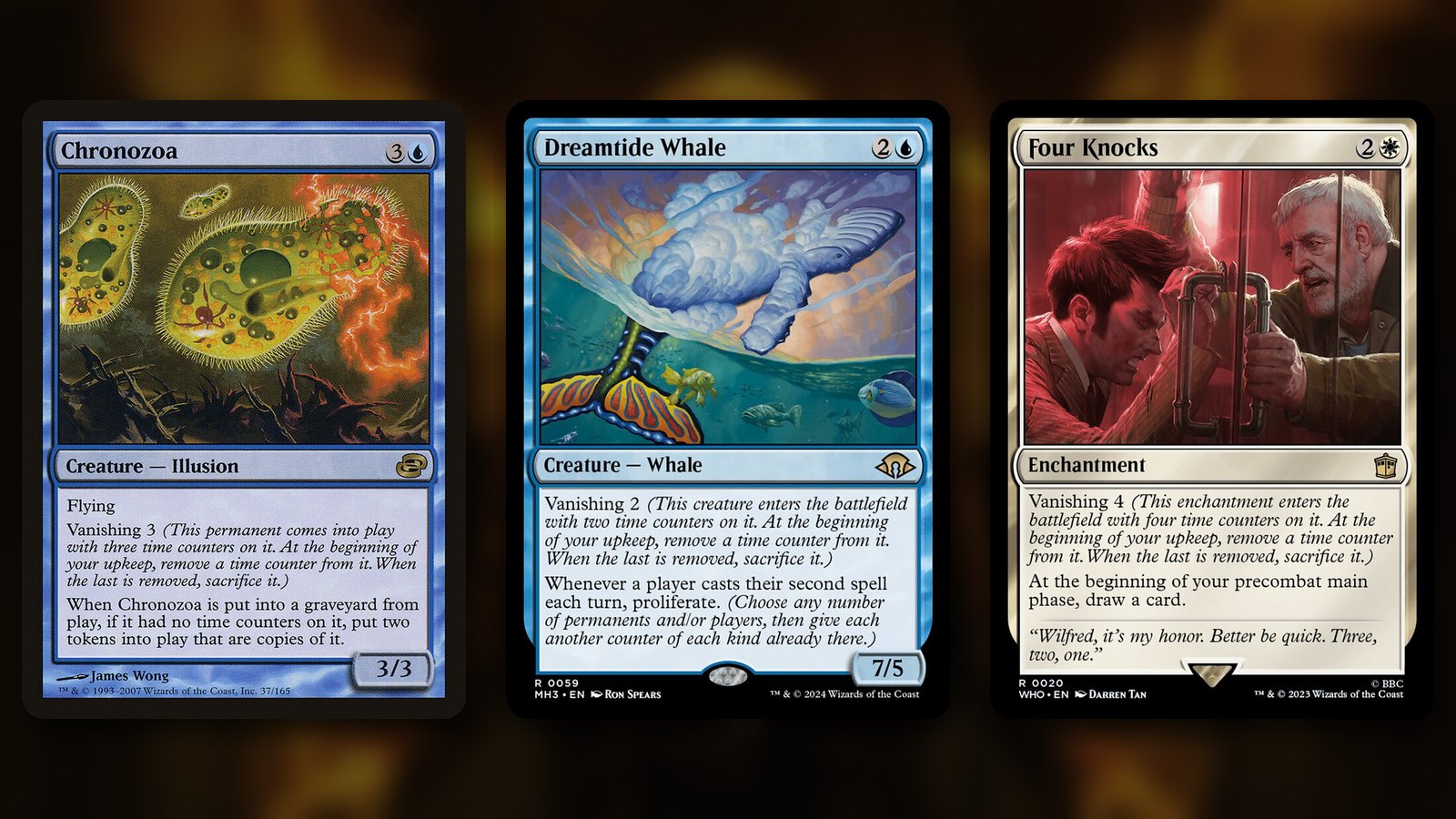
Vanishing is a keyword that puts a clock on a permanent. It enters with a number of time counters, loses one at the start of each of your upkeeps, and is sacrificed when the last one comes off. In exchange the cards are cheap for what they do: Dreamtide Whale is a 7/5 for three mana, Calciderm a 5/5 with shroud for four. There are 20 vanishing cards, 13 of them from the 2007 Time Spiral block (Planar Chaos and Future Sight), 4 from the Doctor Who Commander decks and three from the Modern Horizons sets.
This guide covers the rules (with rule numbers), every vanishing card, how blink and proliferate reset or extend the clock, legality, the best commanders, and a $75 Brago, King Eternal deck built to keep vanishing permanents alive. We also tested the strategy question with numbers: should you keep a vanishing permanent alive, or let it run out? We played the deck 20,000 times for each of three plans.
Short answer: keep them alive. With Brago resetting the clock, extending every vanishing permanent raised the chance of a turn-10 kill from 48.8% to 54.5%. Without Brago it went from 28.2% to 37.1%. Keeping Chronozoa and Lost Auramancers ticking down for their death triggers made no real difference: they turned up too rarely.

How vanishing works
The Comprehensive Rules (6 November 2026 version) define it in rule 702.63a. “Vanishing N” means “This permanent enters with N time counters on it,” “At the beginning of your upkeep, if this permanent has a time counter on it, remove a time counter from it,” and “When the last time counter is removed from this permanent, sacrifice it.” That is three abilities: a replacement effect as it enters, an upkeep trigger, and a sacrifice trigger.
Count the attacks, not the counters
A creature cast in your main phase can’t attack that turn (rule 302.6: “A creature can’t attack unless it has been under its controller’s control continuously since their most recent turn began.”). It loses its first counter in your next upkeep, before combat. So a Vanishing N creature attacks N−1 times. Vanishing 2 means one attack, which is why the vanishing 2 cards hit so hard for their cost: Waning Wurm is a 7/6 for four mana that swings once.
The last counter is the trigger
The sacrifice is a separate trigger that fires when the last counter is removed. Adding a counter in response does not save the permanent, since the trigger is already on the stack. But if the trigger is countered (Stifle and similar cards), the permanent stays with zero counters and nothing happens in later upkeeps either: vanishing only removes a counter “if this permanent has a time counter on it”.
Vanishing without a number
Rule 702.63b: Vanishing without a number means “At the beginning of your upkeep, if this permanent has a time counter on it, remove a time counter from it” and “When the last time counter is removed from this permanent, sacrifice it.” Two cards use it, Out of Time and Tidewalker, because they set their own counter count as they enter. Tidewalker gets one counter per Island you control and its power and toughness equal its counters, so it shrinks every turn. Rule 702.63c adds: “If a permanent has multiple instances of vanishing, each works separately.”
Blink resets the clock
Rule 400.7: “An object that moves from one zone to another becomes a new object with no memory of, or relation to, its previous existence.” A vanishing permanent that is exiled and returned comes back with a fresh set of counters and its enter trigger fires again. That is the whole engine behind the deck below. The catch is tokens: rule 111.7, “A token that’s in a zone other than the battlefield ceases to exist.” so blinking a Chronozoa copy deletes it.
Proliferate extends it
Each proliferate adds one time counter to any vanishing permanents you pick. Dreamtide Whale proliferates itself whenever a player casts their second spell in a turn, so in a deck that casts two spells a turn it never vanishes. Our proliferate guide lists the best sources.
| Situation | What happens |
|---|---|
| Vanishing 1 creature with no haste | Enters with one counter, loses it at your next upkeep and is sacrificed before your combat. It never attacks unless something adds a counter first (Soultether Golem does that itself). |
| Vanishing N creature, cast in your main phase | Attacks N−1 times: Waning Wurm (Vanishing 2) attacks once, Calciderm (Vanishing 4) three times. |
| It is blinked (exiled and returned) | It comes back as a new object (CR 400.7) with a full set of counters and its enter abilities trigger again. |
| A vanishing token is blinked | The token ceases to exist in exile (111.7) and never returns. Never blink Chronozoa tokens. |
| You proliferate | Add a time counter to any vanishing permanents you choose (701.34a). It is optional for each permanent. |
| You add a counter in response to the sacrifice trigger | Too late. The trigger is already on the stack and sacrifices the permanent anyway; the text has no “if it still has no counters” check. |
| The sacrifice trigger is countered (Stifle) | The permanent stays forever with no counters; vanishing never triggers again (Scryfall ruling on Dreamtide Whale). |
| It enters with no counters (Tidewalker with no Islands, Out of Time with no creatures) | Vanishing does nothing, as nothing can be removed. Tidewalker dies as a 0/0; Out of Time stays forever. |
| It dies some other way while it still has counters | No death payoff: Chronozoa, Deadly Grub and Lost Auramancers only trigger if they had no time counters. |
| Someone else gains control of it | Counters come off in its new controller’s upkeep, since “your upkeep” means its controller’s. |
Keep it or let it vanish? We tested it
We played the Brago deck from the end of this guide 20,000 times for each plan: ten turns on the play, one free mulligan, against an opponent with 40 life and no blockers. The plans differ in only one thing: what blinks and proliferates do when a vanishing permanent could be the target.
- Let them vanish: blinks go to card-draw creatures like Mulldrifter, and proliferate never touches a vanishing permanent.
- Extend all: the vanishing permanent closest to dying gets blinked first, and every proliferate adds a counter to all of them.
- Extend all but the death payoffs: the same, except Chronozoa, Lost Auramancers and Regenerations Restored are left to run out, since their best text happens when they do.
We ran each plan twice: with Brago cast as soon as four mana is up (turn 4 or earlier in 68.2% of games), and with Brago never cast, as if it was removed every time.
| Plan | Kill by turn 10 | Kill by turn 8 | Damage by turn 10 | Vanishing attacks | Vanishing cards lost | Blinks |
|---|---|---|---|---|---|---|
| With Brago | ||||||
| Let them vanish | 48.8% | 4.4% | 40.37 | 2.48 | 1.13 | 20.2 |
| Extend all | 54.5% | 6.7% | 43.6 | 3.19 | 0.28 | 29.68 |
| Extend all but the death payoffs | 53% | 6.5% | 43.01 | 3.01 | 0.54 | 27.01 |
| Without Brago | ||||||
| Let them vanish | 28.2% | 1.7% | 30.92 | 2.41 | 1.38 | 4.71 |
| Extend all | 37.1% | 4.4% | 34.94 | 3.37 | 0.69 | 6.26 |
| Extend all but the death payoffs | 36.7% | 4.3% | 34.77 | 3.23 | 0.93 | 5.96 |
Extending wins in both games. With Brago it added 5.7 points to the turn-10 kill rate and cut lost vanishing cards from 1.13 to 0.28 a game. Without Brago the gap is bigger, 8.9 points, because there are far fewer blinks to go around (4.71 a game against 20.2) and each one aimed at a creature about to vanish counts more.
The death payoffs are a trap in a ten-turn window. Letting Chronozoa and Lost Auramancers run out made Chronozoa double in about one game in seven (0.28 copies a game) and Lost Auramancers search in about one in eight (0.12 a game), and scored slightly below extending everything. In a longer game Chronozoa’s doubling grows, but most games are decided before it matters.
Brago is the deck. The same 99 cards killed by turn 10 in 48.8% of games with Brago and 28.2% without, mostly through card draw: blinking Mulldrifter, Cloudblazer and friends every turn drew 16.89 extra cards a game against 9.97.
What the model leaves out: colours of mana, blockers and removal (both push toward blinking more, since blinking also dodges removal), the opponent’s board (so Crack in Time and Reality Acid remove nothing here), and life gain. Extra-turn and copy effects are counted only inside ten turns.
All 20 vanishing cards
Sorted by how many decks play them on EDHREC. Prices are the cheapest ordinary printing on Scryfall on 22 November 2026. 15 are creatures and 5 enchantments; 18 cost under $1.
| Card | Cost | Vanishing | Type | P/T | Set | EDHREC decks | Price |
|---|---|---|---|---|---|---|---|
| Dreamtide Whale | {2}{U} | 2 | Creature: Whale | 7/5 | MH3 2024 | 137,838 | $5.96 |
| Deep Forest Hermit | {3}{G}{G} | 3 | Creature: Elf Druid | 1/1 | MH1 2019 | 47,920 | $0.40 |
| Out of Time | {1}{W}{W} | (none) | Enchantment | – | MH2 2021 | 26,176 | $0.31 |
| Four Knocks | {2}{W} | 4 | Enchantment | – | WHO 2023 | 14,912 | $0.93 |
| Reality Acid | {2}{U} | 3 | Enchantment: Aura | – | PLC 2007 | 13,645 | $0.28 |
| Regenerations Restored | {W}{U} | 12 | Enchantment | – | WHO 2023 | 10,498 | $0.36 |
| Chronozoa | {3}{U} | 3 | Creature: Illusion | 3/3 | PLC 2007 | 8,713 | $6.64 |
| Crack in Time | {3}{W} | 3 | Enchantment | – | WHO 2023 | 6,573 | $0.23 |
| Lost Auramancers | {2}{W}{W} | 3 | Creature: Human Wizard | 3/3 | FUT 2007 | 4,855 | $0.22 |
| Deadwood Treefolk | {5}{G} | 3 | Creature: Treefolk | 3/6 | PLC 2007 | 3,753 | $0.08 |
| Waning Wurm | {3}{B} | 2 | Creature: Zombie Wurm | 7/6 | PLC 2007 | 2,790 | $0.27 |
| Ravaging Riftwurm | {1}{G}{G} | 2 | Creature: Wurm | 6/6 | FUT 2007 | 2,043 | $0.25 |
| Deadly Grub | {2}{B} | 3 | Creature: Insect | 3/1 | PLC 2007 | 1,826 | $0.05 |
| Idris, Soul of the TARDIS | {1}{U}{R} | 3 | Legendary Creature: Human Incarnation | 3/3 | WHO 2023 | 1,810 | $0.25 |
| Aven Riftwatcher | {2}{W} | 3 | Creature: Bird Rebel Soldier | 2/3 | PLC 2007 | 1,422 | $0.05 |
| Keldon Marauders | {1}{R} | 2 | Creature: Human Warrior | 3/3 | PLC 2007 | 708 | $0.15 |
| Tidewalker | {2}{U} | (none) | Creature: Elemental | */* | PLC 2007 | 678 | $0.28 |
| Soultether Golem | {2} | 1 | Artifact Creature: Golem | 3/3 | FUT 2007 | 504 | $0.20 |
| Lavacore Elemental | {2}{R} | 1 | Creature: Elemental | 5/3 | PLC 2007 | 455 | $0.20 |
| Calciderm | {2}{W}{W} | 4 | Creature: Beast | 5/5 | PLC 2007 | 220 | $0.07 |
The ones worth building around
Dreamtide Whale is the most played by far, in 137,838 decks. It is a 7/5 for three with Vanishing 2 that proliferates whenever a player casts their second spell in a turn, so in a spell-heavy deck it keeps itself alive and grows every other counter you have. Deep Forest Hermit (47,920 decks) leaves four 1/1 Squirrels behind; the anthem goes when it vanishes, but the tokens stay. Four Knocks draws a card at the start of your first main phase each turn. Cast in a main phase, it misses that turn’s draw and loses its last counter before the fourth, so it is three cards for three mana; a blink starts the count again.
Reality Acid is removal on a delay: when it leaves the battlefield, the enchanted permanent’s controller sacrifices it. That trigger fires whenever it leaves, so blinking it with Brago kills the permanent at once, and it comes back to enchant a new one. Regenerations Restored is Vanishing 12 with an extra turn at the end; proliferate is bad for it, and Clockspinning or Fury Charm can remove counters to speed it up.
Three cards want to run out: Chronozoa makes two copies of itself (each with Vanishing 3), Deadly Grub leaves a 6/1 with shroud, and Lost Auramancers fetches an enchantment onto the battlefield. All three only trigger if they had no counters when they died. Two cards grow their own clock: Soultether Golem gets a counter whenever another creature of yours enters, and Lavacore Elemental whenever a creature of yours deals combat damage to a player. Kicked Ravaging Riftwurm enters with five counters instead of two.

Cards that reset or extend the clock
Two ways to keep a vanishing permanent: blink it for a fresh set of counters, or add counters. Blink is stronger because it also re-triggers the card’s enter ability, but most blink cards only hit creatures. Only the “any permanent” ones (Brago, Yorion, Flickerwisp) reset Four Knocks, Reality Acid and the other enchantments. Our best blink commanders list has more engines.
| Card | Cost | What it does for vanishing |
|---|---|---|
| Brago, King Eternal | {2}{W}{U} | Blinks any number of your nonland permanents after combat damage. Resets every vanishing card at once, enchantments included. |
| Ephemerate | {W} | Blinks a creature now and again in your next upkeep (rebound). The upkeep blink makes that creature miss the attack, so aim it at one that was not going to attack. |
| Conjurer’s Closet | {5} | Blinks a creature in each of your end steps. |
| Teleportation Circle | {3}{W} | Blinks an artifact or creature in each of your end steps. |
| Soulherder | {1}{W}{U} | End-step blink on a body that grows each time. |
| Restoration Angel | {3}{W} | Flash 3/4 flyer that blinks a non-Angel creature. |
| Yorion, Sky Nomad | {3}{W/U}{W/U} | Blinks any number of your other nonland permanents when it enters. |
| Eerie Interlude | {2}{W} | Blinks any number of your creatures; they return at the next end step. |
| Flickerwisp | {1}{W}{W} | Blinks any permanent, so it can reset Four Knocks and the other enchantments. |
| Clockspinning | {U} | Adds or removes one counter, with buyback {3}. Saves a creature or finishes off Chronozoa. |
| Contentious Plan | {1}{U} | Proliferate and draw a card. |
| Flux Channeler | {2}{U} | Proliferates on every noncreature spell you cast. |
| Thrummingbird | {1}{U} | Proliferates when it deals combat damage to a player. |
| Stifle | {U} | Counters the sacrifice trigger, so the permanent stays forever. |
| Timecrafting | {X}{R} | Adds or removes X time counters. |
| Parallax Wave | {2}{W}{W} | Fading 5, not vanishing, but the classic blink combo card in the same colours. |

Best commanders for vanishing
Only one vanishing card is legendary, Idris, Soul of the TARDIS, and its 143 EDHREC decks show it isn’t really a vanishing commander: its own clock is the drawback, and it gains the abilities of an artifact it exiles. The better picks are blink and proliferate commanders that turn the drawback off.
| Commander | Colours | EDHREC decks | Why |
|---|---|---|---|
| Brago, King Eternal | W U | 15,688 | Resets every vanishing permanent each turn it connects. Flying makes that easy. |
| Atraxa, Praetors’ Voice | W U B G | 46,429 | Proliferates every end step: each vanishing permanent effectively stops ticking. |
| Aminatou, the Fateshifter | W U B | 6,992 | Blinks one permanent a turn with its −1, enchantments included. |
| Roon of the Hidden Realm | G W U | 3,641 | Repeatable creature blink for {2} and a tap; adds green for Deep Forest Hermit and Ravaging Riftwurm. |
| Idris, Soul of the TARDIS | U R | 143 | The only vanishing card that can be a commander. Vanishing 3, so it needs blink to stay. |
Vanishing legality
From Scryfall on 22 November 2026. The four Doctor Who cards (Four Knocks, Crack in Time, Regenerations Restored, Idris) were printed only in Commander decks, so they are legal in Commander, Legacy and Vintage but not Modern.
| Format | Vanishing cards legal | Notes |
|---|---|---|
| Standard | 0 | No vanishing card is in Standard |
| Pioneer | 0 | – |
| Modern | 16 | Not the four Doctor Who cards |
| Pauper | 4 | Aven Riftwatcher, Deadly Grub, Keldon Marauders, Reality Acid |
| Legacy / Vintage | 20 | None banned or restricted |
| Commander | 20 | All legal, none banned |

Budget Brago vanishing deck ($75)
The list the test above played: twelve vanishing cards, sixteen blink effects and seven ways to proliferate or add counters around Brago, King Eternal. It is 100 cards, all Commander legal, inside Brago’s white-blue colour identity, with no Game Changers. Cheapest printings come to $75.84 on Scryfall on 22 November 2026 (basics not counted).
| Role | Count | Cards |
|---|---|---|
| Vanishing cards | 12 | Calciderm, Chronozoa, Aven Riftwatcher, Lost Auramancers, Four Knocks, Crack in Time, Out of Time, Reality Acid, Regenerations Restored, Dreamtide Whale, Tidewalker, Soultether Golem |
| Blink | 16 | Ephemerate, Cloudshift, Momentary Blink, Ghostly Flicker, Essence Flux, Eerie Interlude, Ghostway, Restoration Angel, Soulherder, Conjurer’s Closet, Teleportation Circle, Charming Prince, Flickerwisp, Yorion, Deadeye Navigator, Mistmeadow Witch |
| Proliferate and counters | 7 | Contentious Plan, Grateful Apparition, Thrummingbird, Flux Channeler, Tezzeret’s Gambit, Clockspinning, Steady Progress |
| Enter-the-battlefield value | 10 | Mulldrifter, Cloudblazer, Cloudkin Seer, Man-o’-War, Wall of Omens, Fiend Hunter, Banisher Priest, Venser, Kor Skyfisher, Watcher for Tomorrow |
| Mana rocks | 9 | Sol Ring, Arcane Signet, Azorius Signet, Talisman of Progress, Mind Stone, Fellwar Stone, Thought Vessel, Wayfarer’s Bauble, Commander’s Sphere |
| Interaction | 6 | Swords to Plowshares, Path to Exile, Generous Gift, Counterspell, Arcane Denial, Oblivion Ring |
| Card selection | 3 | Brainstorm, Ponder, Fact or Fiction |
| Lands | 36 | 12 Plains, 12 Island, 12 nonbasic |
Budget Brago Vanishing
100 cards — one click loads the full list into a TCGplayer cart so you can check real prices and grab the whole deck at once.
Buy this deck on TCGplayerView it on KrakenTheMetaAffiliate link — buying through it supports KrakenTheMeta at no extra cost to you.How it plays: rocks on turns 1 to 3, Brago on 4, and from then on every attack resets your vanishing cards, draws off Mulldrifter and Cloudblazer again, and re-fires Reality Acid as removal. Dreamtide Whale and Calciderm are the beaters; Chronozoa is the one you sometimes let run out, when the game will go long. Out of Time is the reset button when you are behind: it phases out every creature, yours included, with one time counter for each, so the board comes back a few turns later. Want a different take? A public Brago list from our community is on the deck page; paste this one into the deck analyzer, or browse more lists on community decks.

Vanishing vs fading, suspend and echo
Fading is vanishing’s older cousin from Nemesis, with 17 Commander-legal cards. Rule 702.32a: “Fading N” means “This permanent enters with N fade counters on it” and “At the beginning of your upkeep, remove a fade counter from this permanent. If you can’t, sacrifice the permanent.” Because a fading permanent is sacrificed only when it can’t remove a counter, Fading N lasts one turn longer than Vanishing N. Fade counters aren’t time counters, so cards like Clockspinning work on both but Timecrafting only touches time counters. Suspend uses the same time counters from exile, and echo is the other old “pay now or lose it” upkeep keyword. For permanents that come back after dying, see persist; for leaving and returning without a zone change, phasing.
| Keyword | Counters | When it ends | Lasts (Vanishing/Fading 3) |
|---|---|---|---|
| Vanishing | Time counters | Sacrificed when the last counter is removed | 2 attacks |
| Fading | Fade counters | Sacrificed when it can’t remove one, a turn later | 3 attacks |
| Suspend | Time counters, in exile | Cast for free when the last counter is removed | – |
| Echo | None | Sacrificed at your next upkeep unless you pay again | – |
Vanishing FAQ
What does vanishing mean in MTG?
A permanent with Vanishing N enters with N time counters, loses one at the start of each of your upkeeps, and is sacrificed when the last one is removed (CR 702.63a).
How many times does a vanishing creature attack?
N−1 times without haste. It can’t attack the turn it enters, and it loses its first counter before your next combat.
Does blinking reset vanishing?
Yes. A blinked permanent is a new object (400.7) and enters with a full set of time counters. Tokens don’t come back from exile, though.
Does proliferate work with vanishing?
Yes. Proliferate can add a time counter to each vanishing permanent you choose, which delays the sacrifice by a turn each time.
Can I save it by adding a counter after the last one is removed?
No. The sacrifice trigger is already on the stack and still sacrifices it. Countering that trigger (Stifle) does keep it forever.
What happens if a vanishing permanent has no counters?
Nothing: vanishing only removes a counter if there is one, and the sacrifice only triggers when the last counter is removed (702.63a). Out of Time can stay forever this way.
Is vanishing the same as fading?
No. Fading uses fade counters and sacrifices the permanent when it can’t remove one, so Fading N lasts a turn longer than Vanishing N.
How many vanishing cards are there?
20: 15 creatures and 5 enchantments, 13 from Planar Chaos and Future Sight, 4 from Doctor Who, and one each from Modern Horizons 1, 2 and 3.
Is vanishing in Standard?
No. None of the cards are Standard or Pioneer legal; 16 are Modern legal and all 20 are Commander legal.
Data: Scryfall (card text, rulings, legality, prices, 22 November 2026), EDHREC (deck counts), Comprehensive Rules effective 6 November 2026. Simulation: 20,000 games per plan per version, ten turns, on the play.
Build your next deck with AI
KrakenTheMeta’s AI deck builder researches the current meta and writes you a complete, format-legal decklist in about a minute — free to try.
Build a Deck with AIor browse community decks