
MTG Aristocrats: What the Archetype Is and How to Build a Sacrifice Commander Deck (2026)
Aristocrats is one of the most beloved — and most misunderstood — archetypes in Magic: The Gathering. Ask ten players what it means and you’ll get ten answers, which is exactly why the top Google result for “mtg aristocrats” is a thread titled “What are aristocrats?” So let’s answer it cleanly: an aristocrats deck turns your own creatures dying into a resource. You sacrifice cheap and token creatures on purpose, and cards you control pay you off for each death — draining opponents, drawing cards, or making mana.
Here’s the thing most guides miss, and the reason so many aristocrats decks feel like they “do nothing”: aristocrats is not a pile of good sacrifice cards. It’s a three-part engine — fodder, outlets, and payoffs — and the ratio between the three is the entire deck. Get the ratio right and the deck hums; get it wrong and you’re sacrificing creatures all game with nothing to show for it. This guide covers what the archetype is, why it’s called that, the exact engine you need to build, the best commanders in 2026, and the honest reasons it’s sometimes called “a trap.”

What is an aristocrats deck in MTG?
An aristocrats deck is a Commander (or 60-card) strategy built to profit from creatures dying, usually by sacrificing them yourself. Three things happen on a good aristocrats turn: you have expendable creatures on the battlefield (fodder), you have a way to throw them away at will (a sacrifice outlet), and you have permanents that reward you every time a creature dies (payoffs). Chain those together and every death becomes life loss for the table, cards in your hand, or mana in your pool.
The key mental shift is that sacrificing is not the same as waiting for combat. A removal-heavy deck hopes creatures trade in battle; an aristocrats deck controls exactly when and how its creatures die, which means it sidesteps counterspells, dodges “target” removal (you can sacrifice a creature in response to save it from exile — the death trigger still fires), and turns board wipes from a disaster into a windfall. When a Wrath of God kills everyone’s board, your Blood Artist drains the whole table.
Why is it called “aristocrats”?
The name comes from the deck that put the strategy on the map: “The Aristocrats,” the sacrifice deck that broke out at Pro Tour Gatecrash in 2013. It was built around two cards that literally have the word in their names — Falkenrath Aristocrat and Cartel Aristocrat — alongside Blood Artist as the payoff. The nickname stuck, and today “aristocrats” describes any deck, in any format, that sacrifices its own creatures for incremental value. The flavor fits, too: the aristocrats send the peasants (your tokens) to die while they collect the rewards.
The three-part engine: outlets, fodder, and payoffs
This is the part that actually matters. An aristocrats deck is three interlocking piles of cards, and a common beginner mistake is loading up on one while neglecting the others. A rough Commander target: 4–6 sacrifice outlets, 12–15 fodder sources, and 8–12 payoffs. Miss on any leg and the engine stalls.
1. Sacrifice outlets — the engine’s ignition
You cannot sacrifice a creature whenever you feel like it — an effect has to let you. That’s what a sacrifice outlet is. The best ones are free (no mana cost per activation) and repeatable, so you can sacrifice as many creatures as you have in a single turn. A free outlet is the single most important piece of the deck; without one, your payoffs only fire when your opponents kill your creatures for you.
| Card | Cost | Why it’s great | ~Price |
|---|---|---|---|
| Viscera Seer | B | Free, repeatable, scries — the gold standard budget outlet | $0.38 |
| Carrion Feeder | B | Free outlet that grows itself; can’t block, but who cares | $4.00 |
| Ashnod’s Altar | 3 | Free outlet that makes two colorless mana per sacrifice — combo glue | $14.32 |
| Goblin Bombardment | 1R | Free outlet that turns each creature into a burn spell | $2.38 |
| Woe Strider | 2B | Free outlet that scries and brings a Goat token with it; escapes from the graveyard | $0.33 |
| Bartolomé del Presidio | WB | A free outlet on a two-mana body — can even be your commander | $0.29 |
2. Fodder — the creatures you feed the machine
Fodder is what you sacrifice. The best fodder is cheap, comes in bulk (tokens), or comes back from the graveyard so you can sacrifice it again and again. Token generators are the backbone here — a single card that spits out a body every turn is an endless fuel line. (For a deeper dive, see our guide to the best token generators in MTG.)
| Card | Cost | What it feeds you | ~Price |
|---|---|---|---|
| Bitterblossom | 1B | A 1/1 flyer every upkeep, forever — the premium token engine | $34.45 |
| Ophiomancer | 2B | A deathtouch Snake token every upkeep (yours and theirs) | $0.80 |
| Grave Titan | 4BB | Four Zombie power on ETB and attack — a fodder bomb | $0.38 |
| Sengir Autocrat | 3B | Three Serf tokens on ETB — instant fodder pile | $0.39 |
| Reassembling Skeleton | 1B | Recurs from the graveyard for 1B every turn — infinite sacrifices | $0.37 |
| Gravecrawler | B | Recast from the graveyard for B as long as you control a Zombie | $1.51 |
| Bloodsoaked Champion | B | Comes back for 1B after you attack — cheap recursive fodder | $0.36 |
3. Payoffs — turning death into damage
Payoffs are the reason to sacrifice at all. They come in three flavors: drain (opponents lose life, you gain it), edicts (opponents are forced to sacrifice too), and value (you draw cards or make mana). A balanced deck runs some of each — drain to win, edicts to control the board, value to refuel.
| Card | Type | What it does on each death/sacrifice | ~Price |
|---|---|---|---|
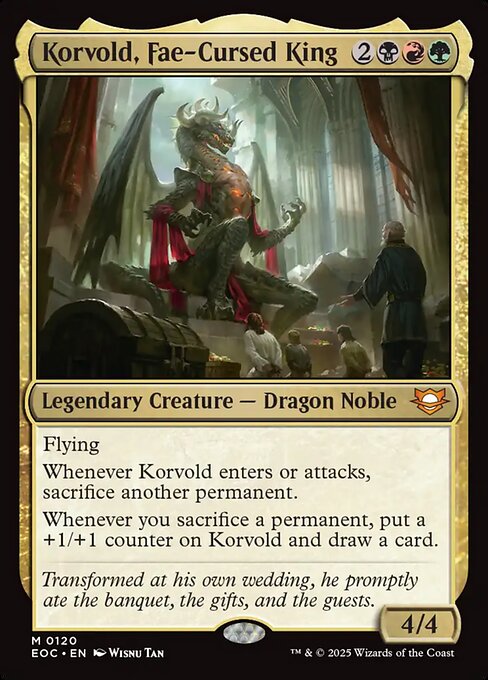
| Mayhem Devil | Damage | 1 damage to any target whenever any player sacrifices any permanent — enormous scope | $0.30 |
| Midnight Reaper | Draw | Draw a card whenever a nontoken creature you control dies | $0.19 |
| Pitiless Plunderer | Mana | A Treasure token every time another creature you control dies | $3.51 |
| Dictate of Erebos | Edict | Each opponent sacrifices a creature whenever one of yours dies (has flash) | $18.20 |
| Grave Pact | Edict | The original — each other player sacrifices a creature per death of yours | $36.97 |
| Skullclamp | Draw | Equip a 1-toughness creature; it dies, you draw two — a card-draw machine | $5.16 |
| Mahadi, Emporium Master | Mana | A Treasure for every creature that died this turn, at your end step | $1.90 |
The Blood Artist trap: read the exact wording
The drain payoffs — the ones that make opponents lose life — look interchangeable. They are not, and the differences decide games. The two axes are which deaths trigger them and who loses life. Blood Artist triggers on any creature dying, including your opponents’, but only drains one player. Zulaport Cutthroat and Cruel Celebrant only trigger on your creatures, but drain every opponent — far better in a four-player pod. Run several; they stack, and each death fires all of them.
| Card | Triggers on | Who loses life | ~Price |
|---|---|---|---|
| Blood Artist | Any creature dying (yours or opponents’) | One target player, 1 life | $2.14 |
| Zulaport Cutthroat | A creature you control dying | Each opponent loses 1 | $1.06 |
| Cruel Celebrant | A creature or planeswalker you control dying | Each opponent loses 1 | $0.92 |
| Bastion of Remembrance | A creature you control dying | Each opponent loses 1 (comes with a token) | $0.30 |
| Elas il-Kor, Sadistic Pilgrim | A creature you control dying (also drains on your ETBs) | Each opponent loses 1 | $2.72 |
| Poison-Tip Archer | Any creature dying + reach/deathtouch body | Each opponent loses 1 | $1.72 |
Why it matters: against a symmetrical board wipe, Blood Artist drains for every creature that dies across the whole table — often 6–10 life in one shot. Zulaport Cutthroat only counts your own dead, but hits all three opponents, so it’s better when you’re the one doing the sacrificing. The drain-combo math (pairing these with life-swing cards like Exquisite Blood) is covered in our lifegain deck guide — aristocrats and lifegain share a bloodstream.
Best aristocrats commanders in 2026
Aristocrats lives in black, splashing white (for extra drain and recursion), red (for damage outlets and Treasure), or green (for recursion and token floods). These commanders each define a slightly different build — pick the one that matches how you want to win.
| Commander | Colors | Why build it | ~Price |
|---|---|---|---|
| Teysa Karlov | WB | Doubles every death trigger you control — Blood Artist drains two, Grave Pact hits twice. The purest payoff amplifier. | $2.50 |
| Yawgmoth, Thran Physician | B | A sac outlet, removal, and card draw stapled to one body — arguably the best mono-black aristocrats commander | $31.03 |
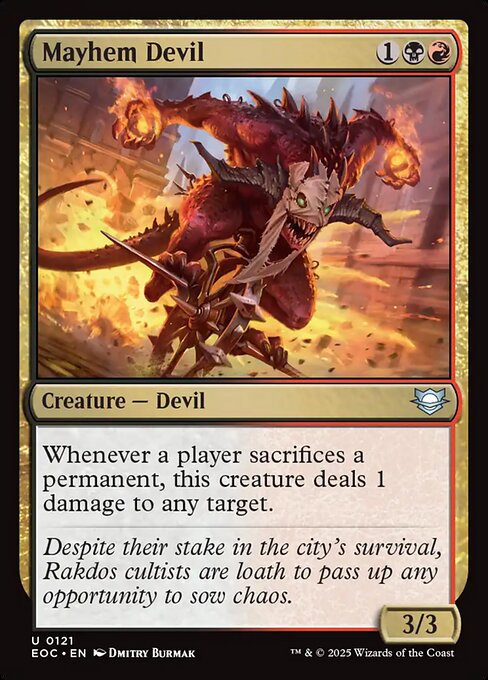
| Korvold, Fae-Cursed King | BRG | Draws a card and grows every time you sacrifice any permanent — the value monster | $0.52 |
| Meren of Clan Nel Toth | BG | Recurs your fodder from the graveyard for free every turn — the grind engine | $1.14 |
| Judith, the Scourge Diva | BR | Pings a target whenever a nontoken creature you control dies, and pumps your team | $0.19 |
| Ghave, Guru of Spores | WBG | Makes its own token fodder and can go infinite with the right payoff | $1.16 |
| Chatterfang, Squirrel General | BG | Doubles your token output and is a built-in sacrifice outlet | $11.33 |
Why aristocrats is called “a trap” — and how to avoid it
Experienced players will warn you that aristocrats is a trap in Commander, and they’re half right. The trap isn’t the archetype — it’s building it wrong. There are three classic failure modes:
- Outlets and fodder, no payoffs. You sacrifice creatures all game and… nothing happens. Sacrificing is a cost, not a wincon. Without payoffs you’re just shrinking your own board.
- Payoffs and fodder, no free outlet. Your Blood Artists only trigger when opponents kill your creatures — which they won’t, if it helps you. A deck with no free sacrifice outlet is not an aristocrats deck; it’s a pile of do-nothing enchantments.
- An engine, but no way to close. This is the real trap. Draining one life at a time can take twenty turns, and in that time a battlecruiser deck just casts a bigger threat and wins. You need a closer.
The fix for the last one is a small package of finishers. The cleanest is Gravecrawler + Phyrexian Altar + a second Zombie + a drain payoff: sacrifice Gravecrawler to the Altar for a black mana, recast it from the graveyard (you control a Zombie), and each loop is a death that drains the table — infinite, as long as you hold a second Zombie on board. Teysa doubles the drain, so you only need to loop half as many times. Even without the combo, a single big turn — a free outlet plus a wide token board plus a drain payoff — can burst 15–20 damage across the table at once. Build to close, not just to grind.
A budget Teysa Karlov starter shell
Teysa Karlov is the ideal first aristocrats commander: two colors (easy mana), cheap, and she doubles every death trigger you control, so the whole deck hits twice as hard. Here’s a 24-card Orzhov core to build around — add your lands, ramp, and removal to reach 100. Everything here is Commander-legal and most of it costs pennies.
Teysa Karlov Orzhov Aristocrats — Starter Shell
24 cards — one click loads the full list into a TCGplayer cart so you can check real prices and grab the whole deck at once.
Buy this deck on TCGplayerView it on KrakenTheMetaAffiliate link — buying through it supports KrakenTheMeta at no extra cost to you.Want the full 100 built for you? Our AI deck builder takes a commander and an archetype and returns a complete, legal decklist in seconds — try “Teysa aristocrats” and tune from there, or browse community public decks for inspiration.
Common mistakes and rules gotchas
- Teysa doubles triggers, not tokens or sacrifices. Her ability copies death-triggered abilities of permanents you control — Blood Artist drains twice, Grave Pact forces two sacrifices. It does not make you sacrifice twice, and it does not double a token-maker’s ETB. (Her second ability gives your tokens vigilance and lifelink.)
- “Nontoken” clauses ignore your token army. Midnight Reaper and Judith only trigger on nontoken creatures dying. Sacrifice ten Faerie tokens and Reaper draws you zero cards. Pair token-heavy fodder with drain payoffs (Blood Artist, Zulaport) that count every death; save the nontoken payoffs for recursive bodies like Reassembling Skeleton.
- Mayhem Devil sees everything. It triggers when any player sacrifices any permanent — including opponents cracking fetchlands and Treasures. In a Treasure-heavy pod it can ping for a dozen a turn.
- Tokens are perfect fodder. A token that’s sacrificed still dies first (triggering Blood Artist and friends) before it ceases to exist — unlike blink effects, which make tokens vanish with no death. That’s why go-wide token strategies and aristocrats fit together so well.
- Aristocrats loves a board wipe. When everything dies at once, your drain payoffs count every creature on the table. Running your own symmetrical board wipes — with a Blood Artist already out — is a legitimate one-card finisher. Recursion from a reanimator package rebuilds you afterward.
Frequently asked questions
What is an aristocrats deck in MTG?
An aristocrats deck sacrifices its own creatures on purpose to trigger payoffs — cards that drain opponents’ life, draw you cards, or make mana each time a creature dies. It’s built from three parts: sacrifice outlets, expendable fodder, and payoffs.
Why is it called “aristocrats”?
It’s named after “The Aristocrats,” a sacrifice deck from Pro Tour Gatecrash (2013) built around Falkenrath Aristocrat and Cartel Aristocrat — two cards with “aristocrat” in their names — plus Blood Artist. The name now describes any self-sacrifice value deck.
What colors are best for aristocrats?
Black is the core (it has the outlets, the fodder recursion, and the drain payoffs). White adds extra drains and recursion (Orzhov), red adds damage outlets and Treasure (Rakdos), and green adds token floods and graveyard recursion (Golgari).
What’s the best aristocrats commander for beginners?
Teysa Karlov (Orzhov) is the best starting point — two colors, inexpensive, and she doubles every death trigger, so the archetype’s payoffs immediately hit twice as hard. Korvold and Meren are strong, cheap alternatives.
How many sacrifice outlets should an aristocrats deck run?
In Commander, aim for 4–6 sacrifice outlets, prioritizing free and repeatable ones, alongside 12–15 fodder sources and 8–12 payoffs. At least one or two outlets should cost no mana to activate.
Is aristocrats good in Commander?
Yes — it’s resilient (it profits from removal and board wipes), interactive, and grindy. Its one weakness is closing games, so make sure your build includes a real finisher, not just incremental drain.
Build your next deck with AI
KrakenTheMeta’s AI deck builder researches the current meta and writes you a complete, format-legal decklist in about a minute — free to try.
Build a Deck with AIor browse community decks