
MTG Banding Explained: How It Works on Attack and Defense, Who Assigns Damage, Every Banding Card, Bands With Other, and a Budget Ayesha Tanaka Deck (2026)
Banding is the most confusing keyword Magic ever printed, and its record shows it. Only 24 cards were ever printed with the word “banding” on them. The last two came out in Weatherlight in June 1997, and no new banding card has been made in the 29 years since. Nineteen of the 24 are mono-white. None is legal in Standard, Pioneer or Modern, and none has ever been on MTG Arena. Yet banding is still in the Comprehensive Rules (rule 702.22), every one of those 24 cards is legal in Commander, Legacy and Vintage, and fifteen are legal in Pauper, so the question “how does banding actually work?” keeps coming up at real tables.
This guide answers it properly. It quotes the rule, walks through a banded attack and a banding block step by step, and gives a one-table summary of who assigns the damage in each situation. It covers “bands with other”, the Legends-era cousin that is even stranger, and lists all 24 banding creatures, the 15 cards that hand banding out, and the 8 “bands with other” cards, with Scryfall prices and EDHREC deck counts. It ends with a $66.80 Ayesha Tanaka Commander deck built around the only legendary creature ever printed with banding.
One number sums up how the game treats the mechanic now: the most-played card in the whole banding family on EDHREC is Tolaria, a land whose only other ability is to take banding away.
What is banding in MTG?
Banding is a combat keyword with two halves. On attack, it lets creatures with banding attack together as a group called a band, which is blocked as a unit. On attack and on defense, it lets you decide how your opponent’s creatures deal their combat damage to your creatures, instead of your opponent deciding. The second half is the one that matters, and the one most players forget.
In short: if a creature with banding is in a combat, its controller assigns the combat damage dealt to it and its friends. Usually that means stacking all of the enemy damage onto one creature that can survive it, or onto one creature you don’t mind losing.
Here is the core of the current rule (Comprehensive Rules, 7 August 2026 text):
702.22c As a player declares attackers, they may declare that one or more attacking creatures with banding and up to one attacking creature without banding (even if it has “bands with other”) are all in a “band.” […] A player may declare as many attacking bands as they want, but each creature may be a member of only one of them.
702.22h If an attacking creature becomes blocked by a creature, each other creature in the same band as the attacking creature becomes blocked by that same blocking creature.
702.22j During the combat damage step, if an attacking creature is being blocked by a creature with banding […], the defending player (rather than the active player) chooses how the attacking creature’s damage is assigned. That player can divide that creature’s combat damage as they choose among any creatures blocking it.
702.22k During the combat damage step, if a blocking creature is blocking a creature with banding […], the active player (rather than the defending player) chooses how the blocking creature’s damage is assigned. That player can divide that creature’s combat damage as they choose among any creatures it’s blocking.
A small detail for rules readers: rule 702.22 runs from 702.22a to 702.22k and then jumps to 702.22m. There is no 702.22l. The Comprehensive Rules never use the letter l for a subrule, most likely so it can’t be misread as the number 1. Only 19 rules in the whole document are long enough to reach m, and banding is one of them.
How banding works when you attack
Step 1: form the band as you declare attackers
When you declare attackers, you can announce that some of them form a band. A band needs at least one creature with banding. It can contain any number of creatures with banding, plus at most one creature without it. That limit doesn’t grow: five banders can still bring along only one non-bander. You can make as many separate bands as you have creatures for, but each creature can be in only one band. All members of a band must attack the same player, planeswalker or battle (702.22d).
Once announced, the band lasts for the rest of combat, even if something later removes banding from its members (702.22e). A creature that is removed from combat leaves its band (702.22f). The members are still separate creatures: they don’t share abilities, so a flier in a band doesn’t give the others flying (702.22g).
Step 2: the band is blocked as one
If any creature in the band becomes blocked, every creature in the band becomes blocked by that same blocker (702.22h). One 2/2 blocking a band of four is blocking all four. That is good for you, because all four will deal their damage to that one blocker. It can also backfire: a blocker only needs to be able to block one member of the band. The official example in the rule is a band of a flier and a creature with swampwalk. If the defender controls a Swamp, they can still block the flier with a creature that has flying or reach, and the swampwalker is blocked too. Don’t band an evasive creature with a creature that isn’t evasive in the same way. You give the whole band the weaker creature’s blockability.
Step 3: you assign the blocker’s damage
This is the reason banding existed. Normally the defending player decides how their blocker’s damage is split among the attackers it blocks. When a blocker is blocking a creature with banding, you, the attacking player, decide instead (702.22k). You can divide the blocker’s damage however you like among the creatures it is blocking. You can put all of it on the toughest member of the band, or all of it on a creature that has protection from the blocker’s color, or all of it on a token you don’t need.
Example: you attack with a band of Icatian Phalanx (2/4, banding) and a 5/5 dragon with no banding. Your opponent blocks with a 4/4. The 4/4 is now blocking both creatures. Both of your creatures deal damage to it (7 total, so it dies), and you assign its 4 damage: all 4 to the Phalanx. Its toughness is 4, so it dies, but the dragon takes nothing. If you had put Kjeldoran Phalanx (2/5) in the band instead, nothing of yours would have died at all.
How banding works when you block
Banding also works on defense, and that half is the one players forget. You can’t form bands as the defending player (702.22c says so directly). But if a creature with banding is among the blockers of an attacking creature, you, the defending player, choose how that attacker’s damage is assigned (702.22j), among all the creatures blocking it.
Example: your opponent attacks with a 6/6. You block with Benalish Hero (1/1, banding) and a 5/5. Without banding, your opponent would assign 6 damage and would kill the 5/5 first (5 to it, 1 to the Hero). With the Hero among the blockers, you assign it: all 6 to Benalish Hero. You lose a one-mana 1/1, the 5/5 survives, and the 6/6 takes 6 and dies.
What banding does to trample and deathtouch
The rule only lets the player with banding divide the damage “among any creatures blocking it”. It does not tell them to assign lethal damage first, and it gives no option to send damage past the blockers. So a trampling attacker blocked by a banding creature doesn’t trample over: the defending player assigns all of its damage to blockers. That is the most practical thing banding still does in Commander, where big tramplers decide games.
Deathtouch works the same way from the other side. A deathtouch blocker kills whatever it damages, and banding lets you choose what it damages. If your band is blocked by a 1/1 deathtouch creature, you put its 1 damage on your least valuable creature, not on your best one.
Who assigns combat damage: the one table you need
| Situation | Who assigns that creature’s combat damage | Rule |
|---|---|---|
| No creature with banding (or “bands with other”) is involved | Each creature’s controller assigns its own damage, as normal | 510.1c, 510.1d |
| Your attacker with banding, or any member of its band, is blocked | You (the attacking player) assign the blocker’s damage among the creatures it is blocking | 702.22k |
| Your creature with banding blocks an attacker (alone or with other blockers) | You (the defending player) assign the attacker’s damage among all its blockers | 702.22j |
| A trampling attacker is blocked by a creature with banding | The defending player assigns it, and only among the blockers, so no trample damage has to reach them | 702.22j |
| A creature with “bands with other [quality]” and another [quality] creature both block the same attacker | The defending player assigns the attacker’s damage | 702.22j |
| A blocker blocks a creature with “bands with other [quality]” and another [quality] creature | The attacking player assigns the blocker’s damage | 702.22k |
| Your own creature’s damage (attacker or blocker) | Always you. Banding never gives your opponent control of your creatures’ damage | 702.22j/k only swap the opponent’s side |
The last row matters. Banding only ever takes damage assignment away from the player who doesn’t control the banding creature. If both players have banding creatures in the same fight, each player assigns the damage the other player’s creatures deal. That sounds absurd, and it is. It is also exactly what the rules say.
Bands with other: the Legends version
“Bands with other [quality]” (702.22b) is a narrower form of banding introduced in Legends (1994). A creature with “bands with other legendary creatures”, for example, can form a band with any number of other attacking legendary creatures, not just one. The catch is that every member must have the named quality, and on defense it only swaps damage assignment when a creature with the ability and another creature of that quality are both blocking the same attacker.
Nine cards in paper Magic mention “bands with other”. One is an Un-set joke (Old Fogey, “bands with other Dinosaurs”). Of the other eight, five are Legends lands, one for each color: Cathedral of Serra (white), Seafarer’s Quay (blue), Unholy Citadel (black), Mountain Stronghold (red) and Adventurers’ Guildhouse (green). Each gives your legendary creatures of that color “bands with other legendary creatures”. One is Master of the Hunt, whose Wolves of the Hunt tokens band with each other. Two take the ability away: Shelkin Brownie (only “bands with other”, not banding, per its Scryfall ruling) and Tolaria, which removes both but only during an upkeep.
| Card | Type | Exact text | First set | EDHREC decks | Price | Reserved List |
|---|---|---|---|---|---|---|
| Tolaria | Legendary Land | {T}: Add {U}. / {T}: Target creature loses banding and all “bands with other” abilities until end of turn. Activate only during any upkeep step. | LEG (1994) | 2,897 | $7.53 | No |
| Cathedral of Serra | Land | White legendary creatures you control have “bands with other legendary creatures.” | LEG (1994) | 1,762 | $25.67 | No |
| Adventurers’ Guildhouse | Land | Green legendary creatures you control have “bands with other legendary creatures.” | LEG (1994) | 1,489 | $10.92 | No |
| Mountain Stronghold | Land | Red legendary creatures you control have “bands with other legendary creatures.” | LEG (1994) | 879 | $8.28 | No |
| Unholy Citadel | Land | Black legendary creatures you control have “bands with other legendary creatures.” | LEG (1994) | 624 | $5.72 | No |
| Seafarer’s Quay | Land | Blue legendary creatures you control have “bands with other legendary creatures.” | LEG (1994) | 603 | $7.87 | No |
| Master of the Hunt | Creature — Human | {2}{G}{G}: Create a 1/1 green Wolf creature token named Wolves of the Hunt. It has “bands with other creatures named Wolves of the Hunt.” | LEG (1994) | 241 | $36.06 | Yes |
| Shelkin Brownie | Creature — Ouphe | {T}: Target creature loses all “bands with other” abilities until end of turn. | LEG (1994) | 96 | $0.46 | No |
Two things stand out. First, the five lands are among the most expensive cards in the family. Cathedral of Serra is $25.67, and Adventurers’ Guildhouse, Mountain Stronghold, Seafarer’s Quay and Unholy Citadel are $5 to $11. That’s because they were printed once, in Legends, and never again, not because anyone is playing them for their banding. Second, Tolaria is the most-played card of all 47, in 2,897 EDHREC decks. It is a land that taps for blue, and players who include it are almost certainly running it for that.
Every card with banding (all 24)
Scryfall lists 24 paper cards with the banding keyword printed on them, not counting Un-set cards. All 24 are creatures. We read every card’s text: this is the full list, sorted by how many EDHREC decks play each one.
| Card | Cost | P/T | Everything else on the card | First set | Rarity | EDHREC decks | Price | Pauper |
|---|---|---|---|---|---|---|---|---|
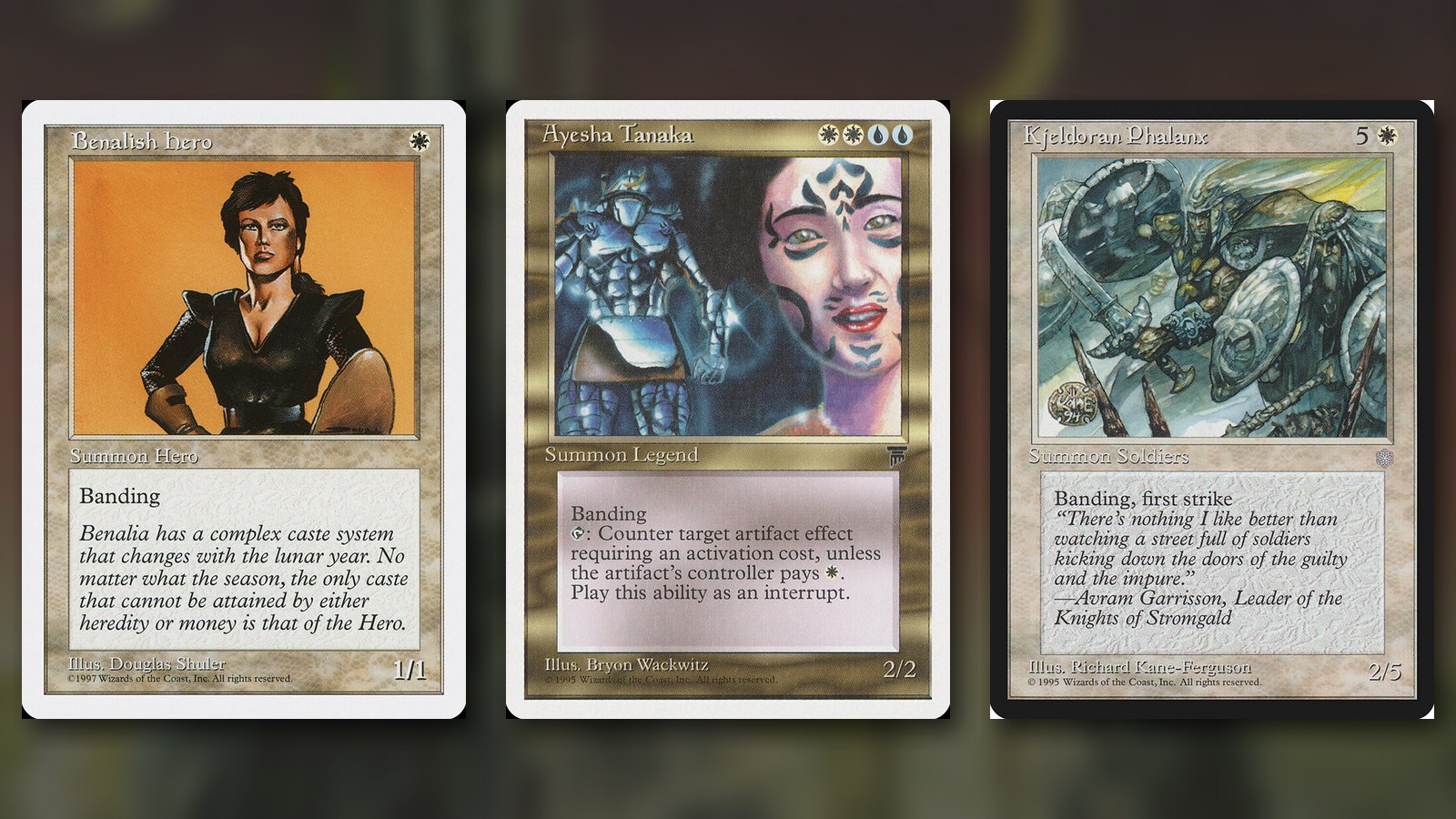
| Benalish Hero | {W} | 1/1 | — (vanilla banding) | LEA (1993) | common | 1,733 | $0.12 | Legal |
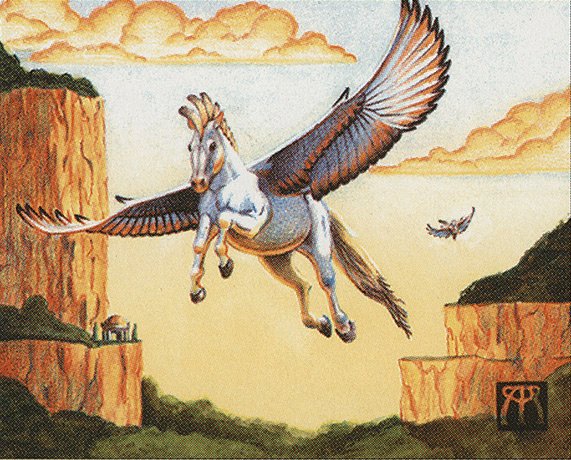
| Mesa Pegasus | {1}{W} | 1/1 | Flying | LEA (1993) | common | 1,719 | $0.16 | Legal |
| Kjeldoran Warrior | {W} | 1/1 | — (vanilla banding) | ICE (1995) | common | 1,391 | $0.28 | Legal |
| Kjeldoran Skyknight | {2}{W} | 1/1 | Flying · first strike | ICE (1995) | common | 1,250 | $0.19 | Legal |
| Pikemen | {1}{W} | 1/1 | First strike | DRK (1994) | common | 1,250 | $0.08 | Legal |
| Shield Bearer | {1}{W} | 0/3 | — (vanilla banding) | ICE (1995) | common | 1,169 | $0.18 | Legal |
| Kjeldoran Knight | {W}{W} | 1/1 | {1}{W}: This creature gets +1/+0 until end of turn. · {W}{W}: This creature gets +0/+2 until end of turn. | ICE (1995) | rare | 1,096 | $1.41 | No |
| Teremko Griffin | {3}{W} | 2/2 | Flying | MIR (1996) | common | 1,067 | $0.12 | Legal |
| Wall of Shields | {3} | 0/4 | Defender | ICE (1995) | uncommon | 1,033 | $0.34 | No |
| Benalish Infantry | {2}{W} | 1/3 | — (vanilla banding) | WTH (1997) | common | 1,024 | $0.14 | Legal |
| Icatian Skirmishers | {3}{W} | 1/1 | First strike · Whenever this creature attacks, all creatures banded with it gain first strike until end of turn. | FEM (1994) | rare | 1,015 | $0.82 | No |
| Timber Wolves | {G} | 1/1 | — (vanilla banding) | LEA (1993) | rare | 1,007 | $0.75 | No |
| War Elephant | {3}{W} | 2/2 | Trample | ARN (1993) | common | 854 | $0.19 | Legal |
| Noble Elephant | {3}{W} | 2/2 | Trample | MIR (1996) | common | 808 | $0.09 | Legal |
| Kjeldoran Escort | {2}{W}{W} | 2/3 | — (vanilla banding) | ALL (1996) | common | 724 | $0.14 | Legal |
| Kjeldoran Skycaptain | {4}{W} | 2/2 | Flying · first strike | ICE (1995) | uncommon | 723 | $0.24 | Legal |
| Knights of Thorn | {3}{W} | 2/2 | Protection from red | DRK (1994) | rare | 721 | $9.23 | Legal |
| Camel | {W} | 0/1 | As long as this creature is attacking, prevent all damage Deserts would deal to this creature and to creatures banded with this creature. | ARN (1993) | common | 708 | $5.69 | Legal |
| Mishra’s War Machine | {7} | 5/5 | At the beginning of your upkeep, this creature deals 3 damage to you unless you discard a card. If it deals damage to you this way, tap it. | ATQ (1994) | rare | 620 | $0.41 | No |
| Icatian Phalanx | {4}{W} | 2/4 | — (vanilla banding) | FEM (1994) | uncommon | 579 | $0.17 | Legal |
| Kjeldoran Phalanx | {5}{W} | 2/5 | First strike | ICE (1995) | rare | 509 | $0.98 | No |
| Ayesha Tanaka | {W}{W}{U}{U} | 2/2 | {T}: Counter target activated ability from an artifact source unless that ability’s controller pays {W}. | LEG (1994) | rare | 405 | $0.34 | No |
| Nalathni Dragon | {2}{R}{R} | 1/1 | Flying · {R}: This creature gets +1/+0 until end of turn. If this ability has been activated four or more times this turn, sacrifice this creature at the beginning of the next end step. | PDRC (1994) | rare | 290 | $0.24 | No |
| Volunteer Reserves | {1}{W} | 2/4 | Cumulative upkeep {1} | WTH (1997) | uncommon | 240 | $0.18 | No |
What the list shows:
- Banding is a white mechanic. 19 of the 24 are mono-white. The rest are Ayesha Tanaka (white-blue), two colorless artifact creatures (Mishra’s War Machine and Wall of Shields), one red (Nalathni Dragon) and one green (Timber Wolves).
- It’s cheap. 21 of the 24 cost under $1. The exceptions are Knights of Thorn ($9.23, a The Dark rare on the Reserved List), Camel ($5.69, Arabian Nights) and Kjeldoran Knight ($1.41).
- Almost nobody plays it. The most-played banding creature, Benalish Hero, is in 1,733 EDHREC decks. That is 0.04% of the 4.69 million decks that could play a white card. All 24 cards together add up to 21,935 deck slots.
- The bodies are small. 16 of the 24 have power 1 or 2 and toughness 1 or 2. The creatures that matter for banding are the high-toughness ones: Kjeldoran Phalanx (2/5, first strike), Icatian Phalanx (2/4), Volunteer Reserves (2/4), Shield Bearer (0/3) and Wall of Shields (0/4, but it has defender, so it can only use banding on defense).
- Ice Age is the banding set. 7 of the 24 debuted in Ice Age (1995), the Kjeldoran soldiers and knights, more than any other set.
Cards that give creatures banding (15)
Another 15 cards don’t have banding themselves but give it to a creature, all from the original era: artifacts that grant it for mana, auras, instants and creatures that gain it for a cost. These are what let you put the damage-assignment half of banding on a creature worth protecting.
| Card | Cost | Type | Exact text | First set | EDHREC decks | Price |
|---|---|---|---|---|---|---|
| Baton of Morale | {2} | Artifact | {2}: Target creature gains banding until end of turn. | ICE (1995) | 2,681 | $0.74 |
| Helm of Chatzuk | {1} | Artifact | {1}, {T}: Target creature gains banding until end of turn. | LEA (1993) | 2,546 | $0.52 |
| Fortified Area | {1}{W}{W} | Enchantment | Wall creatures you control get +1/+0 and have banding. | LEG (1994) | 1,711 | $0.18 |
| Soraya the Falconer | {1}{W}{W} | Legendary Creature — Human | Bird creatures get +1/+1. / {1}{W}: Target Bird creature gains banding until end of turn. | HML (1995) | 1,152 | $2.23 |
| Cooperation | {2}{W} | Enchantment — Aura | Enchant creature / Enchanted creature has banding. | ICE (1995) | 1,068 | $0.13 |
| Formation | {1}{W} | Instant | Target creature gains banding until end of turn. / Draw a card at the beginning of the next turn’s upkeep. | ICE (1995) | 1,026 | $0.92 |
| Icatian Infantry | {W} | Creature — Human Soldier | {1}: This creature gains first strike until end of turn. / {1}: This creature gains banding until end of turn. | FEM (1994) | 842 | $0.16 |
| Urza’s Engine | {5} | Artifact Creature — Juggernaut | Trample / {3}: This creature gains banding until end of turn. / {3}: Attacking creatures banded with this creature gain trample until end of turn. | ALL (1996) | 795 | $0.25 |
| Battering Ram | {2} | Artifact Creature — Construct | At the beginning of combat on your turn, this creature gains banding until end of combat. / Whenever this creature becomes blocked by a Wall, destroy that Wall at end of combat. | ATQ (1994) | 754 | $0.09 |
| Errand of Duty | {1}{W} | Instant | Create a 1/1 white Knight creature token with banding. | ALL (1996) | 738 | $0.19 |
| Nature’s Blessing | {2}{G}{W} | Enchantment | {G}{W}, Discard a card: Put a +1/+1 counter on target creature or that creature gains banding, first strike, or trample. | ALL (1996) | 593 | $0.33 |
| Wall of Caltrops | {1}{W} | Creature — Wall | Defender / Whenever this creature blocks a creature, if at least one other Wall creature is blocking that creature and no non-Wall creatures are blocking that creature, this creature gains banding until end of turn. | LEG (1994) | 563 | $0.68 |
| Urza’s Avenger | {6} | Artifact Creature — Shapeshifter | {0}: This creature gets -1/-1 and gains your choice of banding, flying, first strike, or trample until end of turn. | ATQ (1994) | 474 | $0.42 |
| Dire Wolves | {2}{G} | Creature — Wolf | This creature has banding as long as you control a Plains. | ICE (1995) | 405 | $0.18 |
| Beast Walkers | {1}{W}{W} | Creature — Human Beast Soldier | {G}: This creature gains banding until end of turn. | HML (1995) | 146 | $0.54 |
Baton of Morale and Helm of Chatzuk are the most-played cards in the family after Tolaria (2,681 and 2,546 EDHREC decks). Both are colorless, so they fit any Commander deck, and either one gives any creature banding for the combat that matters. The strongest use: give banding to a blocker in front of a big trampler, and the trample damage stays among your blockers. Nature’s Blessing is the only one with no duration. Its ruling says the banding lasts until the creature leaves the battlefield.
Is banding legal? Every format
| Format | Legal cards with printed banding (of 24) | Legal cards in the whole banding family (of 47) |
|---|---|---|
| Standard | 0 | 0 |
| Pioneer | 0 | 0 |
| Modern | 0 | 0 |
| Premodern | 20 | 33 |
| Old School 93/94 | 10 | 24 |
| Pauper | 15 | 23 |
| Legacy | 24 | 47 |
| Vintage | 24 | 47 |
| Commander | 24 | 47 |
| Arena (Historic / Timeless / Brawl) | 0 | 0 |
No banding card has ever been legal in Standard, Pioneer or Modern. They all come from sets before Eighth Edition (2003), where Modern starts, and none was ever reprinted into a Standard-legal set. None has ever been on MTG Arena, so every Arena format shows 0. All 24 banding creatures and all 47 non-Un cards in the family are legal in Legacy, Vintage and Commander. No banding card has ever been banned or restricted in any format, according to Scryfall’s legality data. Compare that with the banned list: nobody has ever needed to ban a banding card.
The fan formats are where banding still sees real play. 20 of the 24 banding creatures are legal in Premodern (which uses cards from Fourth Edition to Scourge). 10 are legal in Old School 93/94. Pauper allows 15 of the 24.
Why banding disappeared: a short history
Banding was in Magic from the first set. Limited Edition Alpha (August 1993) had four cards in the family: Benalish Hero, Mesa Pegasus, Timber Wolves and Helm of Chatzuk. The mechanic peaked in 1994 and 1995, then stopped.
| Set | Released | New cards with printed banding | New cards in the banding family |
|---|---|---|---|
| Limited Edition Alpha (LEA) | 1993-08-05 | 3 | 4 |
| Arabian Nights (ARN) | 1993-12-17 | 2 | 2 |
| Antiquities (ATQ) | 1994-03-04 | 1 | 3 |
| Legends (LEG) | 1994-06-01 | 1 | 11 |
| Dragon Con (PDRC) | 1994-07-15 | 1 | 1 |
| The Dark (DRK) | 1994-08-01 | 2 | 2 |
| Fallen Empires (FEM) | 1994-11-01 | 2 | 3 |
| Ice Age (ICE) | 1995-06-03 | 7 | 11 |
| Homelands (HML) | 1995-10-01 | 0 | 2 |
| Alliances (ALL) | 1996-06-10 | 1 | 4 |
| Mirage (MIR) | 1996-10-08 | 2 | 2 |
| Weatherlight (WTH) | 1997-06-09 | 2 | 2 |
The table tells the story. 20 of the 47 cards in the family appeared in 1994, 11 of them in Legends, the set that also invented “bands with other”. Ice Age added 11 more in 1995. After that, new banding cards dropped to two or four per set, and the last two, Benalish Infantry and Volunteer Reserves, came out in Weatherlight on 9 June 1997. Fifth Edition (March 1997) was the last core set with banding: it reprinted six banding creatures. Classic Sixth Edition (1999) printed none.
Since then the only new “banding” cards have been jokes. Greater Morphling (Unhinged, 2004) can gain banding or any of 12 other abilities. Old Fogey (Unhinged, 2004, reprinted in Unsanctioned in 2020) has “bands with other Dinosaurs” in a list of nine old keywords. The most recent printing of a real banding card is Nalathni Dragon in Mystery Booster 2 (August 2024), a reprint of a 1994 promo.
Mark Rosewater, Magic’s head designer, has said banding won’t come back. On 7 October 2012 he rated it a 10 on his “Storm Scale”, the scale he uses for how unlikely a mechanic is to return, and wrote that banding “confused everyone”. He added that he could see elements of banding coming back one day, but not the full mechanic. The problem he described is clear from the rule: one keyword does two unrelated things (grouping attackers and swapping damage assignment), and one of them changes who makes a decision rather than what a card does.
Is banding any good in Commander?
Honestly, not very. The grouping half is weak in multiplayer. A band has to attack one player, so it can’t split up to pressure several opponents, and one blocker stops the whole group. The small banding bodies from 1994 can’t keep up with modern creatures.
The damage-assignment half is still good, though, and it’s cheap. Three uses are worth a slot in a casual deck:
- Stopping trample. A creature with banding (or one given banding by Baton of Morale or Helm of Chatzuk) among the blockers means the defending player assigns the trampler’s damage, and only among blockers. Commander has a lot of big tramplers, and a 1/1 bander with a chump blocker can hold one off.
- Protecting your best creature in combat. Put your commander in a band, and all of the blocker’s damage goes onto a creature you don’t need.
- Playing around deathtouch and first strike blockers. You choose which creature the dangerous blocker damages.
Ayesha Tanaka is the only legendary creature ever printed with banding, so she’s the only banding commander. EDHREC lists 225 decks with her as commander. Her other ability counters an activated ability from an artifact source unless its controller pays {W}. Note that mana abilities can’t be targeted, since they don’t use the stack, so she can’t stop Sol Ring or signets. She stops things like equip costs, artifact sacrifice outlets and activated artifact card draw.

Budget Ayesha Tanaka banding deck ($66.80)
This is a casual deck that makes banding matter, not a competitive one. It is built around Ayesha Tanaka with 34 cards from the banding family: Ayesha, 21 more banding creatures in her colors, and the 12 white, blue and colorless cards that give banding. The rest is support that makes a pile of 1/1 soldiers work.
- Anthems turn banders into threats. Glorious Anthem, Honor of the Pure, Benalish Marshal, Spear of Heliod and Always Watching. With two out, Benalish Hero is a 3/3 for one mana, and your bands deal real damage.
- Small creatures draw cards. Skullclamp, Mentor of the Meek and Welcoming Vampire all reward a deck full of creatures with power 2 or less. Errand of Duty and Raise the Alarm give Skullclamp more to work with.
- Use the damage rule. When you attack, put a high-toughness bander in every band (Kjeldoran Phalanx, Icatian Phalanx, Volunteer Reserves) and assign every blocker’s damage to it. When you block, keep a bander among your blockers, or Baton of Morale ready, to take control of the attacker’s damage.
- Band fliers only with fliers. Mesa Pegasus, Kjeldoran Skyknight, Kjeldoran Skycaptain and Teremko Griffin make an all-flying band. Add a ground creature and the whole band can be blocked from the ground (702.22h).
- Protect the team. Unbreakable Formation and Brave the Elements save your creatures in a big combat or from a removal spell.
The deck runs 37 lands (Kjeldoran Outpost makes more soldiers), six mana rocks and nine removal spells and counterspells. It was checked card by card against Scryfall: 100 cards, all Commander-legal, all within white-blue color identity. One change came out of that check: Crusade was in the first draft and is banned in Commander, so Spear of Heliod replaced it. Prices are the cheapest ordinary (non-promo) printing of each card on Scryfall today, which totals $66.80 (lands included, basics excluded).
The ten most expensive cards in the list:
| Card | Cheapest ordinary printing | Set |
|---|---|---|
| Kjeldoran Outpost | $10.85 | ALL |
| Knights of Thorn | $9.23 | DRK |
| Camel | $5.69 | ARN |
| Skullclamp | $5.02 | MSC |
| Welcoming Vampire | $3.37 | TDC |
| Counterspell | $2.25 | 6ED |
| Soraya the Falconer | $2.23 | HML |
| Arcane Denial | $1.61 | MSC |
| Swords to Plowshares | $1.43 | MSC |
| Sol Ring | $1.42 | FIC |
Ayesha Tanaka — Budget Banding Commander
100 cards — one click loads the full list into a TCGplayer cart so you can check real prices and grab the whole deck at once.
Buy this deck on TCGplayerAffiliate link — buying through it supports KrakenTheMeta at no extra cost to you.If you’d rather start from somebody else’s list, browse the community decks on KrakenTheMeta’s deck gallery, or paste this one into the free deck analyzer to see its curve and mana. For cheaper versions of the staples, the budget swap tool suggests alternatives card by card.
Banding rulings and common mistakes
- Only one creature without banding per band. It doesn’t matter how many banders you have. (702.22c; Ayesha Tanaka’s 2008 ruling.)
- The defending player can’t form bands. Banding on defense only changes damage assignment. (702.22c.)
- A band has one defender. Every member must attack the same player, planeswalker or battle. (702.22d.)
- Losing banding after attackers are declared doesn’t break the band. (702.22e.) Tolaria can only be activated during an upkeep, so use it before combat, not after the band is announced.
- Banded creatures don’t share abilities. A band with a first striker still deals damage in two steps. (702.22g.) Icatian Skirmishers and Urza’s Engine are exceptions only because their text grants first strike or trample to the rest of the band.
- Blocking one member blocks all of them, and a blocker only needs to be able to block one member. (702.22h and its flying/swampwalk example.)
- If an effect makes one member blocked, the whole band is blocked. (702.22i.)
- You can assign all of the damage to one creature. Banding says “divide as they choose”, with no requirement to assign lethal damage in order. (702.22j/k.)
- Your own creatures’ damage is always yours to assign. Banding only takes the decision away from your opponent.
- Multiple instances of banding do nothing extra. (702.22m.)
- Removing banding removes “bands with other” too (702.22b), but Shelkin Brownie removes only “bands with other”, not banding (its Scryfall ruling).
- Wall of Caltrops gains banding during the declare blockers step, when its trigger resolves, if another Wall is also blocking that creature and no non-Walls are (card text and Scryfall ruling, 2004).
- Master of the Hunt’s ability has no tap, so you can activate it as many times as you can pay {2}{G}{G} (Scryfall ruling, 2004).
For how banding fits alongside the other old combat keywords, see our guide to combat damage keywords. Menace is the modern keyword that changes how blocks work, and protection explains why Knights of Thorn (protection from red) is the best creature to take damage from red blockers in a band.
Banding FAQ
Does banding still exist in Magic?
Yes. It is still rule 702.22 in the Comprehensive Rules, and every banding card is legal in Commander, Legacy and Vintage. But no new card with banding has been printed since Weatherlight in June 1997, apart from Un-set jokes.
What does banding do, simply?
It lets creatures attack as a group that is blocked together, and it lets the banding creature’s controller decide how the opponent’s creatures deal their combat damage in that fight.
How many creatures without banding can join a band?
One. A band can have any number of creatures with banding, but at most one without it.
Does banding work when blocking?
Yes. You can’t form a band on defense, but if a creature with banding is blocking an attacker, you decide how that attacker’s damage is split among all of its blockers (702.22j).
Does banding stop trample?
In practice, yes. If a creature with banding is blocking the trampler, the defending player assigns the trampler’s damage, and the rule only lets them divide it among the blocking creatures.
Can I band a flier with a creature that can’t fly?
You can, but then a creature that can block either member blocks the whole band. So a ground creature can block your flier by blocking the band. Band fliers with fliers.
Is banding legal in Commander?
Yes. All 24 banding creatures and all of the cards that grant it are Commander-legal. The only commander with banding is Ayesha Tanaka.
Is banding on MTG Arena?
No. No card with banding, or that gives banding, has ever been released on Arena.
Has any banding card been banned?
No. Scryfall shows no banding-family card banned or restricted in any format.
Why did Wizards stop printing banding?
Mark Rosewater gave banding a 10 on his Storm Scale in October 2012, saying it “confused everyone”. It combines two unrelated effects under one word, and one of them changes which player makes a decision.
What’s the difference between banding and “bands with other”?
Banding lets any creatures with banding group with up to one other creature. “Bands with other [quality]” lets creatures of one quality (legendary creatures, Wolves of the Hunt, Dinosaurs) band with any number of other creatures of that quality, but only with each other, and on defense it needs two such creatures blocking together.
Can a band attack a planeswalker?
Yes, as long as the whole band attacks the same planeswalker (or the same player or battle).
What is the most expensive banding card?
In the whole family, Master of the Hunt ($36.06) and Cathedral of Serra ($25.67), both from Legends. Among the 24 creatures with printed banding, Knights of Thorn ($9.23).
Banding is one of the mechanics that shaped how Magic’s rules are written today, and it still wins combats that nobody at the table expects. For more mechanics explained with every card counted, read our guides to goad, the monarch and storm. If you want to look up any of these cards’ current prices and printings, use the card finder.
Build your next deck with AI
KrakenTheMeta’s AI deck builder researches the current meta and writes you a complete, format-legal decklist in about a minute — free to try.
Build a Deck with AIor browse community decks
One Comment
Comments are closed.