MTG Dredge Explained: How It Works, All 14 Dredge Cards, and a Commander Deck (2026)
Dredge is the most notorious mechanic in Magic that almost nobody owns. It has been banned in Modern, restricted in Vintage, and it gave its name to an entire archetype that has terrorised eternal formats for twenty years. And yet the entire mechanic is fourteen cards. Twelve of them came out on the same day in 2005. You can buy a complete set of every dredge card ever printed for under ten dollars.
This guide covers what dredge actually does under the Comprehensive Rules, the seven rules interactions that decide real games, every one of the fourteen cards with current prices and legality, the single card in Magic that hands dredge to things that never had it, and a 100-card Commander deck built to abuse all of it.
What dredge actually does
Dredge is a static ability that works only while the card is in your graveyard. It is defined in rule 702.52 of the Comprehensive Rules, and 702.52a gives the exact reminder:
“Dredge N” means “As long as you have at least N cards in your library, if you would draw a card, you may instead mill N cards and return this card from your graveyard to your hand.”
That is the whole mechanic, and it is a replacement effect. You are not drawing and then doing something extra. The draw is replaced. Every time you would draw a card, you get a choice: take the card off the top of your library like normal, or mill N cards and pick up the dredge card instead.
The loop is what makes it dangerous. Dredge a card back, and it is in your hand. Play it or discard it, and it is in your graveyard again, ready to replace your next draw. A single Stinkweed Imp converts every draw step for the rest of the game into “mill five cards.” Nothing in the exchange costs mana. Nothing uses the stack. Nobody can respond to it.
The trade you are making is precise: you are spending cards off the top of your library to guarantee which card you get. In a deck that does not care what is in its graveyard, that is a terrible deal. In a deck built to fill its graveyard on purpose, it is the strongest engine in the format — which is exactly why Golgari Grave-Troll is banned in Modern.
The seven dredge rules that decide games
1. You need at least N cards in your library, or you cannot dredge at all
This clause is part of the rule itself, not a side note. With three cards left in your library, Golgari Grave-Troll (dredge 6) is simply not an option — the replacement is unavailable and you draw normally. With exactly six cards left, you may dredge, and you will mill your last six.
The practical consequence catches players out constantly: dredge cannot save you from decking out. It accelerates the problem. Once your library is empty, you cannot dredge, and the next draw you are required to make loses you the game.
2. You draw nothing
The card you would have drawn stays on top of your library and then gets milled as part of the dredge. Effects that trigger on drawing a card do not trigger. If an opponent has an effect punishing you for drawing, dredging sidesteps it entirely. If you have a payoff that cares about drawing cards, dredging turns it off.
3. It only functions in the graveyard
Dredge does nothing from your hand, nothing on the battlefield, and nothing in exile. A Stinkweed Imp sitting in your opening hand is a three-mana 1/2 flyer and no more. The mechanic only switches on after the card has already died, been discarded, or been milled. Getting the card into the graveyard is the real first step of every dredge deck.
4. It is optional, every single time
Dredge says “you may.” You choose per draw, and you can decline. This matters more than it sounds: when you are at four cards in library and need a specific answer, drawing normally is often correct. Nothing forces you onto the dredge treadmill once you start.
5. One replacement per draw
If you have three dredge cards in your graveyard and you draw one card, you dredge one of them. Each draw is a separate event that can be replaced once. The way to dredge repeatedly in a turn is to have multiple draws — which is why cheap cantrips and repeatable draw engines are the real enablers, not more dredge cards.
6. Milling yourself is the cost and the point at the same time
Every card dredge puts in your graveyard is a card you can no longer draw. In a vacuum that is card disadvantage. In a deck full of recursion, flashback and reanimation targets, those milled cards are resources you have just moved somewhere more useful. If you want the wider version of that plan, our guide to the best mill cards in MTG covers the self-mill shells that dredge slots into.
7. A dredge card that gets milled is immediately live
This is the interaction that makes dredge snowball. Dredge six cards off the top, and if one of those six is another dredge card, it lands in your graveyard where its ability works. Your next draw can now dredge that one instead. Dredge decks do not draw into their engine; they mill into it.
Every dredge card in Magic
All fourteen, sorted by dredge value. Prices are the cheapest available printing at the time of writing, and every card here is legal in Commander.
| Card | Dredge | Cost | Type | Debut set | Price |
|---|---|---|---|---|---|
| Golgari Grave-Troll | 6 | {4}{G} | Creature — Troll Skeleton | Ravnica: City of Guilds | $0.83 |
| Stinkweed Imp | 5 | {2}{B} | Creature — Imp | Ravnica: City of Guilds | $1.07 |
| Golgari Thug | 4 | {1}{B} | Creature — Human Warrior | Ravnica: City of Guilds | $0.38 |
| Life from the Loam | 3 | {1}{G} | Sorcery | Ravnica: City of Guilds | $5.01 |
| Darkblast | 3 | {B} | Instant | Ravnica: City of Guilds | $0.35 |
| Shambling Shell | 3 | {1}{B}{G} | Creature — Plant Zombie | Ravnica: City of Guilds | $0.12 |
| Greater Mossdog | 3 | {3}{G} | Creature — Plant Dog | Ravnica: City of Guilds | $0.05 |
| Necroplasm | 2 | {1}{B}{B} | Creature — Ooze | Ravnica: City of Guilds | $0.67 |
| Dakmor Salvage | 2 | — | Land | Future Sight | $0.25 |
| Moldervine Cloak | 2 | {2}{G} | Enchantment — Aura | Ravnica: City of Guilds | $0.14 |
| Golgari Brownscale | 2 | {1}{G}{G} | Creature — Lizard | Ravnica: City of Guilds | $0.11 |
| Nightmare Void | 2 | {3}{B} | Sorcery | Ravnica: City of Guilds | $0.09 |
| Shenanigans | 1 | {1}{R} | Sorcery | Modern Horizons | $0.31 |
| Grave-Shell Scarab | 1 | {2}{B}{G}{G} | Creature — Insect | Ravnica: City of Guilds | $0.28 |
Total cost of every dredge card ever printed: $9.66. More than half of that is one card — Life from the Loam at $5.01. The other thirteen combined come to $4.65.
Dredge by the numbers
Three things stand out once you count the mechanic properly, and all three are unusual for a keyword this famous.
Twelve of the fourteen came from one set
| Debut set | Year | Dredge cards |
|---|---|---|
| Ravnica: City of Guilds | 2005 | 12 |
| Future Sight | 2007 | 1 |
| Modern Horizons | 2019 | 1 |
| Total | 14 |
Dredge was a Golgari guild mechanic in the original Ravnica block and Wizards has essentially never gone back. In the twenty-one years since, exactly two more dredge cards have been printed: Dakmor Salvage in Future Sight and Shenanigans in Modern Horizons, fourteen years apart.
The dredge numbers cluster low
| Dredge value | Cards |
|---|---|
| Dredge 6 | 1 |
| Dredge 5 | 1 |
| Dredge 4 | 1 |
| Dredge 3 | 4 |
| Dredge 2 | 5 |
| Dredge 1 | 2 |
Only three cards dredge for four or more, and the single dredge 6 is the one that got banned. That is not a coincidence: dredge value is raw speed, and speed is what breaks the mechanic.
It is a Golgari mechanic with exactly one exception
| Colour | Cards |
|---|---|
| Black | 5 |
| Green | 5 |
| Black-green | 2 |
| Colourless (land) | 1 |
| Red | 1 |
Thirteen of the fourteen sit inside the black-green Golgari identity or are colourless. The lone outlier is Shenanigans, a red artifact-removal sorcery from Modern Horizons — printed in 2019, fourteen years after the mechanic debuted, and still the only red card with dredge in the game.
The one card that gives other cards dredge
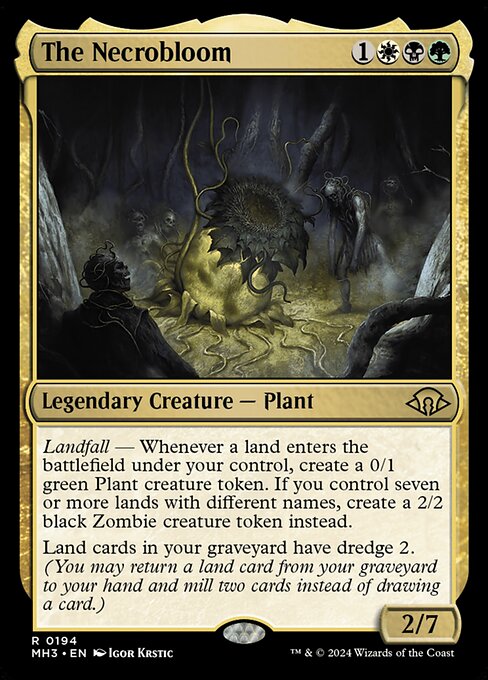
The Necrobloom from Modern Horizons 3 is a four-mana legendary Plant with landfall, and its second ability is unique in all of Magic:
Land cards in your graveyard have dredge 2.
No other card grants dredge. That single line takes a mechanic with fourteen members and applies it to every land in your graveyard — a zone that fills up naturally through fetches, sacrifice lands and self-mill. Every land in the yard becomes a repeatable “mill two, return a land to hand,” and since the returned card is a land, you can replay it for free that turn instead of paying mana for it.
Pair it with Life from the Loam and the deck stops resembling a normal Magic deck. It is also the reason The Necrobloom is the obvious commander for a dredge deck, which we build below. If land value is your thing generally, our best lands for Commander guide is the companion piece.
Where dredge is legal in 2026
| Format | Legal | Notes |
|---|---|---|
| Commander | 14 of 14 | Nothing restricted — even the Modern ban is legal here |
| Legacy | 14 of 14 | All fourteen fully legal |
| Vintage | 13 of 14 | Golgari Grave-Troll is restricted to one copy |
| Modern | 13 of 14 | Golgari Grave-Troll is banned |
| Pauper | 6 of 14 | Only the commons are legal |
| Pioneer | 0 of 14 | No dredge card has ever been Pioneer-legal |
| Standard | 0 of 14 | Nothing has been Standard-legal since 2007 |
Two figures are worth pausing on. Golgari Grave-Troll is the only dredge card that has ever been hit by any format — and it has been hit twice, banned in Modern and restricted in Vintage. Every other dredge card is unrestricted everywhere it is legal.
And dredge has a hard zero in Pioneer. Pioneer starts at Return to Ravnica in 2012; twelve dredge cards predate it by seven years, Dakmor Salvage by five, and Shenanigans only ever appeared in Modern Horizons, a set that has never been Pioneer-legal. There is no dredge in Pioneer and, short of a reprint, there never will be.
The six Pauper-legal dredge cards are Stinkweed Imp, Greater Mossdog, Shambling Shell, Golgari Brownscale, Moldervine Cloak and Shenanigans — which is enough of an engine that dredge shells are a real presence in the format.
The best dredge cards, ranked
EDHREC inclusion ranks give a useful sanity check on which of the fourteen people actually play. The spread is enormous: from inside the top 1,000 cards in Commander down past 21,000.
The three that are genuinely great
| Card | Dredge | EDHREC rank | Why it is played |
|---|---|---|---|
| Life from the Loam | 3 | #701 | Returns three lands per cast and dredges itself back forever. The best card the mechanic ever produced, and the engine of every lands deck in Legacy. |
| Dakmor Salvage | 2 | #1287 | The only land with dredge. Lands are played, not cast, so it recurs itself without ever costing mana. |
| Golgari Grave-Troll | 6 | #2726 | The highest dredge value in the game and a creature that grows with your graveyard. Banned in Modern for exactly that reason. |
The reliable engine pieces
| Card | Dredge | EDHREC rank | Role |
|---|---|---|---|
| Stinkweed Imp | 5 | #3104 | Dredge 5 on a three-mana body that also kills anything it touches in combat. The classic engine when Grave-Troll is illegal. |
| Golgari Thug | 4 | #3437 | Dredge 4, and on death it puts a creature from your graveyard back on top of your library — which the next dredge then mills again. |
| Shenanigans | 1 | #9512 | Repeatable artifact removal for two mana. Low dredge value is the point: it barely costs you library. |
| Darkblast | 3 | #10052 | A one-mana instant that recurs every turn. Kills x/1s all game long for free. |
The fringe and the filler
| Card | Dredge | EDHREC rank | Verdict |
|---|---|---|---|
| Shambling Shell | 3 | #14327 | Free sacrifice outlet that comes back. Real value in aristocrats shells. |
| Necroplasm | 2 | #15295 | A recurring sweeper that scales up each turn. Slow, but genuinely powerful. |
| Golgari Brownscale | 2 | #18293 | Two life per dredge adds up in long games. Otherwise blank. |
| Moldervine Cloak | 2 | #18830 | A +3/+3 aura that returns after removal. Fine in Pauper, marginal elsewhere. |
| Grave-Shell Scarab | 1 | #19164 | Five mana is far too many, but dredge 1 is the cheapest possible library cost. |
| Greater Mossdog | 3 | #19572 | A vanilla 3/3 with dredge 3. Pure engine, zero text. |
| Nightmare Void | 2 | #21678 | Repeatable targeted discard. Least-played dredge card in Commander. |
Five cards named “Dredge” that do not have dredge
This trips up searches constantly. Five cards carry the word in their name and not one of them has the mechanic — including a card called simply Dredge, printed in Invasion in 2000, five years before dredge existed.
| Card | Cost | Set | What it actually does |
|---|---|---|---|
| Dredge | {B} | Invasion (2000) | Sacrifice a creature or land, draw a card. Predates the mechanic entirely. |
| Canal Dredger | {4} | Conspiracy (2014) | A draft-matters artifact creature that bottoms cards from graveyards. |
| Dredge the Mire | {3}{B} | Commander 2020 | Steals a creature from each opponent’s graveyard. |
| Treasure Dredger | {1}{B} | Outlaws of Thunder Junction (2024) | Pays life to make Treasure tokens. |
| Dredger’s Insight | {1}{G} | Aetherdrift (2025) | Mills four and gains life on graveyard recursion. |
If you are searching a card database for dredge, search the rules text, not the name. The name will give you five cards without the mechanic and miss all fourteen that have it.
Dredge versus every other way back from the graveyard
| Mechanic | Costs mana? | Repeatable? | Where the card ends up |
|---|---|---|---|
| Dredge | No | Yes, forever | Your hand |
| Flashback | Yes | No — exiled after | Exile |
| Escape | Yes | Yes, if you keep exiling | Battlefield or stack |
| Unearth | Yes | No — exiled at end of turn | Exile |
| Reanimation spells | Yes | Only with recursion | Battlefield |
Dredge is the only one of these that costs no mana and never exiles itself. That is the entire case for the mechanic, and the entire reason it needed banning. For the mana-paying alternatives, see our breakdowns of how flashback works and the best reanimation spells in MTG.
Dredge also has a cousin on the way in: surveil looks at the top cards of your library and lets you choose which ones go to the graveyard, where dredge then finds them. The two do not interact directly — surveil is not a draw, so a dredge card in your graveyard cannot replace it — but a surveil that bins a dredge card is the fastest way to start the engine, and the 20 surveil lands do it as a land drop.
How to build a dredge Commander deck
The Necrobloom is the natural commander because it is the only card that scales the mechanic past fourteen. The colour identity is white-black-green, which happens to legally contain thirteen of the fourteen dredge cards — only the red Shenanigans is excluded.
The deck below runs all thirteen. The plan is straightforward: fill the graveyard, turn every draw into a dredge, recur lands with Life from the Loam and Crucible of Worlds, and win through accumulated land drops and landfall triggers. It is 44 lands and 56 spells, which looks absurd until you remember that with The Necrobloom on the battlefield, a land in the graveyard is a card in your hand.
The single most important build note: you need real draw spells. Dredge replaces draws, so a deck with no card draw has no dredge triggers beyond one per turn. Sylvan Library, Phyrexian Arena and Skullclamp are engine pieces here, not filler.
Total cost on cheapest printings is about $256, and 53 of the 88 unique cards are under a dollar — the price is concentrated in a handful of staples you likely already own. Swap Sylvan Library, Crucible of Worlds and Damnation for budget alternatives and it lands near $180.
The Necrobloom Dredge — 100-Card Commander Deck
100 cards — one click loads the full list into a TCGplayer cart so you can check real prices and grab the whole deck at once.
Buy this deck on TCGplayerAffiliate link — buying through it supports KrakenTheMeta at no extra cost to you.How the deck actually wins
It does not win by dredging. Dredging is the engine, not the plan. The kill comes from Titania, Protector of Argoth making 5/3 Elementals every time a land hits the graveyard, The Gitrog Monster converting every mill into extra cards, and Splendid Reclamation returning a graveyard full of lands to the battlefield at once for a landfall burst. Ghost Quarter and Field of Ruin are deliberately included because sacrificing them is upside once Loam can return them every turn.
If you want to see what other players are doing with graveyard-heavy commanders, our public deck gallery is full of Golgari builds, and you can price out any of these cards with the card price tool.
Frequently asked questions about dredge
What does dredge do in MTG?
Dredge replaces a card draw. Instead of drawing, you mill N cards from the top of your library and return the dredge card from your graveyard to your hand. It costs no mana and works only from the graveyard.
How many cards have dredge?
Fourteen. Twelve debuted in Ravnica: City of Guilds in 2005, one in Future Sight in 2007, and one in Modern Horizons in 2019.
Do you have to dredge?
No. Dredge says “you may,” and you make the choice separately for each draw. You can always take the normal draw instead.
Can you dredge with an empty library?
No. Rule 702.52a requires at least N cards in your library. Dredge cannot prevent you from decking out — it makes it happen faster.
Does dredge count as drawing a card?
No. The draw is replaced, so nothing that triggers on drawing a card will trigger, and effects that punish you for drawing do not apply.
Can you dredge more than once per turn?
Yes, but only once per draw. Each draw can be replaced by one dredge, so dredging multiple times in a turn requires multiple draw effects.
Is dredge banned?
Golgari Grave-Troll is banned in Modern and restricted in Vintage. It is the only dredge card restricted in any format — the other thirteen are unrestricted everywhere they are legal.
Is dredge legal in Commander?
Yes. All fourteen dredge cards are legal in Commander, including Golgari Grave-Troll.
Is dredge legal in Pioneer or Standard?
No. No dredge card has ever been legal in Pioneer, which begins at Return to Ravnica in 2012, and none has been Standard-legal since 2007.
What is the best dredge card?
Life from the Loam, comfortably. It is the only dredge card inside EDHREC’s top 1,000 and it anchors lands decks across multiple formats.
Does dredge work from your hand or the battlefield?
No. Dredge is a static ability that functions only while the card is in your graveyard. In any other zone it does nothing.
Is there a dredge commander?
The Necrobloom from Modern Horizons 3 is the closest thing. It is the only card in Magic that grants dredge to other cards, giving every land in your graveyard dredge 2.
What happens if you dredge a card that is already in your graveyard?
Dredge cards milled into the graveyard are immediately live. If a dredge puts another dredge card into your graveyard, you can dredge that one on your next draw — which is how dredge decks assemble their engine without drawing any cards.
Build your next deck with AI
KrakenTheMeta’s AI deck builder researches the current meta and writes you a complete, format-legal decklist in about a minute — free to try.
Build a Deck with AIor browse community decks