MTG Phasing Explained: How Phasing Works, Every Phase-Out Card Ranked, All 13 Phasing Cards and a $79 King of the Oathbreakers Deck (2026)
Phasing is the Magic: The Gathering mechanic that makes a permanent temporarily stop existing. A phased-out permanent is treated as though it isn’t on the battlefield until its controller’s next untap step, when it phases back in with its counters, Auras and Equipment still attached. It never leaves the battlefield, so nothing that says “enters” or “leaves” triggers.
We pulled every card that uses phasing from Scryfall and every deck count from EDHREC. There are 70 phasing cards in paper Magic. Only 13 have the phasing keyword, and 12 of those were printed in 1996 and 1997 (the 13th is an Un-set joke card). The other 57 just say “phases out”, and that’s the version of the mechanic people actually play: 35 of them have been released since 2017. One card, Teferi’s Protection, is in 741,738 Commander decks. That’s 66 times as many as all 13 keyword cards put together, and 31% of every deck slot any phasing card fills.
This guide covers the exact rules, what happens to tokens, Auras, counters and combat, how phasing compares to exile, blink, hexproof and indestructible, the 25 most-played phase-out cards, all 13 cards with the keyword, the history, the phasing commanders ranked by real deck counts, prices, legality in every format and a $78.72 budget Commander deck built around King of the Oathbreakers, the most-built phasing commander.
What is phasing in MTG?
Phasing started as a keyword on Mirage cards in 1996. Here is the core of the rule from the current Comprehensive Rules (effective 25 September 2026):
702.26a Phasing is a static ability that modifies the rules of the untap step. During each player’s untap step, before the active player untaps permanents, all phased-in permanents with phasing that player controls “phase out.” Simultaneously, all phased-out permanents that had phased out under that player’s control “phase in.”
702.26b If a permanent phases out, its status changes to “phased out.” Except for rules and effects that specifically mention phased-out permanents, a phased-out permanent is treated as though it does not exist. It can’t affect or be affected by anything else in the game. A permanent that phases out is removed from combat.
702.26d The phasing event doesn’t actually cause a permanent to change zones or control, even though it’s treated as though it’s not on the battlefield and not under its controller’s control while it’s phased out. Zone-change triggers don’t trigger when a permanent phases in or out. Tokens continue to exist on the battlefield while phased out. Counters and stickers remain on a permanent while it’s phased out.
Three facts answer most phasing questions:
- A phased-out permanent doesn’t exist for the game. It can’t be targeted, destroyed, exiled, sacrificed, counted, attacked or blocked. Its static abilities stop working and its triggered abilities can’t trigger. If you control three creatures and one is phased out, “draw a card for each creature you control” draws two.
- It comes back on its own. Phased-out permanents phase in during their controller’s next untap step, just before that player untaps. A creature that phases in can attack and use tap abilities that turn, because you’ve controlled it the whole time.
- It never leaves the battlefield. No “enters” or “leaves the battlefield” abilities trigger, it keeps its counters, and it keeps anything attached to it.
The phasing keyword vs “phases out”
There are two ways a card can use the mechanic. The phasing keyword (Merfolk Raiders, Teferi’s Isle, Taniwha) makes the permanent phase out on its own every other untap step, forever: out on one of your turns, back in on the next. Wizards stopped printing it after Weatherlight in 1997. The second way is an effect that says a permanent “phases out”, once, usually for a single turn cycle. That’s what every modern phasing card does, and it’s the version that matters in Commander. Both follow the same rule above: the only difference is whether the permanent phases out once or keeps doing it.
How phasing works: tokens, Auras, counters and combat
When do phased-out permanents come back?
During their controller’s next untap step, before anything untaps. Phasing in isn’t optional and doesn’t use the stack, so nobody can respond to it. If your untap step is skipped, the phasing simply doesn’t happen that turn (702.26m). A few cards change the timing: Oubliette, The Moment and The Pandorica keep a permanent phased out for as long as they stay on the battlefield (or stay tapped), and Disciple of Caelus Nin says “Permanents can’t phase in” at all, which turns every phase-out into a lock.
What happens to tokens?
They phase out and come back like any other permanent. This changed in 2017: under the old rules a phased-out token ceased to exist, which is why older articles still warn you not to phase out your tokens. Scryfall’s Teferi’s Protection rulings call the current behaviour “a change from previous rules”. Today you can phase out a board of Spirit or Soldier tokens and get all of them back.
What happens to Auras, Equipment and counters?
Anything attached to a permanent phases out with it “indirectly” (702.26g) and comes back still attached. Counters stay on, so a planeswalker phases back in with the same loyalty and a creature keeps its +1/+1 counters. Choices made when the permanent entered, like a named card or a chosen creature type, are remembered. If an Aura or Equipment phases out on its own and the thing it was attached to is gone when it comes back, it phases in unattached and an Aura goes to the graveyard.
Does phasing trigger “enters the battlefield” abilities?
No. Phasing out isn’t leaving and phasing in isn’t entering, so ETB and leaves-the-battlefield triggers never fire. That’s the biggest practical difference from blinking. It also means any effect waiting “until this leaves the battlefield” is unaffected: if you phase out your own Banishing Light, the exiled card stays exiled. But effects that last “for as long as” something is true do notice: if you phase out a creature that’s holding another creature with “for as long as you control this”, that effect ends for good (702.26f).
Phasing in combat
A permanent that phases out is removed from combat (506.4). Phase out an attacker and it deals no damage and takes none. Phase out a blocker and the creature it blocked stays blocked (509.1h), so it deals no combat damage unless it has trample. Phase out your own creatures during an opponent’s turn and they can’t block; phase out an opponent’s creatures before your attack and they can’t block either, which is how kicked Galadriel’s Dismissal ends games.
Phasing in response to removal
Because a phased-out permanent can’t be targeted, phasing it out in response makes a targeted spell lose that target. If all of a spell’s targets are gone, it doesn’t resolve at all. Board wipes don’t target, but they can’t see phased-out permanents either, so a “destroy all creatures” or “exile all nonland permanents” simply misses them.
Phasing vs exile, blink, hexproof and indestructible
Phasing is often lumped in with other protection. The rules make it stronger than any of them against removal, and weaker in one important way: your phased-out creatures can’t block.
| Question | Phasing out | Blink (exile and return) | Hexproof | Indestructible |
|---|---|---|---|---|
| Survives a “destroy all” board wipe? | Yes | Only if blinked in response | No | Yes |
| Survives an “exile all” or sacrifice effect? | Yes | Only if blinked in response | No | No |
| Stops opponents’ targeted removal? | Yes | Yes, in response | Yes | Only destroy effects |
| Triggers “enters the battlefield” abilities? | No | Yes | — | — |
| Keeps counters, Auras and Equipment? | Yes | No (it’s a new object) | Yes | Yes |
| Can the creature block until your next turn? | No | Yes | Yes | Yes |
| Can it attack the turn it comes back? | Yes | Only with haste | Yes | Yes |
For more on the other options, see our guides to protection, indestructible and the best blink commanders.
The 25 most-played phase-out cards
These are the phasing cards Commander players actually run, ranked by the number of EDHREC decks that include them. The 25 cards below account for 96.3% of every deck slot filled by any phasing card. Six are in more than 100,000 decks each.
| Card | Mana cost | Type | What it phases out | First set | EDHREC decks | Cheapest copy |
|---|---|---|---|---|---|---|
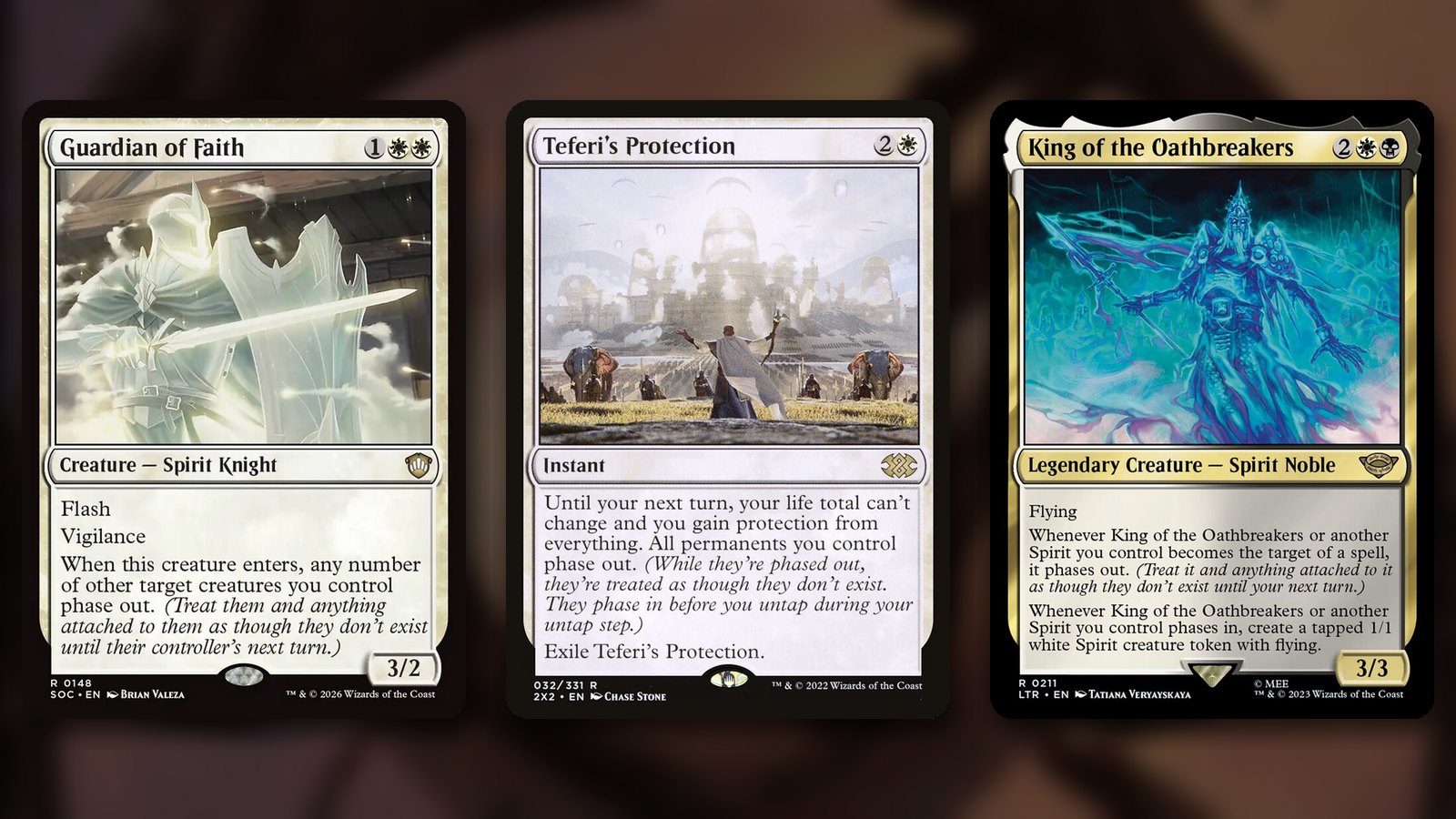
| Teferi’s Protection | {2}{W} | Instant | All your permanents, plus life lock and protection from everything | C17 (2017) | 741,738 | $38.53 |
| Clever Concealment | {2}{W}{W} | Instant | Any number of your nonland permanents (convoke) | ONC (2023) | 242,144 | $3.71 |
| Talon Gates of Madara | Land | Up to one creature, when the land enters (or from hand for {4}) | M3C (2024) | 238,252 | $31.15 | |
| Ripples of Potential | {1}{U} | Instant | Your permanents that got a counter from its proliferate | LCC (2023) | 165,243 | $3.60 |
| Slip Out the Back | {U} | Instant | One creature, which also gets a +1/+1 counter | SNC (2022) | 143,207 | $3.77 |
| March of Swirling Mist | {X}{U} | Instant | Up to X creatures (pitch blue cards to cut the cost) | NEO (2022) | 101,128 | $4.31 |
| Galadriel’s Dismissal | {W} | Instant | One creature, or every creature a player controls if kicked | LTC (2023) | 98,899 | $30.77 |
| Guardian of Faith | {1}{W}{W} | Creature | Any number of your other creatures (flash, on entry) | AFR (2021) | 84,687 | $0.61 |
| Teferi, Master of Time | {2}{U}{U} | Legendary Planeswalker | A creature you don’t control (−3, at instant speed) | M21 (2020) | 75,678 | $7.79 |
| Perch Protection | {4}{W}{W} | Instant | All your permanents, if you promise the gift | BLC (2024) | 68,351 | $3.77 |
| Robe of Stars | {1}{W} | Artifact | The equipped creature, for {1}{W} | AFC (2021) | 54,278 | $15.23 |
| Oubliette | {1}{B}{B} | Enchantment | One creature, until Oubliette leaves | ARN (1993) | 41,036 | $2.74 |
| Haystack | {1}{W} | Artifact | One creature you control, for {2} and a tap | ACR (2024) | 31,807 | $0.35 |
| Out of Time | {1}{W}{W} | Enchantment | Every creature, until its time counters run out | MH2 (2021) | 25,688 | $0.32 |
| Kaito Shizuki | {1}{U}{B} | Legendary Planeswalker | Itself, at end step on the turn it entered | NEO (2022) | 24,399 | $1.31 |
| Vronos, Masked Inquisitor | {3}{U}{U} | Legendary Planeswalker | Up to two of your other planeswalkers (+1) | CMM (2023) | 21,189 | $4.08 |
| Change of Plans | {X}{1}{U} | Instant | Any of the X creatures that connived | NCC (2022) | 21,023 | $13.96 |
| Vanishing | {U} | Enchantment | The enchanted creature, for {U}{U} | VIS (1997) | 16,667 | $0.46 |
| Unite the Coalition | {2}{W}{U}{B}{R}{G} | Instant | One permanent per mode chosen | DMC (2022) | 15,430 | $0.95 |
| The War Doctor | {2}{R}{W} | Legendary Creature | Nothing itself: counts permanents phasing out | WHO (2023) | 13,906 | $0.37 |
| Brokers Confluence | {2}{G}{W}{U} | Instant | One creature per mode chosen | NCC (2022) | 12,072 | $1.47 |
| Hostile Hostel | Land | Creeping Inn, for {4} | MID (2021) | 11,471 | $0.68 | |
| The Phasing of Zhalfir | {2}{U}{U} | Enchantment | A nonland permanent, chapters I and II, while you keep the Saga | DMU (2022) | 10,240 | $0.34 |
| Renegade Silent | {3}{U} | Creature | Itself, every end step | WHO (2023) | 9,986 | $0.30 |
| Teferi’s Veil | {1}{U} | Enchantment | Each of your attackers, at end of combat | WTH (1997) | 9,687 | $1.07 |
Teferi’s Protection is the reason most players know the word. It phases out everything you control, locks your life total and gives you protection from everything until your next turn, so a board wipe, an alpha strike or a “each player loses” effect all miss you. It’s on the Commander Game Changers list (see our Commander banned list guide), and at $38.53 for the cheapest copy it’s the most expensive phasing card. Note what it doesn’t do: you can still be attacked, and the damage is prevented. Your creatures are phased out, so they can’t block for anyone else.
Clever Concealment (242,144 decks) is the budget answer: it phases out any number of your nonland permanents, and convoke lets a board of tokens pay for it. Unlike Teferi’s Protection it leaves your lands behind, which means you keep your mana after a wipe. Perch Protection is the closest copy of Teferi’s Protection at six mana, and makes four 2/2 fliers whether or not you promise the gift.
The rest of the top ten split into two jobs. Slip Out the Back, Ripples of Potential, Guardian of Faith and March of Swirling Mist save your own things. Talon Gates of Madara, Galadriel’s Dismissal and Teferi, Master of Time can point at either side: save your creature, or remove an opponent’s blocker for a turn.

Phasing as removal and as a combat trick
Phasing out an opponent’s permanent is temporary removal: it’s gone for one turn cycle and comes back untouched. That sounds weak, but timing makes it strong. Phase out a blocker in your main phase and the attack goes through. Phase out an attacker during combat and the damage never happens. Kicked Galadriel’s Dismissal phases out every creature one player controls for a single white mana plus kicker, which clears the way for a lethal attack.
Some cards make it last longer. The Phasing of Zhalfir keeps its targets phased out for as long as you control the Saga, then destroys every creature on chapter III. Oubliette holds a creature until the enchantment leaves. Teferi, Timeless Voyager‘s ultimate phases out an opponent’s whole team and keeps it out through their next turn. And Disciple of Caelus Nin lets every player keep five permanents, phases out the rest and stops anything phasing back in.
The newest phasing card does something no other card does. Teferi’s Reproach (Reality Fracture Commander, released 2 October 2026) is Teferi’s Protection pointed at an opponent: until that player’s next turn, all their nonland permanents phase out, their life can’t change and they gain protection from everything. Their blockers, mana rocks and static hate pieces are gone for your turn and everyone else’s, but you can’t hurt that player either. It’s already in 2,797 decks on EDHREC two days after release.
All 13 cards with the phasing keyword
These are the cards that phase out every other turn on their own. Seven come from Mirage, three from Visions and two from Weatherlight; the last is Old Fogey from Unhinged, a joke card that isn’t legal anywhere. Six of the 13 are on the Reserved List, so they’ll never be reprinted.
| Card | Mana cost | Type | P/T | First set | Reserved List | EDHREC decks | Cheapest copy |
|---|---|---|---|---|---|---|---|
| Taniwha | {3}{U}{U} | Legendary Creature | 7/7 | MIR (1996) | Yes | 5,357 | $5.96 |
| Teferi’s Isle | — | Legendary Land | — | MIR (1996) | Yes | 3,143 | $10.95 |
| Merfolk Raiders | {1}{U} | Creature | 2/3 | MIR (1996) | No | 344 | $0.22 |
| Teferi’s Imp | {2}{U} | Creature | 1/1 | MIR (1996) | Yes | 281 | $1.02 |
| Sandbar Crocodile | {4}{U} | Creature | 6/5 | MIR (1996) | No | 224 | $0.10 |
| Teferi’s Drake | {2}{U} | Creature | 3/2 | MIR (1996) | No | 199 | $0.14 |
| Warping Wurm | {2}{G}{U} | Creature | 1/1 | MIR (1996) | Yes | 67 | $0.61 |
| Katabatic Winds | {2}{G} | Enchantment | — | VIS (1997) | Yes | 559 | $1.06 |
| Shimmering Efreet | {2}{U} | Creature | 2/2 | VIS (1997) | No | 416 | $0.22 |
| Breezekeeper | {3}{U} | Creature | 4/4 | VIS (1997) | No | 127 | $0.10 |
| Ertai’s Familiar | {1}{U} | Creature | 2/2 | WTH (1997) | Yes | 381 | $0.84 |
| Tolarian Drake | {2}{U} | Creature | 2/4 | WTH (1997) | No | 100 | $0.14 |
| Old Fogey | {G}{G} | Summon | 7/7 | UNH (2004) | No | 0 | — |
All 13 together are in 11,198 Commander decks. Most of that is Taniwha (5,357), a 7/7 trampler for five whose drawback is that all your lands phase out every upkeep, and Teferi’s Isle (3,143), a land that taps for two blue but only exists every other turn.
What did the keyword cost? Mirage-block stats
Phasing on a creature means it’s only around for half your turns, so you’d expect the creatures to be bigger. We compared the 10 phasing creatures from Mirage, Visions and Weatherlight with the other 292 creatures from the same three sets that have printed power and toughness:
| Mana value | Phasing creatures (n) | Their average P/T | Other Mirage-block creatures (n) | Their average P/T |
|---|---|---|---|---|
| 2 | 2 | 2.00 / 2.50 | 44 | 1.30 / 1.66 |
| 3 | 4 | 2.00 / 2.25 | 82 | 1.96 / 2.02 |
| 4 | 2 | 2.50 / 2.50 | 80 | 2.61 / 2.70 |
| 5 | 2 | 6.50 / 6.00 | 38 | 3.34 / 3.84 |
| All (avg MV 3.4 vs 3.44) | 10 | 3.00 / 3.10 | 292 | 2.40 / 2.56 |
At almost the same average mana value (3.4 against 3.44), phasing creatures averaged 3.0 / 3.1 against 2.4 / 2.56: about +0.6 power and +0.5 toughness. By mana value it’s bigger at 2 and 5 mana, about even at 3 and slightly smaller at 4. The samples are tiny (two to four creatures per row), so treat this as a direction, not a rate. Wizards did pay for the drawback with stats; it just wasn’t enough to make the cards good.
A short history of phasing
Phasing was Mirage’s headline mechanic in 1996 and was gone by the end of the block. Of the 70 phasing cards, 32 were first printed in Mirage, Visions or Weatherlight. Then nothing for 20 years apart from an Unhinged joke, until Teferi’s Protection in Commander 2017. Since 2020, Wizards has released 34 cards that phase things out, with one more previewed for November, and none of them has the keyword.
| Year | Cards with the phasing keyword | Cards that phase things out | Most-played card that year | Sets |
|---|---|---|---|---|
| 1993 | 0 | 1 | Oubliette | ARN |
| 1996 | 7 | 11 | Reality Ripple | MIR |
| 1997 | 5 | 9 | Vanishing | VIS, WTH |
| 2004 | 1 | 0 | Old Fogey | UNH |
| 2017 | 0 | 1 | Teferi’s Protection | C17 |
| 2020 | 0 | 2 | Teferi, Master of Time | M21 |
| 2021 | 0 | 7 | Guardian of Faith | MH2, AFR, AFC, MID |
| 2022 | 0 | 10 | Slip Out the Back | NEO, NCC, SNC, DMU, DMC, UNF, BRC |
| 2023 | 0 | 10 | Clever Concealment | ONC, LTR, CMM, WHO, LTC, LCC |
| 2024 | 0 | 3 | Talon Gates of Madara | M3C, ACR, BLC |
| 2026 | 0 | 3 | Vision, Synthezoid Avenger | MSC, FRC, TRK |
Two dates in the table need a footnote. Oubliette (1993) predates phasing by three years. Its original Arabian Nights wording took the creature out of the game but let it keep its counters, which is close to how phasing works, and its Oracle text has used “phases out” since its Double Masters reprint in 2020. And one of the three 2026 cards isn’t out yet: The City on the Edge of Forever, from the Star Trek set due on 13 November, phases out every artifact and creature and makes a token that says “Permanents can’t phase in”. It’s counted in the 70 but left out of the legality and price tables.
The best phasing commanders
Four legal commanders use phasing directly. On EDHREC they lead 5,834 decks between them, and one card leads 88% of those.
| Commander | Colours | What it does with phasing | First set | Decks led (EDHREC) | Cheapest copy |
|---|---|---|---|---|---|
| King of the Oathbreakers | Black-White | Your Spirits phase out when targeted by a spell, then make a 1/1 flier when they phase in | LTR (2023) | 5,133 | $0.31 |
| Taniwha | Blue | Has phasing; all your lands phase out each upkeep | MIR (1996) | 499 | $5.96 |
| Vision, Synthezoid Avenger | Colourless | Can phase itself out whenever a spell is cast off-turn | MSC (2026) | 105 | $0.27 |
| The War Doctor | Red-White | Gets a time counter when other permanents phase out or cards are exiled | WHO (2023) | 97 | $0.37 |
King of the Oathbreakers is the only one built as a phasing deck rather than around something else. Whenever it or another Spirit you control becomes the target of a spell, it phases out, and whenever one of them phases in, you create a tapped 1/1 flying Spirit. Opponents’ targeted removal fizzles against your Spirits, and your own cheap targeting spells turn into token makers. Taniwha decks are mostly blue big-creature decks, and The War Doctor (usually with a companion partner) cares about exile as much as phasing.
Budget King of the Oathbreakers phasing deck ($78.72)
This is a 100-card Orzhov Spirits deck that costs $78.72 at the cheapest printing of each card, validated against Scryfall for legality and colour identity. It runs 23 Spirit cards including the commander, 17 cards that make Spirit tokens, 27 creatures and 36 lands. The King himself costs $0.31.
How the deck works
The engine is simple: target your own Spirits with a spell, they phase out, and each one makes a new Spirit token when it phases back in at your next untap step. Every Spirit token is a Spirit too, so the engine scales with your board. Three things make it work:
- Cheap spells with “any number of targets.” Cauldron Haze, Rabid Attack, Eerie Interlude and Clever Concealment can each target your whole team at instant speed. Target eight Spirits in response to a board wipe and you lose none of them, then get eight tokens next turn. Note that once all your targets have phased out, the spell has no legal targets and does nothing else: Rabid Attack won’t give the bonus and Defiant Strike won’t draw a card. Here they’re two-mana and one-mana phase-out buttons, which is the point.
- A repeatable phase-out. Haystack phases out a creature for {2} every turn. It’s an ability, not a spell, so it doesn’t trigger the King’s first ability, but the Spirit still phases in at your untap step and the second ability still makes a token.
- Payoffs for going wide. Intangible Virtue and Phantom General pump tokens; Thalisse, Reverent Medium doubles your token-making each turn; Skullclamp turns 1/1s into cards; Drumbellower untaps your team in every other player’s untap step, so the tapped tokens the King makes can still block.
The King also gives your Spirits built-in protection: an opponent’s Swords to Plowshares on your Divinity of Pride makes it phase out, the removal fizzles, and you get a token next turn. It doesn’t help against abilities, board wipes or edicts, which is why the deck still runs Selfless Spirit, Kami of False Hope, Guardian of Faith and Clever Concealment.
Why there’s no Horobi, Death’s Wail or Teferi’s Protection
Horobi, Death’s Wail is in 59% of King of the Oathbreakers decks on EDHREC, and it’s a trap in this list. It destroys any creature that becomes the target of a spell or ability. The King only saves Spirits from spells, so Haystack activations, Skullclamp’s equip and Kaya, Geist Hunter’s +1 on a token would all get your own creature destroyed. Teferi’s Protection is the best card for the deck, but it’s a $38.53 Game Changer, so it’s the first upgrade instead.
The decklist
Budget King of the Oathbreakers Phasing — Commander Deck
100 cards — one click loads the full list into a TCGplayer cart so you can check real prices and grab the whole deck at once.
Buy this deck on TCGplayerAffiliate link — buying through it supports KrakenTheMeta at no extra cost to you.Use the button above to load the whole list into a TCGplayer cart. The ten most expensive cards:
| Card | Role in the deck | Cheapest copy | Printing |
|---|---|---|---|
| Eerie Interlude | Mass flicker; on Spirits it becomes a mass phase-out | $7.26 | SOI |
| Cauldron Haze | Targets any number of creatures: a one-card mass phase-out | $5.99 | EVE |
| Ghostly Prison | Attack tax | $5.88 | PLST |
| Silent Clearing | Dual land that cycles itself late | $5.53 | MH1 |
| Skullclamp | Turns 1/1 Spirit tokens into cards | $4.61 | PLST |
| Clever Concealment | Mass phase-out, castable by tapping tokens | $3.71 | MSC |
| Séance Board | Mana for Spirit and instant spells | $3.31 | DSC |
| Drumbellower | Untaps your team on every opponent’s turn | $2.68 | SOC |
| Infernal Kirin | Discard trigger on Spirit spells | $2.36 | SOK |
| Shattered Sanctum | Dual land | $2.32 | SOS |
Upgrades, in order: Teferi’s Protection, Smothering Tithe, Galadriel’s Dismissal (as a finisher: kick it on the player in your way), Anointed Procession and Godless Shrine. If you want to test changes first, run the list through our free deck analyzer, or check budget swaps for anything you’re missing.
Phasing card prices
Phasing is cheap. Of the 66 released phasing cards with a paper price, 39 cost under $1. The expensive ones are recent Commander-product cards that haven’t been reprinted much, plus a few Mirage cards on the Reserved List.
| Card | Cheapest copy | Cheapest printing | Printings | Reserved List | EDHREC decks |
|---|---|---|---|---|---|
| Teferi’s Protection | $38.53 | TLE | 12 | No | 741,738 |
| Talon Gates of Madara | $31.15 | M3C | 2 | No | 238,252 |
| Galadriel’s Dismissal | $30.77 | LTC | 4 | No | 98,899 |
| Robe of Stars | $15.23 | AFC | 3 | No | 54,278 |
| Change of Plans | $13.96 | NCC | 3 | No | 21,023 |
| Teferi’s Isle | $10.95 | MIR | 1 | Yes | 3,143 |
| Shimmer | $10.46 | MIR | 1 | Yes | 1,024 |
| Teferi, Master of Time | $7.79 | M21 | 11 | No | 75,678 |
| Frenetic Efreet | $7.10 | MIR | 1 | Yes | 7,353 |
| Taniwha | $5.96 | MIR | 1 | Yes | 5,357 |
Prices are the cheapest non-promo printing on Scryfall’s TCGplayer data on 4 October 2026. Look up any card’s current price and printings on our MTG card price tool.
Is phasing legal in Standard, Pioneer, Modern and Pauper?
| Format | Cards with the phasing keyword (of 13) | All phasing cards legal (of 69 released) |
|---|---|---|
| Standard | 0 | 0 |
| Pioneer | 0 | 12 |
| Modern | 0 | 15 |
| Pauper | 5 | 13 |
| Legacy | 12 | 67 |
| Vintage | 12 | 67 |
| Commander | 12 | 68 |
| Premodern | 12 | 32 |
| Historic (Arena) | 0 | 16 |
- Standard: no phasing card is legal right now.
- Pioneer (12): mostly white and blue tricks: Slip Out the Back, Guardian of Faith, March of Swirling Mist, Teferi, Master of Time and The Phasing of Zhalfir.
- Modern (15): those plus Out of Time, Haystack and King of the Oathbreakers.
- Pauper (13): all commons from the Mirage era (including five of the keyword cards) plus Oubliette.
- Commander: 68 of the 69 released cards. The exception is Old Fogey, the Unhinged joke card. Ferris Wheel, an Unfinity Attraction, is legal in Commander but banned in Oathbreaker and Duel Commander.
- Arena: 16 are legal in Historic.
Phasing FAQ
What does phasing do in MTG?
It makes a permanent act as though it doesn’t exist until its controller’s next untap step. It can’t be targeted, destroyed, blocked or counted, and its abilities stop working. It then phases back in with everything attached and every counter still on it.
Does phasing out trigger “enters the battlefield” or “leaves the battlefield”?
No. A phasing permanent never changes zones, so ETB and LTB triggers don’t fire when it phases out or in.
Can a creature attack the turn it phases back in?
Yes. It phases in during your untap step and you’ve controlled it continuously, so it isn’t summoning sick and can attack or use tap abilities.
What happens to tokens that phase out?
They phase back in like any other permanent. Before the 2017 rules update, a phased-out token ceased to exist; that rule is gone.
Is phasing the same as exile?
No. An exiled permanent leaves the battlefield and comes back (if it does) as a new object without its counters or Auras. A phased-out permanent stays on the battlefield and keeps everything.
Can you phase out in response to a board wipe?
Yes, with an instant like Teferi’s Protection, Clever Concealment or Slip Out the Back. The wipe resolves and can’t see your phased-out permanents.
Can you attack a player who cast Teferi’s Protection?
Yes. Protection from everything stops targeting and prevents damage, but it doesn’t stop attacks. The damage is prevented and the player’s life total can’t change anyway.
What happens to a creature I stole if it phases out?
If the control effect ends while it’s phased out, it phases back in under its owner’s control. Effects that last “for as long as” you control something end as soon as that thing phases out.
What happens if a blocking creature phases out?
It’s removed from combat. The attacker it blocked stays blocked and deals no combat damage unless it has trample.
Will the phasing keyword come back?
The keyword hasn’t been on a new card since 1997, apart from one Unhinged joke. The phase-out effect is a regular part of Magic again: 34 new cards released since 2020, including Teferi’s Reproach this week and a Star Trek Saga in November.
For the other keywords that decide who can be targeted, blocked or killed, see our guides to hexproof, horsemanship and the best board wipes that phasing is built to dodge. You can also browse thousands of community Commander decks for more Spirit and phasing lists.
Build your next deck with AI
KrakenTheMeta’s AI deck builder researches the current meta and writes you a complete, format-legal decklist in about a minute — free to try.
Build a Deck with AIor browse community decks