
MTG Hexproof, Shroud, Ward, and Protection Explained: What Each Keyword Actually Stops (2026)
Four keywords in Magic: The Gathering all promise to keep your stuff safe — hexproof, shroud, ward, and protection. Players usually learn them as a difficulty ladder: shroud is clumsy hexproof, ward is soft hexproof, protection is the good one.
That model is wrong, and it costs games. Three of these four keywords answer exactly one question — can this be targeted? — and nothing else. Only protection does anything about damage or blocking. And the single most reliable “protection” card in Commander, Teferi’s Protection, doesn’t actually save your board with its protection clause at all.
Here is what each keyword really does, what it quietly fails to stop, and how to build a protection package that survives the removal people actually cast.
The 30-second answer
| Keyword | Rule | What it stops | Who it stops | Ability type |
|---|---|---|---|---|
| Hexproof | 702.11 | Being targeted | Opponents only | Static |
| Shroud | 702.18 | Being targeted | Everyone, including you | Static |
| Ward | 702.21 | Nothing — it charges a toll | Opponents only | Triggered |
| Protection from [quality] | 702.16 | Damage, Enchanting, Blocking, Targeting | Only sources with that quality | Static |
The mnemonic for protection is DEBT: a permanent with protection from a quality can’t be Damaged, Enchanted or equipped, Blocked, or Targeted by anything with that quality. Hexproof, shroud, and ward only ever touch the T.
Hexproof: a one-way wall
Hexproof is the modern default, and its reminder text is precise about the important part. Swiftfoot Boots reads: “Equipped creature has hexproof and haste. (It can’t be the target of spells or abilities your opponents control.)“
Those last four words are the whole design. Hexproof is a one-way wall — your opponents can’t target the creature, but you still can. You can equip it, enchant it, pump it, and hand it a second layer of protection. That is why hexproof, not shroud, became the evergreen keyword. We break the keyword down card by card in our complete hexproof guide.
Hexproof also has qualified versions that people misread as the full thing:
- Veil of Summer grants “hexproof from blue and from black” — nothing at all against a red burn spell.
- General Ferrous Rokiric has “hexproof from monocolored” — a gold removal spell kills it.
- Elenda, Saint of Dusk has “hexproof from instants” — a sorcery-speed answer still connects.
- Volatile Stormdrake has “hexproof from activated and triggered abilities” — regular removal spells work fine.
Read the whole line before you assume you’re safe.
| Card | Cost | What it does | Approx. price |
|---|---|---|---|
| Swiftfoot Boots | {2} | Hexproof + haste, equip {1} — the default commander seatbelt | $2.09 |
| Snakeskin Veil | {G} | +1/+1 counter and hexproof for one mana | $0.26 |
| Blossoming Defense | {G} | +2/+2 and hexproof — the combat-trick version | $0.32 |
| Champion’s Helm | {3} | +2/+2, and hexproof while the creature is legendary | $3.51 |
| Veil of Summer | {G} | Hexproof from blue and black, uncounterable, often cantrips | $3.45 |
| Tamiyo’s Safekeeping | {G} | Hexproof and indestructible on any permanent you control | $6.61 |
| Heroic Intervention | {1}{G} | Hexproof and indestructible for your entire board | $16.06 |
| Asceticism | {3}{G}{G} | All your creatures have hexproof, plus a regenerate outlet | $8.38 |
| Privileged Position | {2}{G/W}{G/W}{G/W} | Every other permanent you control has hexproof | $5.03 |
| Shalai, Voice of Plenty | {3}{W} | Hexproof for you, your planeswalkers and your other creatures | $0.99 |
| Sigarda, Host of Herons | {2}{G}{W}{W} | Hexproof — and opponents can’t make you sacrifice | $3.30 |
| Leyline of Sanctity | {2}{W}{W} | You have hexproof — shuts off targeted discard and burn | $0.55 |
| Carnage Tyrant | {4}{G}{G} | Uncounterable, trample, hexproof — a whole plan in one card | $4.11 |
| Thrun, the Last Troll | {2}{G}{G} | Uncounterable, hexproof, regenerates for {1}{G} | $0.82 |
| Invisible Stalker | {1}{U} | Hexproof and unblockable — the classic Voltron shell | $2.30 |
| Witchbane Orb | {4} | Colorless “you have hexproof” for any deck | $0.36 |
Shroud: the trap hiding in your Equipment

Shroud is the older keyword, and its reminder text is one clause shorter — which is the entire problem. Lightning Greaves reads: “Equipped creature has haste and shroud. (It can’t be the target of spells or abilities.)“
No “your opponents control.” Shroud locks out the whole table, and you are at the table. A creature carrying Lightning Greaves cannot be targeted by your Blossoming Defense, cannot be enchanted by your Auras, and — the one that catches people mid-game — cannot have a second Equipment attached to it, because equipping targets.
There is one workaround worth knowing, and it is a rules technicality rather than a card. Proliferate says choose, not target — so if the creature under the Greaves already has counters on it, you can keep growing them even though you cannot target it with anything. It is the only reliable way to keep pumping a shrouded creature. Our proliferate guide covers what that keyword can and cannot reach.
That is the real trade behind the two most-played Equipment in the format. Lightning Greaves has equip {0} and hands your commander instant haste; Swiftfoot Boots costs {1} to equip but leaves the door open for the rest of your toolkit. In a Voltron deck that wants to stack Equipment, Boots is usually correct and Greaves is the trap. If you want the deeper version of that decision, our guide to the best Equipment in MTG works through the whole Voltron package.
Shroud isn’t useless — it’s just a cost. Blastoderm is a 5/5 for four that nothing can touch. Sterling Grove and Greater Auramancy give your other enchantments shroud, which is exactly right because you rarely want to target your own enchantments anyway. Shroud’s full story — why Wizards stopped designing new shroud cards in 2011, and the one situation where it still beats hexproof — is in our dedicated shroud guide.
| Card | Cost | What it does | Approx. price |
|---|---|---|---|
| Lightning Greaves | {2} | Haste + shroud, equip {0} — fast, but locks you out too | $3.92 |
| Whispersilk Cloak | {3} | Shroud and unblockable — a finisher, not a shield | $1.56 |
| Sylvan Safekeeper | {G} | Sac a land: shroud until end of turn. Repeatable, instant-speed | $6.70 |
| Sterling Grove | {G}{W} | Shroud for your other enchantments, plus an enchantment tutor | $3.43 |
| Greater Auramancy | {1}{W} | Shroud for your other enchantments and your enchanted creatures | $39.39 |
| Diplomatic Immunity | {1}{U} | An Aura with shroud that grants shroud — it protects itself | $2.36 |
| Blastoderm | {2}{G}{G} | Untouchable 5/5 for four turns, then it fades away | $0.25 |
| Crystalline Sliver | {W}{U} | All Slivers have shroud — including your opponents’ | $3.68 |
| Solitary Confinement | {2}{W} | You have shroud and take no damage — at the cost of your draw step | $0.50 |
| Wall of Denial | {1}{W}{U} | 0/8 flying shroud blocker that almost nothing removes | $0.49 |
Ward: a tax, not a wall — and it uses the stack
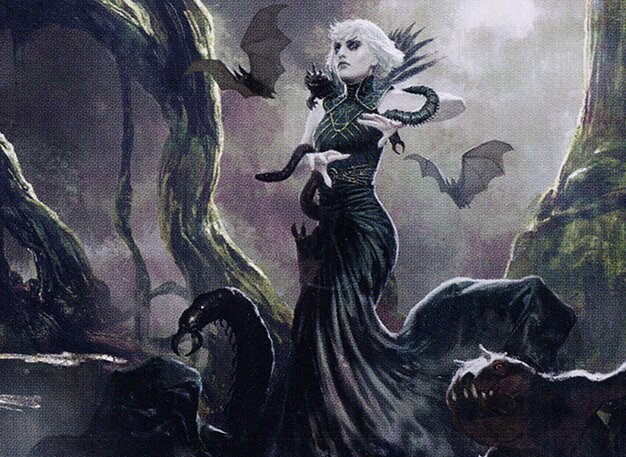
Ward is the most misunderstood of the four, because it isn’t a wall at all. Adrix and Nev, Twincasters spells it out: “Ward {2} (Whenever this creature becomes the target of a spell or ability an opponent controls, counter it unless that player pays {2}.)“
Two things fall out of that wording that change how you play:
Ward is a triggered ability. Hexproof and shroud are static — they simply make targeting illegal. Ward lets the spell be cast, then puts a trigger on the stack. Your opponent is offered a choice, and if they pay, the spell resolves and your creature dies. Ward doesn’t protect; it prices.
Because it’s a trigger, it can be interacted with. It goes on the stack above the removal spell, and both players get priority. Stifle-style effects counter the ward trigger and the removal resolves for free.
The other thing people miss: ward isn’t always mana. The cost can be anything, and the punishing ones aren’t payable at instant speed with a Sol Ring.
| Card | Ward cost | Why it matters | Approx. price |
|---|---|---|---|
| Adrix and Nev, Twincasters | Ward {2} | The plain-vanilla mana tax, on a token doubler | $8.60 |
| Sedgemoor Witch | Pay 3 life | Life is cheap in Commander — this is a soft tax | $6.08 |
| Miirym, Sentinel Wyrm | Ward {2} | Protects a commander that wins the game if it survives a turn | $6.35 |
| Kappa Cannoneer | Ward {4} | Four generic at instant speed genuinely stops most decks | $0.41 |
| Koma, World-Eater | Ward {4} | Uncounterable, trample, ward — very hard to answer cleanly | $0.51 |
| Vein Ripper | Sacrifice a creature | Non-mana cost — an empty board means it can’t be removed | $6.48 |
| Maha, Its Feathers Night | Discard a card | Cheap in the abstract, awful in topdeck mode | $21.86 |
| Ygra, Eater of All | Sacrifice a Food | Most tables have zero Food — often functionally hexproof | $11.61 |
| Valgavoth, Terror Eater | Sacrifice three nonland permanents | The most punishing ward printed — usually a hard no | $15.90 |
| Sire of Seven Deaths | Pay 7 life | Steep in a 40-life pod, trivial in the late game | $19.63 |
| Bronze Guardian | Ward {2} | Hands ward {2} to every other artifact you control | $1.29 |
| Roaming Throne | Ward {2} | Doubles your tribal triggers and is annoying to remove | $51.72 |
Protection: the only one that answers combat

Protection is a different category of effect. It doesn’t care about targeting alone — it covers all four letters of DEBT against a stated quality:
- Damage from sources with that quality is prevented.
- Enchanting and equipping by objects with that quality is impossible, and anything already attached falls off.
- Blocking by creatures with that quality is impossible.
- Targeting by spells and abilities with that quality is impossible.
Two of those — damage and blocking — are things hexproof, shroud, and ward do nothing about. That’s why protection is the Voltron keyword: Spirit Mantle’s “protection from creatures” makes a creature unblockable and immune to combat damage in one line. And the reason that line matters is that damage and blocking are resolved in the combat damage step, which is the one part of the game these four keywords never touch — that step belongs to first strike, double strike, deathtouch and trample, and indestructible, not protection, is what actually turns deathtouch off.
The quality also doesn’t have to be a color. Yawgmoth, Thran Physician has protection from Humans. Stonecoil Serpent has protection from multicolored. True-Name Nemesis has protection from a player you choose. Emrakul, the Aeons Torn has protection from spells that are one or more colors — though she’s banned in Commander, so leave her out of the deck. For the complete picture — all 196 cards that have the keyword, the seven that grant protection from everything, and the single card in Magic that can remove it — see our full protection guide.
The catch worth knowing: Commander’s Plate grants “protection from each color that’s not in your commander’s color identity.” In a mono-black deck that’s protection from four colors and the card is absurd. Under a five-color commander it grants protection from nothing — it’s a +3/+3 anthem you paid $45 for. Match it to your commander before you buy it.
| Card | Cost | What it does | Approx. price |
|---|---|---|---|
| Mother of Runes | {W} | Tap: protection from a color of your choice. Repeatable, one mana | $12.99 |
| Giver of Runes | {W} | Same, but can also grant protection from colorless — and can’t target itself | $11.76 |
| Teferi’s Protection | {2}{W} | Protection from everything, life total locked, whole board phases out | $51.76 |
| Akroma’s Will | {3}{W} | With a commander out: lifelink, indestructible and protection from each color | $15.38 |
| Commander’s Plate | {1} | +3/+3 and protection from every color outside your identity | $45.31 |
| Spirit Mantle | {1}{W} | Protection from creatures — unblockable and immune to blockers | $0.36 |
| Sejiri Shelter | {1}{W} | A protection trick on the front, a land on the back — free slot | $1.99 |
| Sword of Feast and Famine | {3} | Protection from black and green, untaps your lands on hit | $39.18 |
| Sword of Fire and Ice | {3} | Protection from red and blue, plus 2 damage and a card | $48.89 |
| Sword of Truth and Justice | {3} | Protection from white and blue, plus counters and proliferate | $35.70 |
| Karmic Guide | {3}{W}{W} | Protection from black on a reanimation body — dodges black removal | $0.36 |
| Progenitus | {W}{W}{U}{U}{B}{B}{R}{R}{G}{G} | Protection from everything, and shuffles back instead of dying | $0.95 |
| True-Name Nemesis | {1}{U}{U} | Protection from one chosen player — untouchable by them, period | $3.13 |
| Stonecoil Serpent | {X} | Protection from multicolored, on a scalable colorless body | $0.34 |
| Akroma’s Memorial | {7} | Your whole team gets protection from black and red, plus evasion | $32.95 |
What gets through all four — and this is the important part
Here’s the section most keyword guides skip. Look at what actually kills things at a Commander table:
Board wipes don’t target. “Destroy all creatures” doesn’t use the word target, so hexproof, shroud, and ward are all irrelevant. Your hexproof commander dies to Wrath of God exactly as fast as everything else.
Edicts don’t target the creature. Diabolic Edict targets the player; the player then chooses a creature to sacrifice. Nothing ever targeted the creature, so no keyword on this page applies. Grave Pact does the same thing every turn.
And protection is only a partial answer here — which produces a genuinely non-obvious split:
- Toxic Deluge gives all creatures -X/-X. That’s not damage and doesn’t target, so protection from black does not save you.
- Blasphemous Act deals 13 damage from a red source. Protection from red does save you — same “everything dies” text box, opposite result.
One card genuinely answers the edict problem: Sigarda, Host of Herons reads “Spells and abilities your opponents control can’t cause you to sacrifice permanents.” And one card answers wraths: Teferi’s Protection, because it phases your permanents out — a phased-out permanent is treated as though it doesn’t exist, so a Damnation resolving finds nothing to destroy. The protection-from-everything clause is almost the least important line on that card.
| Card | Cost | Why the keywords don’t help | Approx. price |
|---|---|---|---|
| Wrath of God | {2}{W}{W} | Destroys all creatures — no targeting anywhere | $4.20 |
| Damnation | {2}{B}{B} | Same, in black, and they can’t be regenerated | $20.20 |
| Toxic Deluge | {2}{B} | -X/-X isn’t damage — beats protection from black too | $3.77 |
| Blasphemous Act | {8}{R} | Damage, so protection from red does stop it | $2.02 |
| Farewell | {4}{W}{W} | Exiles — dodges indestructible and every keyword here | $5.96 |
| Cyclonic Rift | {1}{U} | Overloaded, it changes “target” to “each” — hexproof does nothing | $40.76 |
| Diabolic Edict | {1}{B} | Targets the player; they choose what dies | $0.20 |
| Grave Pact | {1}{B}{B}{B} | A recurring edict every time one of their creatures dies | $36.15 |
| Massacre Wurm | {3}{B}{B}{B} | -2/-2 to their whole board on ETB, no targeting | $1.27 |
If you want to be on the casting side of that list rather than the receiving side, our guide to the best board wipes in MTG ranks them by what they actually leave behind.
How to build a protection package that works
The mistake is loading up on one kind of shield. A deck with four hexproof grants and nothing else is untouchable right up until someone casts a wrath, and then it does nothing for six turns.
In a 100-card Commander deck, budget roughly 6–8 protection slots and spread them across three jobs:
- 2–3 permanent shields. Equipment or enchantments that sit on the board and make targeted removal a non-option: Swiftfoot Boots, Champion’s Helm, Asceticism, Privileged Position.
- 3–4 instant-speed answers. One-mana tricks you hold up: Snakeskin Veil, Blossoming Defense, Veil of Summer, Tamiyo’s Safekeeping, Heroic Intervention. These are what beat a targeted removal spell you didn’t see coming.
- 1–2 board-wipe answers. The slot everybody skips: Teferi’s Protection, Heroic Intervention (indestructible half), Akroma’s Will, Sigarda for edicts. Without one of these, the other six cards do nothing on the turn it matters most.
Two more habits worth building. First, remember that your commander doesn’t need to survive — it needs to keep coming back cheaply. The commander tax is {2} per recast; a removal spell that costs your opponent two cards and you four mana is a trade you often want to take rather than burning a protection spell on it. Second, protection cards are dead when you’re behind, so don’t run more than about eight — a hand full of shields with no threats loses slowly. Repeatable tutors can fetch the right shield instead, which is why a good tutor package often beats a bigger protection package.
Here’s the full menu in one cart. It spans all five colors on purpose — pick the six to eight that fit your commander’s identity rather than buying the lot:
The Commander Protection Toolbox
21 cards — one click loads the full list into a TCGplayer cart so you can check real prices and grab the whole deck at once.
Buy this deck on TCGplayerAffiliate link — buying through it supports KrakenTheMeta at no extra cost to you.Playing against hexproof, shroud, ward and protection
All four keywords can be stripped, and the cards that do it are cheap and under-played.
| Card | Cost | What it strips | Approx. price |
|---|---|---|---|
| Arcane Lighthouse | Land | Opponents’ creatures lose hexproof and shroud — and can’t regain them | $1.75 |
| Shadowspear | {1} | {1}: opponents’ permanents lose hexproof and indestructible | $31.31 |
| Shay Cormac | {W}{B} | {1}: strips hexproof, indestructible, protection, shroud and ward | $0.33 |
Beyond those, the answer list is the one from the section above: wraths, edicts, and -X/-X effects that never use the word target. A single Arcane Lighthouse in your mana base costs you almost nothing and turns off an entire archetype — see our removal guide and Commander staples list for where those slots come from.
Which keyword do you actually want?
- Protecting your commander? Hexproof, every time — you keep the ability to target it yourself.
- Building Voltron? Protection. It handles blockers and combat damage, which nothing else on this list does.
- Want a body that’s hard to answer at all? Ward with a non-mana cost (Ygra, Vein Ripper, Valgavoth) is often stronger than hexproof in practice, because the tax is unpayable rather than merely expensive.
- Running enchantments or an Aura-based combo? Shroud, via Sterling Grove or Greater Auramancy — you weren’t going to target them anyway.
- Actually afraid of losing your board? None of these. You want Teferi’s Protection, a phase-out, or a rebuild plan.
Keyword abilities are the easiest place in Magic to build a deck out of assumptions. If you’d rather have the list checked for you, our AI deck builder reads real card text when it assembles a deck, you can browse what other players have built on the public decks page, and current prices for everything above live on our card pricing tool. If you enjoy this kind of rules deep-dive, our cascade explainer takes apart another mechanic most guides get wrong.
Frequently asked questions
What’s the difference between hexproof and shroud in MTG?
Hexproof stops your opponents from targeting the permanent but lets you target it. Shroud stops everyone, including you — so you can’t enchant it, equip it, or protect it with your own spells. That’s why Lightning Greaves (shroud) blocks you from attaching a second Equipment while Swiftfoot Boots (hexproof) doesn’t.
Is ward better than hexproof?
It depends entirely on the cost. Ward {2} is a speed bump most decks pay without thinking. Ward costs like “sacrifice three nonland permanents” or “sacrifice a Food” are frequently unpayable, which makes them stronger than hexproof — and unlike hexproof, ward still lets you target your own creature. Two ward costs are unpayable by rule rather than by circumstance, and a single keyword accounts for more than half of every ward card printed — our complete guide to ward in MTG breaks down all 189 of them.
Does hexproof stop board wipes?
No. Wrath of God, Damnation, Toxic Deluge and Blasphemous Act never use the word “target,” so hexproof, shroud and ward do nothing against them. What actually saves the board depends on which sweeper it is: protection from the right quality, or phasing out with Teferi’s Protection, answers all four. Indestructible does not. It stops Wrath of God, Damnation and Blasphemous Act, but Toxic Deluge gives every creature −X/−X, and a creature at zero toughness is put into the graveyard rather than destroyed — so an indestructible board dies to it anyway. We cover that distinction in full in our guide to what indestructible actually stops (and the eight ways it still dies).
What does protection actually prevent in MTG?
Four things, from sources with the stated quality only: damage, being enchanted or equipped, being blocked, and being targeted — the DEBT mnemonic. It does not stop non-damage effects like -X/-X, sacrifice effects, counters, or “destroy all” and “exile all” spells.
Can you remove hexproof from an opponent’s creature?
Yes. Arcane Lighthouse is a land that makes opponents’ creatures lose hexproof and shroud for the turn, Shadowspear strips hexproof and indestructible for {1}, and Shay Cormac strips all five protective keywords including ward and protection.
Why did Wizards stop printing hexproof?
Because a hexproof threat that your opponent can’t interact with produces unfun games — the only answers are wraths and edicts. Ward was designed as the interactive replacement: it charges a price rather than closing the door, so the game stays a conversation. Modern sets print ward routinely and hexproof rarely.
Build your next deck with AI
KrakenTheMeta’s AI deck builder researches the current meta and writes you a complete, format-legal decklist in about a minute — free to try.
Build a Deck with AIor browse community decks