Split Second MTG: How It Works, What You Can Still Do, Every Split Second Card and a $70 Samut Deck (2026)
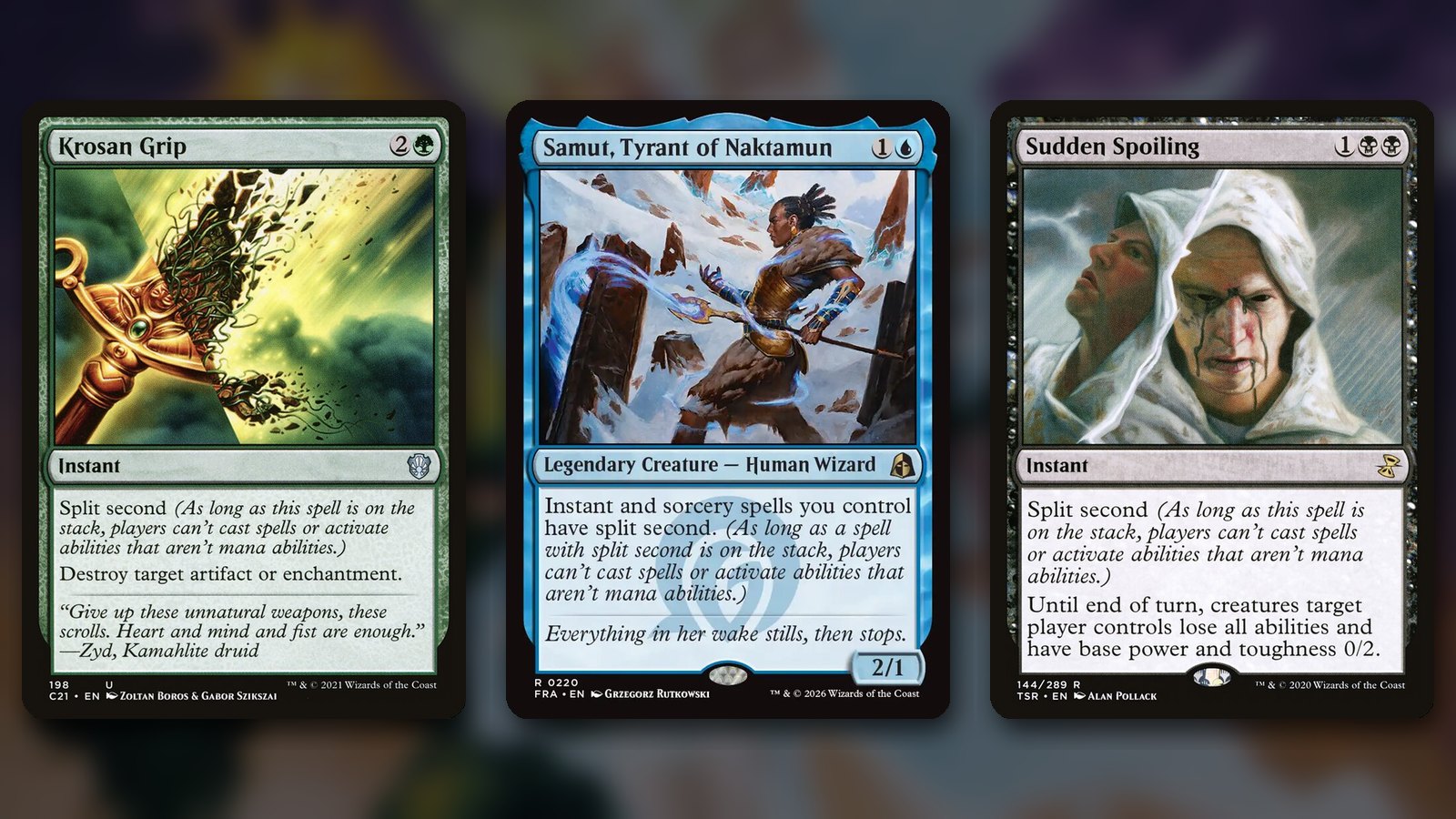
Split second is a Magic: The Gathering keyword from Time Spiral (October 2006). While a spell with split second is on the stack, no player can cast spells or activate abilities that aren’t mana abilities. In plain terms: nobody can respond to it. Krosan Grip destroys the artifact and the owner doesn’t get to activate it, protect it or counter the Grip first. That makes split second one of the cleanest ways to stop an opponent’s trick at the exact moment it matters.
For almost twenty years split second lived on a short list of Time Spiral instants. In October 2026 that changed. Samut, Tyrant of Naktamun from Reality Fracture is a two-mana blue commander that gives every instant and sorcery you control split second. Your Counterspell can’t be countered back. Your bounce spell can’t be answered with a protection spell. We counted what that switches off: 3,754 Commander-legal instants, 607 flash cards and every activated ability that doesn’t make mana. Only a handful of cards still get through, and we list all 10 of the ones that matter.
This guide covers how split second works, what you can and can’t do in response (the part most players get wrong), every split second card with its real Commander play count, the three cards that grant it, legality in every format, and a $70.21 budget Samut, Tyrant of Naktamun deck.
What is split second in MTG?
Split second is rule 702.61 of the Comprehensive Rules. Rule 702.61a defines it: “As long as this spell is on the stack, players can’t cast other spells or activate abilities that aren’t mana abilities.” It is a static ability, and it only does anything while the spell is on the stack. Once the spell resolves, or leaves the stack some other way, it stops mattering, and players can cast spells and activate abilities as normal again before the next thing on the stack resolves.
Every card with the keyword carries the same reminder text: “As long as this spell is on the stack, players can’t cast spells or activate abilities that aren’t mana abilities.” The design point is the word response. Most instant-speed interaction in Magic works by responding: you hold priority, cast something on top, and it resolves first. Split second takes that option away from everyone, including you.
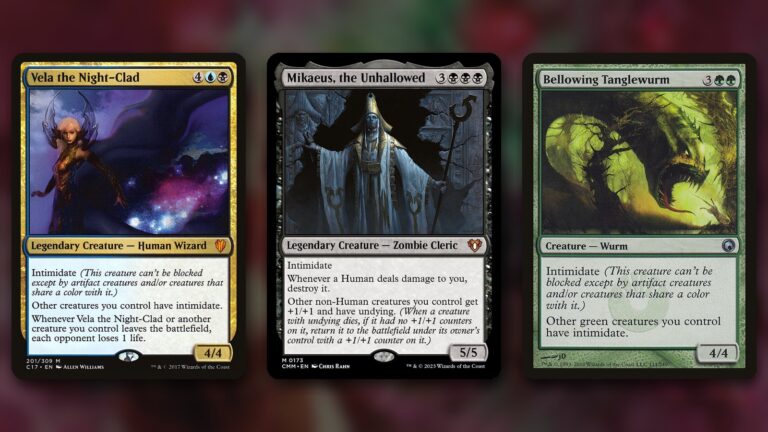
Split second was the signature mechanic of Time Spiral and Planar Chaos. The cycle of “Sudden” instants (Sudden Shock, Sudden Death, Sudden Spoiling) came from there, along with Krosan Grip, Trickbind and Angel’s Grace. Wizards brought it back in small numbers: Sudden Substitution (Commander 2019), Sudden Edict (Modern Horizons 2), Legolas’s Quick Reflexes (The Lord of the Rings Commander), V.A.T.S. and Inventory Management (Fallout) and Siege Smash (Modern Horizons 3). There are 21 cards with the keyword and 3 more that grant it.
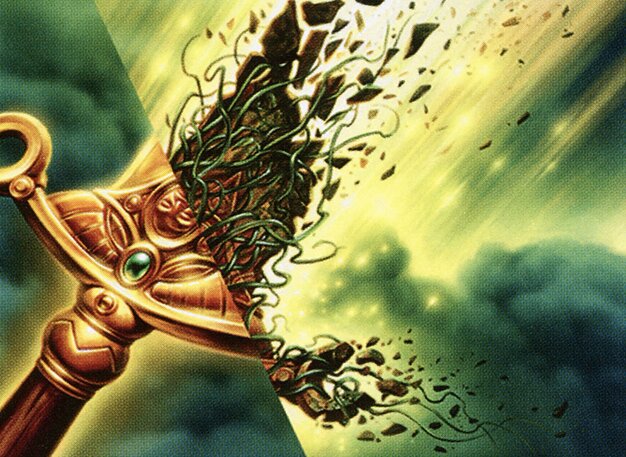
How split second works: what you can still do
Split second doesn’t stop everything. Rule 702.61b says players may still “activate mana abilities and take special actions” while a split second spell is on the stack, and that triggered abilities “trigger and are put on the stack as normal.” Here is every case that comes up at the table.
| What you want to do | Allowed under split second? | Details |
|---|---|---|
| Casting an instant or a flash spell | No | 3,754 Commander-legal instants and 607 nonland cards with flash are switched off, including all 286 cards that say "counter target spell". |
| Activating a non-mana ability | No | Equip, planeswalker loyalty abilities, cycling, ninjutsu, Viscera Seer-style sacrifice outlets, Lightning Greaves equip: all activated abilities, all off. |
| Activating a mana ability | Yes | Ashnod's Altar, Phyrexian Altar and Phyrexian Tower still let you sacrifice a creature in response, because their abilities add mana. |
| Turning a face-down creature face up | Yes | A special action (rule 116.2b). 111 Commander-legal morph, megamorph and disguise cards have a "when turned face up" trigger; 7 of them can counter or redirect a spell. |
| Triggered abilities | Yes | They trigger and go on the stack as normal. Rhystic Study, Mystic Remora and death triggers all still happen. |
| Casting a spell from a trigger (cascade, discover) | No | The trigger resolves, but the spell it would let you cast cannot be cast while split second is on the stack. |
| Foretelling a card | Yes, on your own turn | Foretell is a special action you can take any time you have priority during your turn (rule 116.2h). |
| Exiling a card with suspend | No | Suspend's exile is a special action, but only if you could begin to cast the card (rule 116.2f), and you can't. |
| Playing a land, plotting, getting your companion | No | All three need an empty stack. |
You still get priority, you just can’t do much with it
A split second spell doesn’t skip priority. Each player still gets the chance to act before it resolves. The official rulings put it this way: players still get priority, “their options are just limited to mana abilities and certain special actions.” In practice that means everyone passes unless they have a mana ability or a face-down creature worth flipping.
Mana abilities still work, and that includes sacrificing for mana
A mana ability is an ability that produces mana (the rulings for Sudden Substitution stress it: “not an ability that costs mana”). Sol Ring, lands and Treasure tokens can all be used. The important part is sacrifice outlets that make mana. If an opponent casts a split second spell to steal or exile your creature, Ashnod’s Altar or Phyrexian Altar can still sacrifice it in response, because their abilities add mana. A Viscera Seer can’t: “Sacrifice a creature: Scry 1” is an activated ability that isn’t a mana ability. Of the 236 Commander-legal cards with an ability whose whole cost is “Sacrifice a creature:” or “Sacrifice another creature:”, only 7 are mana abilities.
Turning a face-down creature face up is a special action
Turning a morph, megamorph or disguise creature face up doesn’t use the stack, so split second can’t stop it. The Trickbind rulings confirm it can’t counter “paying the morph cost to turn a face-down creature face up, since that action doesn’t use the stack.” If the creature has a “when turned face up” trigger, that trigger goes on the stack as normal. That is why the classic answer to a split second spell is Willbender: flip it face up and change the target of the spell. 111 Commander-legal morph, megamorph and disguise cards have a turned-face-up trigger, and 7 of them can counter, copy or redirect a spell.
Triggered abilities trigger, but can’t let you cast anything
Split second doesn’t stop triggered abilities. Rhystic Study and Mystic Remora still trigger off a split second spell, and opponents can still pay for them. Death triggers, Chalice of the Void triggers and cast triggers all happen as normal. One exception: “If the resolution of a triggered ability involves casting a spell, that spell can’t be cast if a spell with split second is on the stack.” A cascade or discover trigger that resolves on top of a split second spell finds its card but can’t cast it.
It doesn’t touch what is already on the stack
“Casting a spell with split second won’t affect spells and abilities that are already on the stack.” If an opponent has already cast a spell, your split second spell can’t stop it resolving. Split second protects the split second spell; it isn’t a counterspell. The order matters: if you cast Krosan Grip in response to an equip activation, the equip ability is already on the stack, so it stays there. The Grip resolves first and destroys the Equipment, and the equip ability then has nothing to attach.
It doesn’t let you cast at instant speed
Split second isn’t flash. An Aura with split second such as In Too Deep or Take Possession can still be cast only in your main phase when the stack is empty. The In Too Deep rulings say it directly: split second “doesn’t allow players to cast the spell it’s on at times when they otherwise wouldn’t be able to cast it.”
It is not “can’t be countered”
Split second stops responses, not counterspells as such. Nobody can cast Counterspell targeting a split second spell while it is on the stack, so in practice it can’t be countered by a spell. But a Willbender flip can change its target, a Stratus Dancer flip can counter it, and a triggered ability can still interact with it. Multiple instances of split second on one spell do nothing extra (rule 702.61c).
Every split second card, ranked by Commander play
These are all 21 cards with the split second keyword, sorted by the number of Commander decks on EDHREC that run them. Krosan Grip is the clear number one at 207,995 decks: an artifact or enchantment answer that the owner can’t protect or activate in response (unless the activation is a mana ability). Legolas’s Quick Reflexes (113,581) is second, mostly as a one-mana protection spell that also untaps a creature.
| Card | Type and mana cost | What it does | EDHREC decks | Cheapest printing |
|---|---|---|---|---|
| Krosan Grip | Instant, {2}{G} | Destroy target artifact or enchantment | 207,995 | $0.77 (CMA) |
| Legolas's Quick Reflexes | Instant, {G} | Untap a creature; it gains reach, hexproof and deals damage to a creature whenever it becomes tapped | 113,581 | $52.68 (LTC) |
| Angel's Grace | Instant, {W} | You can't lose and opponents can't win this turn; damage can't take you below 1 | 85,213 | $3.31 (TSR) |
| Sudden Spoiling | Instant, {1}{B}{B} | Target player's creatures lose all abilities and become 0/2 | 78,701 | $5.28 (C14) |
| Siege Smash | Instant, {1}{R} | Destroy target artifact, or +3/+2 and trample | 51,963 | $0.29 (MH3) |
| Inventory Management | Instant, {R}{W} | Reattach any number of your Auras and Equipment | 49,056 | $2.84 (PIP) |
| V.A.T.S. | Instant, {2}{B}{B} | Destroy any number of creatures with equal toughness | 34,960 | $1.13 (PIP) |
| Trickbind | Instant, {1}{U} | Counter target activated or triggered ability; that permanent's activated abilities are off for the turn | 23,559 | $17.19 (TSP) |
| Sudden Substitution | Instant, {2}{U}{U} | Exchange control of a noncreature spell and a creature | 22,276 | $7.07 (C19) |
| Sudden Edict | Instant, {1}{B} | Target player sacrifices a creature | 12,810 | $0.20 (MH2) |
| In Too Deep | Enchantment, Aura, {U}{U} | Aura: the permanent becomes a Clue and loses all other abilities | 8,380 | $0.73 (NCC) |
| Word of Seizing | Instant, {3}{R}{R} | Untap and steal any permanent until end of turn | 7,445 | $0.21 (CMR) |
| Sudden Shock | Instant, {1}{R} | 2 damage to any target | 6,431 | $0.11 (MMA) |
| Wipe Away | Instant, {1}{U}{U} | Return target permanent to its owner's hand | 5,347 | $0.27 (TSR) |
| Celestial Crusader | Creature, Spirit, {2}{W}{W} | Flash 2/2 flyer, other white creatures get +1/+1 | 4,497 | $0.13 (TSP) |
| Stonewood Invocation | Instant, {3}{G} | +5/+5 and shroud | 3,436 | $1.07 (TSP) |
| Sudden Death | Instant, {1}{B}{B} | -4/-4 | 2,742 | $0.12 (TSR) |
| Take Possession | Enchantment, Aura, {5}{U}{U} | Aura: you control enchanted permanent | 1,802 | $0.23 (MMA) |
| Extirpate | Instant, {B} | Exile a card from a graveyard and every copy from its owner's graveyard, hand and library | 1,401 | $0.86 (TSR) |
| Sulfur Elemental | Creature, Elemental, {2}{R} | Flash 3/2; white creatures get +1/-1 | 176 | $0.17 (TSR) |
| Quagnoth | Creature, Beast, {5}{G} | 4/5 shroud that returns to hand if an opponent makes you discard it | 141 | $0.31 (FUT) |
A few patterns stand out. Most split second cards are removal or protection that would normally get answered: destroying a combo artifact (Krosan Grip, Siege Smash), shutting off an army for a turn (Sudden Spoiling), or making sure you survive the turn (Angel’s Grace). Trickbind is the odd one: a split second Stifle that can counter an activated or triggered ability, including a fetch land’s activation or a storm trigger, without the opponent being able to respond with another copy. Sudden Spoiling is the best defensive card on the list: cast it during an opponent’s combat and every creature they control becomes a 0/2 with no abilities, with no chance to pump or protect them in response.
The three cards that give split second
| Card | Set | Gives split second to | Condition | EDHREC decks | Cheapest printing |
|---|---|---|---|---|---|
| Samut, Tyrant of Naktamun | Reality Fracture | Every instant and sorcery spell you control | Always | 16,229 | $6.12 (FRA) |
| Shadow the Hedgehog | Secret Lair Drop | Every spell you cast | Only if mana from an artifact was spent to cast it | 15,396 | Secret Lair only |
| Molten Disaster | Future Sight | Itself | Only if kicked (an extra {R}) | 8,726 | $0.51 (C13) |
Samut, Tyrant of Naktamun is the one that changes what split second means in Commander. It is a 2/1 Human Wizard for {1}{U} with one line of text: “Instant and sorcery spells you control have split second.” It is already in 344 decks as a commander on EDHREC two and a half weeks after release, and it is legal in Standard and Pioneer, where it is the only split second card in either format.
Shadow the Hedgehog (Secret Lair x Sonic the Hedgehog) is the Rakdos version: each spell you cast has split second if mana from an artifact was spent to cast it, so Treasures, Sol Ring and Mind Stone turn it on. It covers creatures too, not only instants and sorceries. It leads 12,211 decks on EDHREC. Molten Disaster from Future Sight gets split second only when kicked, which makes it a board wipe that also damages every player and can’t be answered.

What Samut actually turns off
The easiest way to see how strong Samut is: count what an opponent can’t do in response to one of your spells. We ran the searches on Scryfall against every Commander-legal card.
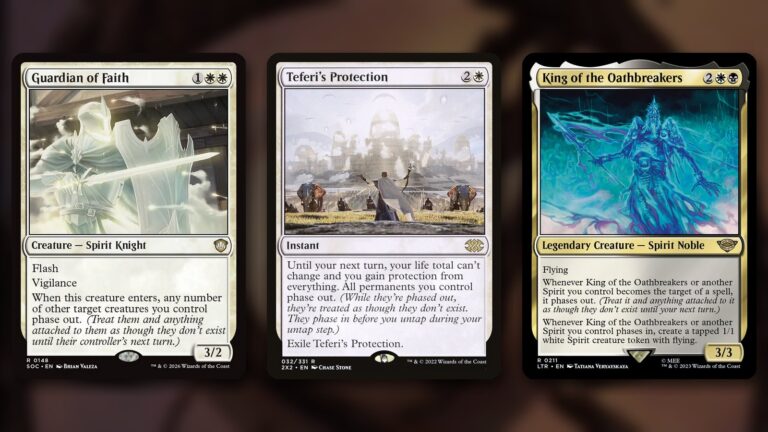
- 3,754 instants can’t be cast, including every protection spell (Heroic Intervention, Teferi’s Protection, Deflecting Swat) and every free spell (Force of Will, Fierce Guardianship, Pact of Negation).
- 607 nonland cards with flash can’t be cast.
- 286 cards that say “counter target spell” can’t be cast. A counter war against Samut ends the moment Samut’s player casts a counterspell.
- Every activated ability that isn’t a mana ability can’t be used: equip, regeneration, loyalty abilities, Lightning Greaves, Viscera Seer, Aetherflux Reservoir.
What gets through is short. These are the 10 cards worth knowing about if you’re sitting across from Samut, or if you’re the Samut player and want to know what can still stop you.
| Card | How it gets past split second | EDHREC rank |
|---|---|---|
| Ashnod's Altar | Mana ability. Sacrifice a creature: add {C}{C} | 134 |
| Phyrexian Tower | Mana ability. {T}, sacrifice a creature: add {B}{B} | 194 |
| Phyrexian Altar | Mana ability. Sacrifice a creature: add one mana of any color | 307 |
| Kheru Spellsnatcher | Turned face up (special action). Morph {4}{U}{U}: counter target spell, exile it, you may cast it free | 8,009 |
| Stratus Dancer | Turned face up (special action). Megamorph {1}{U}: counter target instant or sorcery spell | 8,471 |
| Willbender | Turned face up (special action). Morph {1}{U}: change the target of a spell or ability with a single target | 8,584 |
| Boltbender | Turned face up (special action). Disguise {1}{R}: choose new targets for any number of other spells and abilities | 10,575 |
| Voidmage Apprentice | Turned face up (special action). Morph {2}{U}{U}: counter target spell | 12,601 |
| Mischievous Quanar | Turned face up (special action). Morph {1}{U}{U}: copy target instant or sorcery spell | 13,743 |
| Silumgar Spell-Eater | Turned face up (special action). Megamorph {4}{U}: counter target spell unless its controller pays {3} | 23,027 |
Beyond these, the only answers are triggered abilities and static effects that are already in play. A Grand Abolisher or a Silence effect still stops you casting spells on their turn, a Rhystic Study trigger still taxes you, and Chalice of the Void still counters on cast. Samut also has to stay on the battlefield, and it is a 2/1 for two. Opponents can remove it on their own turn with a sorcery, or in response to anything that isn’t one of your instants or sorceries: your creature spells, your artifacts and your activated abilities don’t get split second.

The drawback: you can’t respond to yourself either
Split second is symmetrical. While one of your instants is on the stack, you can’t cast another spell either. You can’t hold priority and stack two of your own counterspells, and you can’t respond to your own Brainstorm with a second Brainstorm. You don’t lose much: once your spell resolves, every player gets priority again before the next object on the stack resolves, so if an opponent has stacked two spells you can counter the top one, let it resolve, then counter the one under it. What you lose is the ability to protect your own spell with a second one, and you never need to, because nobody can respond to the first.
Copies have split second too
Samut says “spells you control,” and a copy of a spell is a spell. Copies from Make Disappear’s casualty, Lose Focus’s replicate or Sea Gate Stormcaller all have split second while they are on the stack. The copies are created by triggered or cast abilities, which split second doesn’t stop, so the copy still happens. Samut is also a Wizard, which turns on Wizard’s Retort’s discount and counts toward Docent of Perfection’s transform.
Budget Samut, Tyrant of Naktamun split second deck ($70.21)
This is a mono-blue spellslinger list built around the one thing Samut does: every answer you cast resolves. It runs 44 instants and sorceries, 17 of them counterspells, cost reducers (Baral, Sapphire Medallion) and payoffs that trigger on every instant or sorcery (Talrand, Archmage Emeritus, Murmuring Mystic, Docent of Perfection), with 35 lands. We validated it against Scryfall (100 cards, singleton, mono-blue identity, every card Commander-legal) and priced it at the cheapest normal printing of each card: $70.21. The first draft cost $144.65; nine swaps (Snapcaster Mage, Faerie Mastermind, Swan Song, Mystic Remora, Isochron Scepter, Dramatic Reversal, Chain of Vapor, Time Warp, Windfall) brought it down. Those nine are the first upgrades.
Budget Samut, Tyrant of Naktamun Split Second - Commander Deck
100 cards — one click loads the full list into a TCGplayer cart so you can check real prices and grab the whole deck at once.
Buy this deck on TCGplayerAffiliate link — buying through it supports KrakenTheMeta at no extra cost to you.How the deck plays
Play Samut on turn two if you can. It is cheap enough to recast, and the deck can afford to protect it with counterspells on the opponent’s turn that can’t be answered. Leave mana open on every opponent’s turn: the deck’s power comes from casting one counterspell per turn cycle that is guaranteed to stick. Baral looting off every counter and Archmage Emeritus drawing off every instant keep the hand full. Talrand and Docent of Perfection turn each spell into a flying body, and Propaganda slows down the creature decks while you build up.
Use bounce (Into the Roil, Snap, Repeal, Unsubstantiate) on the problem permanents at the end of an opponent’s turn: with split second, the owner can’t sacrifice the creature for value or protect it in response. Aetherize during an opponent’s attack is a one-sided board reset they can’t answer. Unsubstantiate can bounce a spell, too, which matters against a spell you can’t counter cleanly.
Priciest cards in the list
| Card | Cheapest printing | Price |
|---|---|---|
| Sapphire Medallion | C14 | $8.17 |
| Samut, Tyrant of Naktamun | FRA | $6.12 |
| Reliquary Tower | MKC | $4.28 |
| Cryptic Command | PLST | $4.05 |
| Baral, Chief of Compliance | TSR | $4.03 |
| Snap | PLST | $3.26 |
| An Offer You Can't Refuse | FIC | $3.04 |
| Thought Vessel | FIC | $2.35 |
| Pongify | PLST | $2.33 |
| Counterspell | FDC | $2.15 |
Want a second opinion on this list or your own? Paste it into the MTG deck analyzer for a mana curve and colour check, look up any card’s current price in the card finder, or browse community Commander decks, such as this Baral, Chief of Compliance spellslinger deck.
Split second legality in every format
| Format | Split second cards legal (of 24) | Which |
|---|---|---|
| Standard | 1 | Samut, Tyrant of Naktamun |
| Pioneer | 1 | Samut, Tyrant of Naktamun |
| Modern | 18 | All except Sudden Substitution, In Too Deep, Legolas's Quick Reflexes, Inventory Management, V.A.T.S., Shadow the Hedgehog |
| Pauper | 1 | Siege Smash |
| Legacy | 24 | All |
| Vintage | 24 | All |
| Commander | 24 | All |
| Brawl | 6 | Angel's Grace, Krosan Grip, Sudden Edict, Legolas's Quick Reflexes, Siege Smash, Samut, Tyrant of Naktamun |
| Historic (Arena) | 6 | Angel's Grace, Krosan Grip, Sudden Edict, Legolas's Quick Reflexes, Siege Smash, Samut, Tyrant of Naktamun |
No split second card is banned or restricted anywhere. Samut is the only one in Standard and Pioneer, and Siege Smash (a common from Modern Horizons 3) is the only one in Pauper. In Modern, 18 of the 24 are legal: the five cards first printed in Commander products (Sudden Substitution, In Too Deep, Legolas’s Quick Reflexes, Inventory Management and V.A.T.S.) and the Secret Lair Shadow the Hedgehog aren’t. On Arena, six are legal in Historic: Angel’s Grace, Krosan Grip, Sudden Edict, Legolas’s Quick Reflexes, Siege Smash and Samut.
Split second vs flash, Stifle effects and “can’t be countered”
These get mixed up, so here is the difference in one place.
- Flash lets you cast a spell any time you could cast an instant. It is about when you can cast. Split second is about what others can do while your spell is on the stack. A split second Aura still needs your main phase. Our guide to flash in MTG covers the timing side.
- “Can’t be countered” (Abrupt Decay, Carnage Tyrant) only stops counterspells. Opponents can still respond with a protection spell, a sacrifice or a pump. Split second stops all of those, but a face-up morph trigger can still counter a split second spell, while nothing counters a “can’t be countered” spell.
- Stifle effects counter abilities. Trickbind is a Stifle with split second, which means the controller can’t respond by activating the same ability again.
- Storm copies are created by a trigger, so a split second storm spell (Samut on a storm card) still copies. Our storm guide has the full rules on copies.
If you want more ways to break the stack open, our morph guide explains face-down creatures and why turning them up is a special action, and our list of the best spellslinger commanders has more blue instant and sorcery shells that Samut fits into. For the rest of Samut’s set, see our Reality Fracture commanders guide.
Frequently asked questions
What does split second do in MTG?
While a spell with split second is on the stack, no player can cast spells or activate abilities that aren’t mana abilities. Nobody can respond to it with instants, flash spells or activated abilities.
Can you respond to split second?
Only in limited ways. You can activate mana abilities (including sacrifice-for-mana outlets like Ashnod’s Altar), turn face-down creatures face up, and triggered abilities still trigger. You can’t cast spells or activate any other ability.
Can a split second spell be countered?
Not by a counterspell, because nobody can cast one while it is on the stack. A face-up trigger can counter it: Stratus Dancer, Voidmage Apprentice or Kheru Spellsnatcher turned face up can, and Willbender can change its target.
Does split second stop triggered abilities?
No. Triggered abilities trigger and resolve normally. The only limit is that a trigger can’t let anyone cast a spell while split second is on the stack.
Can I sacrifice a creature in response to split second?
Only with a mana ability. Ashnod’s Altar, Phyrexian Altar and Phyrexian Tower work because they add mana. Viscera Seer, Carrion Feeder and other sacrifice outlets that don’t make mana can’t be used.
Can I play a land or morph a creature while split second is on the stack?
You can’t play a land, because that needs an empty stack. You can turn a face-down creature face up, because that is a special action that can be taken any time you have priority.
What does Samut, Tyrant of Naktamun do?
Samut, Tyrant of Naktamun (Reality Fracture) is a {1}{U} 2/1 Human Wizard. Every instant and sorcery spell you control has split second, so opponents can’t respond to any of them.
What is the best split second card?
By Commander play, Krosan Grip (207,995 decks on EDHREC), then Legolas’s Quick Reflexes and Angel’s Grace. For a deck built around the mechanic, Samut, Tyrant of Naktamun is the best commander.
Is split second legal in Standard?
Only through Samut, Tyrant of Naktamun. No card with the split second keyword is in Standard or Pioneer.
Does split second give a spell flash?
No. A split second spell is cast at its normal timing. Most split second cards are instants, but the two Auras (In Too Deep and Take Possession) still need your main phase.
Build your next deck with AI
KrakenTheMeta’s AI deck builder researches the current meta and writes you a complete, format-legal decklist in about a minute — free to try.
Build a Deck with AIor browse community decks