
Hexproof in MTG: Rules, All 95 Cards, and Why Green Owns It
Hexproof means one thing: your opponents can’t target it. You still can. That single asymmetry is what separates hexproof from shroud, and it is the reason hexproof went from a niche Portal Three Kingdoms curiosity to one of Magic’s evergreen keywords while shroud was quietly retired.
But the interesting part of hexproof isn’t the rule — it’s what the card pool actually looks like once you count it. 95 paper cards have the hexproof keyword. 179 more give hexproof to something else without having it. Hexproof is overwhelmingly a thing you hand out, not a thing you print on a creature — which is the exact opposite of how ward works. This guide covers the rules, every corner of the card pool, the cards that beat it, and a budget package that costs less than a booster pack.
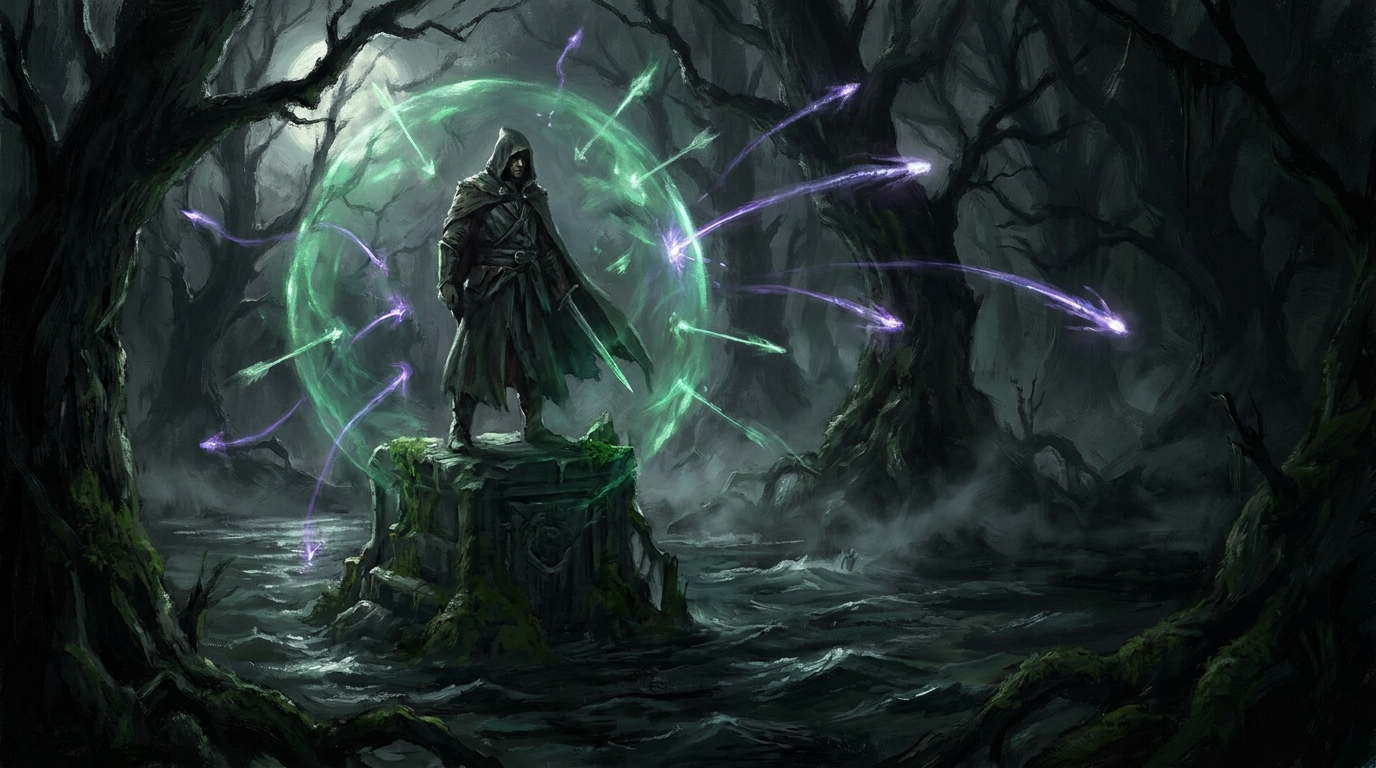
What hexproof does, exactly
Hexproof is a static ability. It is always on, it doesn’t use the stack, and it doesn’t trigger. It changes what your opponents are legally allowed to choose when they put a spell or ability on the stack.
The Comprehensive Rules give hexproof seven sub-rules — more than any other protection keyword in the game. Here is the whole of rule 702.11:
| Rule | What it says |
|---|---|
| 702.11a | Hexproof is a static ability. |
| 702.11b | “Hexproof” on a permanent means “This permanent can’t be the target of spells or abilities your opponents control.” |
| 702.11c | “Hexproof” on a player means “You can’t be the target of spells or abilities your opponents control.” |
| 702.11d | “Hexproof from [quality]” means it can’t be the target of [quality] spells your opponents control, or abilities your opponents control from [quality] sources. |
| 702.11e | Any effect that causes an object to lose hexproof also strips all its “hexproof from [quality]” abilities. |
| 702.11f | “Hexproof from A and from B” is shorthand for two separate abilities — losing one leaves the other intact. |
| 702.11g | Multiple instances of the same hexproof ability are redundant. |
Two of those are worth pausing on. 702.11c is the one most players never read — hexproof can sit on a player, not just a permanent, and that is a completely different card (more on those below). And 702.11g is the clause ward does not have.
Why the redundancy clause matters
Hexproof (702.11g) and shroud (702.18b) both say multiple instances are redundant. Ward has no such clause, because each instance of ward triggers separately — two wards mean two taxes. Stacking hexproof effects on one creature does nothing at all; stacking ward does. That is a real deckbuilding difference hiding in a rules footnote.
The one-sided rule: hexproof vs shroud
This is the distinction the keyword exists for. Compare the two rules side by side:
- Hexproof (702.11b): “can’t be the target of spells or abilities your opponents control.”
- Shroud (702.18a): “can’t be the target of spells or abilities.” Full stop.
Shroud protects a creature from you too. You cannot enchant your own shrouded creature, you cannot pump it, you cannot give it a counter with a targeted spell. Hexproof leaves all of that open. That is why Bogles-style Aura decks are built on hexproof creatures like Gladecover Scout and never on shroud creatures — the whole plan is targeting your own guy.
It is also why shroud is effectively a dead keyword: just 35 paper cards have shroud against 95 with hexproof, and Wizards stopped printing it in favour of the strictly-more-playable version. The last new design with shroud was Neurok Commando on 4 February 2011, five months and eleven days before hexproof was keyworded in Magic 2012 — our complete shroud guide lists all 35 of them. If you want the full four-way breakdown, we keep a dedicated hexproof vs shroud vs ward vs protection comparison that covers every interaction between them.
What hexproof does NOT stop
Hexproof only ever answers one question: “may my opponent choose this as a target?” Anything that never uses the word target goes straight through it. This is where most games are actually lost.
| Effect | Does hexproof stop it? | Why |
|---|---|---|
| Board wipes (Wrath of God, Blasphemous Act) | No | They destroy “all creatures” — no targeting involved |
| Edicts (Diabolic Edict, Liliana’s Triumph) | No | They target the player, who then sacrifices |
| Sacrifice effects | No | You choose and sacrifice; nothing targets the creature |
| Cyclonic Rift overloaded | No | Overload replaces “target” with “each” — this is the classic blowout |
| Damage-based sweepers | No | “Deals X damage to each creature” doesn’t target |
| Blocking and combat damage | No | Blocking is not targeting |
| Opponent’s targeted removal | Yes | This is the one job it does |
| Your own targeted pump/Auras | No — and that’s the point | Hexproof only restricts opponents |
The short version: hexproof is protection from removal, not protection from losing. A deck that answers hexproof creatures with sweepers and edicts never needs to interact with the keyword at all. Note that indestructible has the mirror-image weakness — it survives wraths but folds to targeted exile — which is why the two get paired on so many protection spells.
Overloaded spells ignore hexproof entirely
The cleanest way past hexproof is not to strip it — it is to cast a spell that never targets in the first place. Magic’s overload mechanic does exactly that: paying a spell’s overload cost changes the word “target” to “each”, and the official rulings state plainly that a spell with overload doesn’t target when its overload cost is paid, so it may affect permanents with hexproof. An overloaded Cyclonic Rift returns a hexproof creature to its owner’s hand with no interaction from hexproof at all, because there is no target for hexproof to object to. All 27 overload cards work this way.
The four protection keywords, by the numbers
All counts are paper, non-digital cards, checked against Scryfall on 14 August 2026:
| Keyword | Paper cards | Rule | Ability type | Symmetrical? |
|---|---|---|---|---|
| Protection | 204 | 702.16 | Static | No |
| Ward | 190 | 702.21 | Triggered | No |
| Hexproof | 95 | 702.11 | Static | No |
| Shroud | 35 | 702.18 | Static | Yes |
Ward is the odd one out and it is not close. It is the only one of the four that is a triggered ability (702.21a) — it uses the stack, it can be responded to, and it can be countered. Hexproof, shroud and protection are all static: they simply make an illegal choice illegal, with nothing to respond to.
The inversion: more cards grant hexproof than have it
This is the finding that reframes the whole keyword. Of 329 paper cards that mention hexproof:
- 95 have the keyword themselves
- 179 say “gains hexproof” / “have hexproof” without having it
Nearly twice as many cards hand out hexproof as carry it. Compare ward, where 190 cards have the keyword and only about ten grant it. Ward is a stat you print on a creature; hexproof is an effect you hold in your hand.
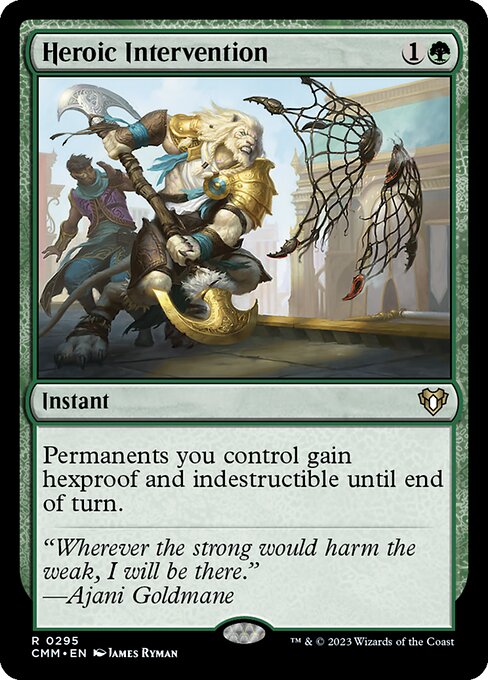
The play data agrees, and brutally. The most-played hexproof card in Commander doesn’t have hexproof. Heroic Intervention sits at EDHREC rank #31 — a top-50 card in the entire format. The best card that actually has the keyword is Lotus Field at #901. That is a 29× gap in rank between granting it and having it.
The most-played hexproof cards in Commander
Ranked by EDHREC position among cards that actually have the keyword. Prices are the cheapest available printing, checked 14 August 2026.
| Card | Cost | Type | EDHREC | Price |
|---|---|---|---|---|
| Lotus Field | — | Land | #901 | $2.23 |
| Valgavoth’s Lair | — | Enchantment Land | #1,665 | $0.65 |
| Sylvan Caryatid | {1}{G} | Creature — Plant | #1,943 | $0.94 |
| Volatile Stormdrake | {1}{U} | Creature — Drake | #2,007 | $0.71 |
| Invisible Stalker | {1}{U} | Creature — Human Rogue | #2,673 | $0.61 |
| Slippery Bogbonder | {3}{G} | Creature — Human | #3,861 | $4.59 |
| General Ferrous Rokiric | {1}{R}{W} | Legendary Creature | #3,914 | $0.54 |
| Breaker of Creation | {6}{C}{C} | Creature — Phyrexian | #3,967 | $0.37 |
| Elenda, Saint of Dusk | {2}{W}{B} | Legendary Creature | #4,917 | $0.37 |
| Silumgar, the Drifting Death | {4}{U}{B} | Legendary Creature | #5,224 | $0.44 |
| Sigarda, Host of Herons | {2}{G}{W}{W} | Legendary Creature | #5,878 | $1.21 |
| Carnage Tyrant | {4}{G}{G} | Creature — Dinosaur | #6,660 | $4.19 |
The top two hexproof cards are lands
There are exactly two hexproof lands in paper Magic, and they are the two most-played hexproof cards in the format. Lotus Field (#901) and Valgavoth’s Lair (#1,665) both outrank every hexproof creature ever printed.
Neither is played for the protection. Lotus Field taps for three mana of any one colour; Valgavoth’s Lair fixes a colour. The hexproof is there to stop the land-destruction and Field of Ruin effects that would otherwise punish a land that good — it’s a design guardrail, not a selling point. It’s the same pattern we found in the scry card pool, where the most-played “scry card” in Commander is a land people run for the fixing. If you’re building a mana base around effects like these, our best lands for Commander breakdown goes deeper on which utility lands actually earn their slot.
Green owns hexproof — and red has none
Ask most players which colour “does” hexproof and you’ll get a shrug. The card pool is unambiguous. Of the 95 cards with the keyword, by colour identity:
| Colour | Cards with it in colour identity | Mono-coloured cards |
|---|---|---|
| Green | 49 | 40 |
| Blue | 35 | 21 |
| White | 16 | 2 |
| Black | 16 | 5 |
| Red | 8 | 0 |
| Colourless | 5 | 5 |
There is not a single mono-red card with hexproof in all of paper Magic. All eight red-identity hexproof cards are multicolour — General Ferrous Rokiric, Odric, Blood-Cursed, Uril, the Miststalker, Narset, Enlightened Master, both five-colour Niv-Mizzets, Sphinx of the Guildpact and Monica Rambeau. Red gets hexproof only when it’s holding another colour’s hand.
Green’s dominance is even starker than the totals suggest: 40 of the 45 green-identity cards are mono-green. Hexproof is green’s answer to a colour pie problem — green historically can’t counter spells or destroy creatures, so “you may not touch mine” became its interaction.
“Hexproof from [quality]” — the 19-card variant
In 2019, Veil of Summer introduced a narrower version: hexproof from a specific quality. It needed four separate sub-rules (702.11d through 702.11g) to govern, and it has stayed rare — 19 paper cards, seven years on.
| Card | Set | Cost | Hexproof from | Price |
|---|---|---|---|---|
| Veil of Summer | M20 (2019) | {G} | Blue and black | $2.68 |
| Garruk’s Harbinger | M21 (2020) | {1}{G}{G} | Black | $0.33 |
| Sporeweb Weaver | M21 (2020) | {2}{G} | Blue | $0.49 |
| Sphinx of the Guildpact | 2XM (2020) | {7} | Monocoloured | $0.05 |
| Nevinyrral, Urborg Tyrant | CMR (2020) | {3}{W}{U}{B} | Artifacts | $0.39 |
| Eradicator Valkyrie | KHM (2021) | {2}{B}{B} | Planeswalkers | $2.65 |
| General Ferrous Rokiric | MH2 (2021) | {1}{R}{W} | Monocoloured | $0.54 |
| Sungold Sentinel | MID (2021) | {1}{W} | A chosen colour | $0.23 |
| Skrelv, Defector Mite | ONE (2023) | {W} | A chosen colour | $2.85 |
| Niv-Mizzet, Supreme | MAT (2023) | {W}{U}{B}{R}{G} | Monocoloured | $0.30 |
| Niv-Mizzet, Guildpact | MKM (2024) | {W}{U}{B}{R}{G} | Multicoloured | $0.28 |
| Breaker of Creation | MH3 (2024) | {6}{C}{C} | Each colour | $0.37 |
| Volatile Stormdrake | MH3 (2024) | {1}{U} | Activated and triggered abilities | $0.71 |
| Elenda, Saint of Dusk | FDN (2024) | {2}{W}{B} | Instants | $0.37 |
| Knight of Grace | FDN (2024) | {1}{W} | Black | $0.11 |
| Knight of Malice | FDN (2024) | {1}{B} | White | $0.11 |
| Dragonfire Blade | TDM (2025) | {1} | Monocoloured | $0.96 |
| Tam, Mindful First-Year | ECL (2026) | {1}{G/U} | Each of its colours | $0.33 |
| Mondo Gecko | TMT (2026) | {1}{U}{U} | A chosen colour | $0.47 |
Two of these break the pattern in ways worth knowing. Niv-Mizzet, Guildpact has hexproof from multicoloured — the exact inverse of its own predecessor, Niv-Mizzet, Supreme, which has hexproof from monocoloured. The two five-colour Niv-Mizzets are protected from opposite halves of the game. And Volatile Stormdrake has hexproof from activated and triggered abilities — not a colour or a card type at all. It’s the only card that reads the quality slot as a source category rather than a characteristic, and it walks straight past every fight-effect and ping-removal ability in the format while remaining fully vulnerable to ordinary instants.
Player hexproof: the 11 cards nobody counts
Rule 702.11c allows hexproof on a player. Only 11 paper cards say “you have hexproof,” and they do a completely different job: they stop targeted discard, targeted burn to the face, and “target opponent” effects.
| Card | Cost | Type | Price |
|---|---|---|---|
| Leyline of Sanctity | {2}{W}{W} | Enchantment | $0.32 |
| Witchbane Orb | {4} | Artifact | $0.36 |
| Orbs of Warding | {5} | Artifact | $0.59 |
| Aegis of the Gods | {1}{W} | Enchantment Creature | $0.92 |
This is the answer to Thoughtseize, Lava Spike, and every “target player” effect in the format. In Commander it also blanks group-slug cards and forced-sacrifice edicts that target you rather than your board. Leyline of Sanctity can start the game on the battlefield for free, which is the whole reason it sees Legacy play.
The best hexproof granters
Given the inversion above, this is where the real power sits. These are the cards you actually play for hexproof.
| Card | Cost | What it protects | EDHREC | Price |
|---|---|---|---|---|
| Heroic Intervention | {1}{G} | All your permanents, plus indestructible | #31 | $7.53 |
| Snakeskin Veil | {G} | One creature, plus a +1/+1 counter | #444 | $0.18 |
| Tamiyo’s Safekeeping | {G} | One permanent, plus indestructible and 2 life | #483 | $5.30 |
| Veil of Summer | {G} | You and your permanents, from blue and black | #535 | $2.68 |
| Padeem, Consul of Innovation | {3}{U} | All your artifacts, permanently | #900 | $1.12 |
| Shalai, Voice of Plenty | {3}{W} | You, your planeswalkers, your other creatures | #1,191 | $1.03 |
| Saryth, the Viper’s Fang | {2}{G}{G} | Your other untapped creatures | #1,237 | $1.60 |
| Asceticism | {3}{G}{G} | All your creatures, permanently | #1,311 | $6.40 |
| Archetype of Endurance | {6}{G}{G} | Yours gain it, opponents’ lose it | #2,865 | $2.45 |
Two traps in that table
Shalai, Voice of Plenty does not protect herself. The text reads “you, planeswalkers you control, and other creatures you control have hexproof.” Shalai is the one creature on your board that can still be targeted, which makes her the obvious and only removal target. Every Shalai deck loses her to the first Swords to Plowshares that resolves.
Saryth, the Viper’s Fang only protects untapped creatures. Attack with your team and they all become targetable mid-combat. Saryth protects a defensive board, not an offensive one — which is the reverse of how most players deploy her.
How to beat hexproof: only six cards strip it
Here is the number that should shape your removal suite: exactly six paper cards can make an opponent’s permanent lose hexproof. In a format defined by hexproof commanders, six is nothing.
| Card | Cost | What it does | Price |
|---|---|---|---|
| Shadowspear | {1} | {1}: opponents’ permanents lose hexproof and indestructible | $19.23 |
| Arcane Lighthouse | — | Strips hexproof and shroud, and stops them regaining it | $1.52 |
| Shay Cormac | {W}{B} | Strips hexproof, indestructible, protection, shroud and ward | $0.28 |
| Archetype of Endurance | {6}{G}{G} | Opponents lose hexproof and can’t gain it | $2.45 |
| Bonds of Mortality | {1}{G} | {G}: strips hexproof and indestructible; draws a card on entry | $0.34 |
| The Fire Nation Drill | {2}{B}{B} | {1}: opponents’ permanents lose hexproof | $0.32 |
Arcane Lighthouse is the one to own. It’s a colourless land, so it fits in literally every deck at effectively zero cost, and it’s the only card here that also says the creature “can’t have hexproof or shroud” for the turn — meaning a second hexproof effect can’t just be re-applied in response. Shay Cormac is the widest answer, hitting all five protection keywords including ward, for two mana.

The broader lesson stands: don’t try to remove a hexproof creature — go around it. Sweepers, edicts and sacrifice effects are all live, and they’re all far cheaper than the six cards above.
A budget hexproof package under $3
Twelve mono-green hexproof creatures at their cheapest printings. This is the classic “untargetable beater” shell that Aura and Voltron decks are built on.
| Creature | Cost | Price |
|---|---|---|
| Rubbleback Rhino | {4}{G} | $0.04 |
| Primal Huntbeast | {3}{G} | $0.04 |
| Scaled Behemoth | {4}{G}{G} | $0.08 |
| Sacred Wolf | {2}{G} | $0.11 |
| Vine Mare | {2}{G}{G} | $0.13 |
| Wardscale Crocodile | {4}{G} | $0.14 |
| Jade Guardian | {3}{G} | $0.18 |
| Conifer Strider | {3}{G} | $0.21 |
| Gladecover Scout | {G} | $0.23 |
| Witchstalker | {1}{G}{G} | $0.24 |
| Sporeweb Weaver | {2}{G} | $0.49 |
| Dungrove Elder | {2}{G} | $0.78 |
Twelve creatures, $2.67 at cheapest printings against $2.72 at default printings. Gladecover Scout at one mana is the Bogles enabler; Dungrove Elder gets bigger with every Forest you play. Check current prices before you buy — our card pricing tool pulls live market data.
Budget Green Hexproof Package
12 cards — one click loads the full list into a TCGplayer cart so you can check real prices and grab the whole deck at once.
Buy this deck on TCGplayerAffiliate link — buying through it supports KrakenTheMeta at no extra cost to you.New today, and what’s coming
The Hobbit (HOB) releases today, 14 August 2026, and brings one new hexproof card — a genuinely new printing, not a reprint:
| Card | Cost | Text | Price |
|---|---|---|---|
| Gigantic Big Bear | {5}{G}{G} | This spell can’t be countered. Hexproof, haste | $0.43 |
Mono-green, uncounterable, hexproof and hasty — a seven-mana creature built entirely to resolve and connect immediately. It is Commander-legal as of today.
Two more are already spoiled for Mystery Booster Commander Edition (MBC) on 9 November 2026. They are not legal yet and have no market price, so they’re listed here for reference only:
| Upcoming card | Cost | What it does |
|---|---|---|
| Autumn Willow, Harmony | {3}{G}{G} | Hexproof; makes a Forest Dryad land creature token and doubles land-creature mana |
| Blor the Impervious | {3}{G}{G} | Trample, hexproof and indestructible on one five-mana body |
A 31-year history, and a keyword 12 years late
Hexproof’s timeline contains one genuinely strange fact: the oldest cards with hexproof predate the keyword by more than twelve years.
| Date | Event |
|---|---|
| 1 October 1995 | Autumn Willow (Homelands) — has shroud, with an ability to selectively switch it off for one player |
| 1 May 1999 | Taoist Hermit and Zuo Ci, the Mocking Sage (Portal Three Kingdoms) — the oldest cards that now read “hexproof” |
| 15 July 2011 | Magic 2012 — hexproof is keyworded, 12 years and 2 months after those Portal cards |
| 12 July 2019 | Veil of Summer (M20) — the first “hexproof from [quality]” |
| 9 November 2026 | Autumn Willow, Harmony — the same character returns, upgraded from shroud to hexproof |
Those 1999 Portal cards were printed with full text — “can’t be the target of spells or abilities your opponents control” — and were retroactively updated to say “hexproof” when the keyword arrived in M12. They were hexproof for twelve years before the word existed.
The Autumn Willow bookend is the neatest summary of the keyword’s history you’ll find. The 1995 original has shroud plus a baroque ability that lets you turn her shroud off for a chosen player — a clumsy, expensive way to get the one-sided effect. The 2026 remake simply has hexproof. Thirty-one years to replace an entire paragraph with one word.
Auras, Equipment and the timing rule everyone misses
Hexproof checks targeting only at the moment a spell or ability is put on the stack (and again on resolution). It does not retroactively undo anything. Three consequences follow, and all three decide games:
- An opponent’s Aura already attached stays attached. If your creature gains hexproof while carrying an enemy Pacifism, the Aura doesn’t fall off. It only targeted on the way in, and that has already happened.
- Granting hexproof in response to removal works perfectly. The spell was legally targeted when cast, but on resolution it rechecks legality — and an illegal target means it’s countered by game rules. This is the entire job of Snakeskin Veil and Heroic Intervention.
- Your own Auras are safe to cast. Hexproof never restricts you, so Voltron decks can freely stack Auras on their own hexproof creature. That combination — untargetable by them, fully targetable by you — is what makes hexproof the Voltron keyword.
One more corner: “choose” is not “target.” Cards that say “choose a creature” rather than “target creature” ignore hexproof entirely. The same goes for effects that make a player choose, and for anything that affects “each” permanent. If the word target isn’t printed, hexproof isn’t doing anything.
The hexproof commander problem
Hexproof on a commander is the most contentious version of this keyword, and the reason is structural: in Commander, a general that can’t be targeted can’t be answered by roughly half the removal in the format. Uril, the Miststalker ({2}{R}{G}{W}, $1.15) is the canonical example — a 5/5 that grows +2/+2 per Aura and cannot be targeted by opponents.
Two things keep it honest. First, the six strippers above, particularly Arcane Lighthouse, which costs nothing to include. Second, commander damage and sweepers: a hexproof commander still dies to Wrath of God and still has to get through blockers. The archetype is strong, not unbeatable — but a pod with zero sweepers and zero Arcane Lighthouse effects will simply lose to it.
Note also that hexproof does nothing while your commander is on the stack. A hexproof creature spell can be countered, and it can be hit by “target spell” effects on the way down. The protection begins only when it resolves onto the battlefield.
Frequently asked questions
What does hexproof mean in MTG?
Hexproof means the permanent can’t be the target of spells or abilities your opponents control (CR 702.11b). You can still target it yourself.
What’s the difference between hexproof and shroud?
Shroud stops everyone from targeting, including you. Hexproof only stops your opponents. That one-sidedness is why hexproof replaced shroud in modern design.
Does hexproof stop board wipes?
No. Wrath of God, Blasphemous Act and similar effects destroy all creatures without targeting anything, so hexproof does nothing against them.
Does hexproof stop Cyclonic Rift?
Only if it’s cast for its normal cost, which targets one permanent. Overloaded, Cyclonic Rift replaces “target” with “each,” so hexproof does not stop it.
Does hexproof stop sacrifice effects and edicts?
No. Edicts like Diabolic Edict target the player, who then chooses a creature to sacrifice. Nothing ever targets the creature, so hexproof is irrelevant.
Can a player have hexproof?
Yes — CR 702.11c. Eleven paper cards grant it, including Leyline of Sanctity, Witchbane Orb and Orbs of Warding. It stops targeted discard and burn to the face.
Do two instances of hexproof stack?
No. CR 702.11g says multiple instances of the same hexproof ability are redundant. Ward, by contrast, has no redundancy clause — each ward triggers separately.
How do you remove a hexproof creature?
Go around it: board wipes, edicts, sacrifice effects and damage-based sweepers all work. Only six paper cards actually strip hexproof — Arcane Lighthouse is the most playable of them.
How many hexproof cards are there?
95 paper cards have the hexproof keyword as of 14 August 2026, plus 179 more that grant hexproof without having it, and 19 with “hexproof from [quality]”.
What colour is hexproof?
Green, decisively — 49 of 95 cards have green in their colour identity and 40 are mono-green. There are zero mono-red hexproof cards.
Does hexproof protect against counterspells?
No. Hexproof is a property of a permanent on the battlefield. A creature spell on the stack isn’t a permanent yet, so counterspells that target the spell work fine.
Is hexproof better than ward?
They fail differently. Hexproof is absolute against targeting but does nothing once stripped. Ward is a tax an opponent can simply pay, but it’s harder to remove and stacks with itself. See our full ward guide for the details.
Does hexproof stop blocking?
No. Blocking isn’t targeting. A hexproof creature can be blocked, can be dealt combat damage, and dies to it like anything else.
Building around hexproof
Hexproof rewards two very different decks. Voltron stacks Auras and Equipment on an untargetable creature — Invisible Stalker, Gladecover Scout and Uril, the Miststalker are the classic shells, and hexproof is what makes the investment safe. Green midrange uses instant-speed granters like Heroic Intervention and Snakeskin Veil as one-mana counterspells against removal.
The second is stronger in Commander, and the numbers back it: every granter in that table outranks every card that has the keyword. Holding up one green mana beats printing hexproof on a body.
If you want to see how these cards perform in real lists, browse the community deck gallery — every published deck shows its full list and mana curve. You can also test your commander knowledge with Guess That Commander, or create a free account to save and share your own builds.
All card data, prices, rules citations and play rates verified against Scryfall and the Comprehensive Rules on 14 August 2026. Prices are cheapest available printings in USD and move constantly — check before buying.
Build your next deck with AI
KrakenTheMeta’s AI deck builder researches the current meta and writes you a complete, format-legal decklist in about a minute — free to try.
Build a Deck with AIor browse community decks



One Comment
Comments are closed.