MTG Commander Damage Explained: The 21 Rule, Every Edge Case, and the Commanders That Get There (2026)
Every page you have ever read about commander damage tells you the same sentence: deal 21 combat damage with the same commander and that player loses. That sentence is correct, and it is where every one of those pages stops. It is also almost never the thing you needed to know, because the arguments that actually break out at a table are never about the number 21. They are about whether the token copy counts, whether the infect swing counts, whether gaining forty life bought you anything, and whether the counter went back to zero when you finally killed the thing.
This guide answers those. Every rule below is quoted from the official Magic: The Gathering Comprehensive Rules text file effective 7 August 2026 — the version Wizards published alongside The Hobbit — and every card is verified against the live Scryfall database at the time of writing, including its current Commander legality and price. Where a widely repeated piece of advice is wrong, it is named.
The rule, in the exact words that matter
Commander damage is written into the Comprehensive Rules in three separate places, and all three say the same thing. That redundancy is worth knowing about, because it means there is no obscure fourth clause hiding somewhere that changes the answer.
| Rule | What it says | Why it matters |
|---|---|---|
| 903.10a | “A player who’s been dealt 21 or more combat damage by the same commander over the course of the game loses the game. (This is a state-based action. See rule 704.)” | The primary statement. Note “over the course of the game” — this is the phrase that makes the counter permanent. |
| 104.3j | “In a Commander game, a player who’s been dealt 21 or more combat damage by the same commander over the course of the game loses the game.” | Listed among the ways to lose the game, alongside 0 life and ten poison counters. |
| 704.6c | “In a Commander game, a player who’s been dealt 21 or more combat damage by the same commander over the course of the game loses the game.” | Listed as a state-based action, which is what makes it automatic and untargeted. |
Being a state-based action is not trivia. It means nobody has to notice, nobody has to do anything, and it cannot be responded to. The game checks the condition every time a player would receive priority, and the moment the 21st point has been dealt, that player has lost. You cannot hold up an instant to save yourself after the damage resolves, for the same reason you cannot respond to dying at 0 life — and that is the same timing rule that governs everything in flash, priority and the stack.
Four words decide every argument: “combat damage by the same commander”
Nearly every real dispute over commander damage comes down to one of those four words. Here is what each one excludes.
| Source of the damage | Counts toward 21? | The reason |
|---|---|---|
| Your commander attacks and connects with a player | Yes | Combat damage, dealt by the commander, dealt to a player. All three conditions met. |
| Your commander is blocked and assigns damage to the blocker | No | The damage was dealt to a creature, not a player. 903.10a is explicit that the recipient is a player. |
| Your commander deals damage via an activated or triggered ability | No | Not combat damage. A commander that pings for 2 on tap will never close a game on the 21 clock. |
| Your commander fights another creature | No | Fight damage is not combat damage, and it is not dealt to a player. |
| A spell you cast deals damage while your commander is out | No | The commander is not the source. |
| Your commander deals combat damage to a planeswalker | No | Rule 120.3c: that damage removes loyalty counters. The player was not dealt anything. |
| Your commander deals combat damage to a battle | No | Rule 120.3h: that damage removes defense counters. |
| Your commander connects while it has infect | Yes | Combat damage is still dealt; infect only changes the result. See the infect section below. |
| An opponent attacks you with your own commander they have stolen | Yes | 903.10a never says whose commander. It says “the same commander.” Detailed below. |
The second row is the one that costs games. A commander with high power that keeps getting chump-blocked is making no progress at all on the 21 clock, no matter how much damage it “deals” each turn — which is why evasion, not power, is the real currency of this strategy.
Nothing resets the counter. Nothing.
“Over the course of the game” is doing enormous work in 903.10a. The count is a permanent property of a pairing — this commander, that player — and there is no card, effect, or sequence of events in Magic that sets it back to zero. Players get this wrong constantly, usually in a way that gets them killed.
| Myth | Reality |
|---|---|
| “I gained 40 life, so I’m fine.” | Life total is a completely separate loss condition. A player at 200 life who has taken 21 from one commander is dead. |
| “I killed their commander, so the count resets.” | It does not. The commander returning to the command zone under 903.9a changes nothing about damage already dealt. |
| “They recast it, so it’s a new object — new count.” | Rule 903.3: the commander designation “is an attribute of the card itself. The card retains this designation even when it changes zones.” Same card, same count. |
| “They exiled it permanently, so those points are gone.” | The points were dealt. Exile is not a rewind. |
| “It stopped being a creature, so the count went away.” | No. Damage already dealt stays dealt. |
| “I have 20 damage from two different commanders, so I’m at 20.” | You are at 10 and 10, and neither is close. Damage never pools across commanders. |
| “It’s 21 total, so 21 is lethal.” | 21 is lethal. 20 is not. A 20/20 commander connecting once has done twenty — see the Spacecraft section for the most literal example of this in the game. |
The practical consequence: partial commander damage is an unremovable liability. If you have taken 14 from one commander, that number will still be 14 in an hour, and every removal spell you hold for that commander is worth more than it looks. This is exactly the situation where a cheap exile effect earns its slot over a cheap destroy effect — not because exile removes the damage, but because it removes the recursion.
Partners, Backgrounds and the Doctor’s companion: two counters, not one
If a player has two commanders, this is the rule that decides the game, and it is quoted almost nowhere. Rule 702.124d is unambiguous:
“When determining whether a player has been dealt 21 or more combat damage by the same commander, consider damage from each of your two commanders separately (see rule 903.10a).”
Rule 702.124a lists the abilities that let you do this: partner, partner—[text], partner with [name], choose a Background, and Doctor’s companion. So a partner pair that has hit you for 12 and 11 has dealt you 23 total combat damage and has killed nobody. You are on two separate clocks, both of them unreset, and neither has fired.
This cuts both ways for the attacker. Two commanders means two ways to be blocked, two removal targets, and two counters that each have to reach 21 independently — which is why partner pairs are usually built as value engines rather than as commander-damage kills, and why a single-commander build like a dedicated voltron deck closes faster on this axis despite having half the cards in the command zone.
The trap that ends more games than any other: copies are not your commander
This is the single most expensive misunderstanding in the format, and the rule that settles it is one sentence in 903.3:
“This designation is not a characteristic of the object represented by the card; rather, it is an attribute of the card itself.”
A token is not a card. It has no card underneath it. It therefore cannot carry the commander designation, no matter how perfect a copy it is — and a token copy of your commander deals zero commander damage. Three very popular cards run straight into this.
| Card | What it does | Commander damage? | Price |
|---|---|---|---|
| Blade of Selves | Grants myriad: “for each opponent other than defending player, you may create a token copy that’s tapped and attacking that player.” Exiled at end of combat. | None from the tokens. Only the original commander’s damage counts. The tokens hit life totals only. | $2.95 |
| Helm of the Host | “At the beginning of combat on your turn, create a token that’s a copy of equipped creature, except the token isn’t legendary.” | None from the tokens. The copies are enormous value, but they make no progress on any 21 clock. | $4.64 |
| Kiki-Jiki, Mirror Breaker | Creates a token copy of another target nonlegendary creature you control. | None, and it cannot legally copy a legendary commander anyway. | $16.10 |
| Sakashima the Impostor | Enters as a copy of any creature, “except its name is Sakashima the Impostor, it’s legendary in addition to its other types.” | Yes — if Sakashima is your commander. It is the physical card, so all of its combat damage counts, whatever it is currently copying. | $18.50 |
Sakashima is the exception that proves the rule and the reason the rule is worth learning properly. It is not a copy of your commander; it is your commander, wearing something else’s face. Meanwhile Blade of Selves — a card that appears in a great many “voltron” primers — turns your commander into a value engine and quietly stalls the kill you were building toward. Note the further wrinkle: myriad tokens are legendary copies, so on a legendary creature they also collide with the legend rule the instant they arrive.
Your commander can now be a Vehicle or a Spacecraft — and it changes the math
Almost every article on this subject was written when 903.3 read differently. As of the current rules, the card you designate as your commander must be:
“either (a) a creature card, (b) a Vehicle card, or (c) a Spacecraft card with one or more power/toughness boxes.” — 903.3
A live Scryfall query confirms the scale of this: 40 Vehicles and 5 Spacecraft can legally be designated as a commander right now. Both deal combat damage to players when they are creatures, so both accumulate commander damage normally.
There is also a genuine internal wrinkle worth flagging, because it will confuse anyone who reads the rules top to bottom: 903.1 still describes Commander as a format where “each deck is led by a legendary creature.” That summary sentence is narrower than the actual requirement two rules later. 903.3 is the operative text.
| Commander | Type and stats | Swings to 21 | Price |
|---|---|---|---|
| Dawnsire, Sunstar Dreadnought | Legendary Artifact — Spacecraft, {5}, 20/20, becomes an artifact creature at 20+ charge counters | 2 — and this is the point: one connection deals 20, which is one damage short of lethal. | $8.35 |
| Shorikai, Genesis Engine | Legendary Artifact — Vehicle, {2}{W}{U}, 8/8, crew 8 | 3 (24 damage). Its Pilot tokens crew as though their power were 2 greater, which is how it crews itself. | $2.57 |
| Slicer, Hired Muscle | Legendary Artifact Creature — Robot, {4}{R}, 3/4 double strike haste; converts to a 3/2 Legendary Artifact — Vehicle with living metal and first strike | 4 as the Robot (6 per attack) | $8.95 |

Dawnsire deserves the emphasis. A 20/20 commander that connects with an untouched opponent has dealt twenty commander damage, and 903.10a requires twenty-one. Every single-point pump effect in your deck is, in that specific board state, a lethal spell. It is the cleanest demonstration in the game that the threshold is 21 and not 20.
Infect and toxic: two clocks running at once, and one of them is faster
The most common rules question about commander damage that page one of Google does not answer: does infect damage count? Yes. The derivation is short and comes straight from the rules on how damage is processed.
Rule 120.4b deals the damage. Rule 120.4c then processes “damage that’s been dealt” into its results. Rule 120.3b defines that result: “Damage dealt to a player by a source with infect causes that source’s controller to give the player that many poison counters.” Infect changes the result of the damage. The damage was still dealt, by your commander, in combat, to a player — which is the entire test in 903.10a.
So a commander with infect is running two independent loss conditions against the same opponent simultaneously: the 21-damage clock, and the ten-poison-counter clock in 104.3d. The poison clock is less than half as long.
| Card | What it grants | Swings to 21 commander damage | Swings to 10 poison | Price |
|---|---|---|---|---|
| Skithiryx, the Blight Dragon | 4/4 flying, infect, {B}: haste, {B}{B}: regenerate | 6 | 3 | $12.87 |
| Grafted Exoskeleton | +2/+2 and infect; sacrifice the creature if it becomes unattached | Depends on power | Halves almost any clock | $5.40 |
| Phyresis | Aura: enchanted creature has infect | Depends on power | Same | $3.98 |
| Vishgraz, the Doomhive | 3/3 menace, toxic 1; grows +1/+1 for each poison counter your opponents have | 7 and shrinking as it grows | 10 from the commander alone | $1.59 |
Note the distinction in that last row. Toxic is not infect. Rule 120.3g: combat damage from a creature with toxic deals its damage normally and gives poison counters “in addition to the damage’s other results.” A toxic commander therefore drains life, builds commander damage, and stacks poison from the same connection — three clocks, not two. An infect commander trades the life-total clock away for the poison one.
One warning on Grafted Exoskeleton: “Whenever this Equipment becomes unattached from a permanent, sacrifice that permanent.” Any effect that moves it — including a well-meaning one of your own — kills your commander. It goes back to the command zone under 903.9a, but the damage clock does not care and neither does your board.
Damage doublers count. Life-loss doublers do not.
This is the most valuable single distinction in this article and it is almost never stated. Both categories of card kill an opponent faster. Only one of them moves the commander damage counter.
A damage replacement effect changes how much damage is dealt, so 903.10a sees the larger number. A life-loss replacement effect leaves the damage alone and doubles the life the player loses afterwards — so the opponent’s life total falls twice as fast while the commander damage counter creeps up at its original rate. Compare the two oracle texts directly:
| Card | Oracle text | Increases commander damage? | Price |
|---|---|---|---|
| Fiery Emancipation | “If a source you control would deal damage to a permanent or player, it deals triple that damage instead.” | Yes — a 7-power commander deals exactly 21 in one connection | $13.76 |
| Gratuitous Violence | “If a creature you control would deal damage to a permanent or player, it deals double that damage instead.” | Yes — an 11-power commander one-shots | $0.37 |
| Dictate of the Twin Gods | Doubles damage from any source, including your opponents’ | Yes, symmetrically — it also halves your own clock to live | $2.48 |
| Angrath’s Marauders | Doubles damage from sources you control | Yes | $0.41 |
| Bloodletter of Aclazotz | “If an opponent would lose life during your turn, they lose twice that much life instead.” | No. The damage dealt is unchanged; only the life loss doubles | $37.35 |
Bloodletter of Aclazotz is a $37 card that appears in a great many aggressive black lists, and against an opponent you are trying to kill with commander damage specifically, it does nothing for that plan. It is an excellent card doing a different job. Fireshrieker, at 22 cents, does more for the 21 clock than Bloodletter does — because double strike deals combat damage twice, and both instances are combat damage from your commander.
The arithmetic: how many connections you actually need
Twenty-one is an awkward number by design. It is one more than a starting life total in most other formats and one more than the largest common power value, and it repeatedly lands a swing short of where players expect.
| Power of your commander | Connections needed | With double strike | With a damage doubler |
|---|---|---|---|
| 3 | 7 | 4 | 4 |
| 4 | 6 | 3 | 3 |
| 5 | 5 | 3 | 3 |
| 7 | 3 (exactly 21) | 2 | 2, or 1 with a tripler |
| 8 | 3 | 2 | 2 |
| 10 | 3 — 10 and 10 is twenty, one short | 2 | 2 |
| 11 | 2 | 1 | 1 |
| 20 | 2 — one connection is one damage short | 1 | 1 |
| 21+ | 1 | 1 | 1 |
Two rows repay study. At power 10, two connections deal twenty and you need a third whole combat to finish a job that looks done — which is why “+1/+1” effects are disproportionately valuable in these decks and why power 11 is the real breakpoint for a two-swing kill. And double strike is mathematically identical to a damage doubler on this clock while costing far less, because both instances of combat damage are dealt by the commander.
The cards that get you there
Commander damage is not a power problem. It is a connection problem: your commander has to survive removal, get past blockers, and land damage on a player rather than a creature, repeatedly. These are the pieces that solve those three problems, all Commander-legal and all verified today.
| Equipment or land | What it solves | Effect | Price |
|---|---|---|---|
| Rogue’s Passage | Blockers | “{4}, {T}: Target creature can’t be blocked this turn.” A land slot that guarantees a connection. | $0.39 |
| Whispersilk Cloak | Blockers and removal | Equipped creature has shroud and can’t be blocked. The single most efficient answer to both problems on one card. | $1.51 |
| Trailblazer’s Boots | Blockers | Can’t be blocked by creatures with nonbasic lands — in a format built on nonbasic lands, that is close to unblockable | $3.32 |
| Lightning Greaves | Removal and speed | Shroud and haste, equip {0}. Lets a freshly recast commander attack the turn it lands | $4.55 |
| Swiftfoot Boots | Removal and speed | Hexproof and haste — worse protection than Greaves, but you can still target your own commander to equip auras | $1.95 |
| Fireshrieker | Speed | Double strike. Halves your clock for three mana and 22 cents | $0.22 |
| Embercleave | Speed and blockers | +1/+1, double strike and trample, with flash and a cost reduction per attacker | $9.01 |
| Colossus Hammer | Power | +10/+10 for one mana. Equip {8} is the real cost — pair it with an effect that attaches for free | $1.92 |
| Blackblade Reforged | Power | +1/+1 for each land you control; equip {3} on a legendary creature | $2.07 |
| Shadowspear | Blockers and defence | Trample and lifelink, plus the activated ability that strips hexproof and indestructible from all opposing creatures | $31.50 |
| Darksteel Plate | Removal | Indestructible. The counter does not reset when your commander dies, but a dead commander deals no more damage | $6.97 |
| Sword of Feast and Famine | Removal and blockers | Protection from black and green, untaps your lands on connection | $40.11 |
Trample deserves a specific note here because it is routinely overrated for this plan. Trample damage assigned to a player is combat damage from your commander and does count — but you only get the excess, so a 12/12 trampler into a 5/5 blocker moves your counter by seven, not twelve. Deep-dive on how trample, double strike and the rest interact in the combat damage keywords guide, and see the full equipment rankings for the pieces that pull double duty in other archetypes.
Commanders that realistically close on 21
A commander that gets there needs some combination of high power, built-in evasion, a damage multiplier stapled to its own text, or protection from removal. These are verified Commander-legal, with current prices, and none of them are Game Changers under the bracket system — which means every one of them is legal in a Bracket 2 deck.
| Commander | Cost and stats | Why it closes | Price |
|---|---|---|---|
| Rafiq of the Many | {1}{G}{W}{U}, 3/3 | Attacking alone grants exalted +1/+1 and double strike — a 4/4 dealing 8 per swing, three connections for the kill, off a 30-cent card | $0.30 |
| Zurgo Helmsmasher | {2}{R}{W}{B}, 7/2 | Power exactly 7, so three clean connections is exactly 21. Indestructible during your turn, and grows with +1/+1 counters when creatures it damaged die | $0.56 |
| Uril, the Miststalker | {2}{R}{G}{W}, 5/5 | Hexproof, so it dodges targeted removal entirely, and gets +2/+2 for each Aura — three Auras makes it an 11/11 two-swing kill | $1.11 |
| Skithiryx, the Blight Dragon | {3}{B}{B}, 4/4 | Flying, infect, self-haste and regeneration. Three connections for a poison kill, and the regeneration makes it very hard to answer with damage | $12.87 |
| Wilson, Refined Grizzly | {1}{G}, 2/2 | Vigilance, reach, trample, ward {2}, uncounterable, and takes a Background as a second commander. A two-mana body that resists removal for 23 cents | $0.23 |
| Rograkh, Son of Rohgahh | {0}, 0/1 | Free. First strike, menace and trample on a body that costs nothing to recast, however many times it dies | $2.27 |
| Syr Gwyn, Hero of Ashvale | {3}{R}{W}{B}, 5/5 | Equipment costs nothing to attach to Knights and they draw on connection — the archetypal equipment commander | $2.97 |
| Halvar, God of Battle | {2}{W}{W}, 4/4 | Gives equipped and enchanted creatures double strike, and moves auras and equipment each combat. Its back face is an Equipment, which deals no combat damage at all | $24.93 |
| Godo, Bandit Warlord | {5}{R}, 3/3 | Tutors an Equipment on arrival and grants an additional combat phase the first time it attacks each turn — two connections per turn cycle | $1.24 |
| Skullbriar, the Walking Grave | {B}{G}, 1/1 | Counters stay on it when it changes zones, including to the command zone. Removal costs the opponent nothing but tempo | $2.15 |
Zurgo is the honest budget pick on this list. A 7/2 for four mana that must attack every turn, is indestructible on your own turn, and needs precisely three connections — with a 56-cent price tag. The fragility is real: 2 toughness dies to almost anything on an opponent’s turn, which is exactly what Darksteel Plate and Whispersilk Cloak are for.
Defending against it
Because the counter never resets, the defensive game is entirely about preventing connections — and about answering the commander before the count gets uncomfortable rather than after.
| Card | Cost | What it does about a voltron commander | Price |
|---|---|---|---|
| Swords to Plowshares | {W} | Exiles it. One mana, no regeneration, no death triggers, no recursion from the graveyard. The best answer in the format | $1.41 |
| Path to Exile | {W} | Same effect for a basic land. Note that the land helps a ramp deck more than the life gain helps you | $1.24 |
| Beast Within | {2}{G} | Destroys any permanent at instant speed. The 3/3 token it leaves is a real cost against a deck that wanted a blocker | $0.51 |
| Generous Gift | {2}{W} | The white equivalent, and it answers hexproof commanders that Swords cannot target | $0.74 |
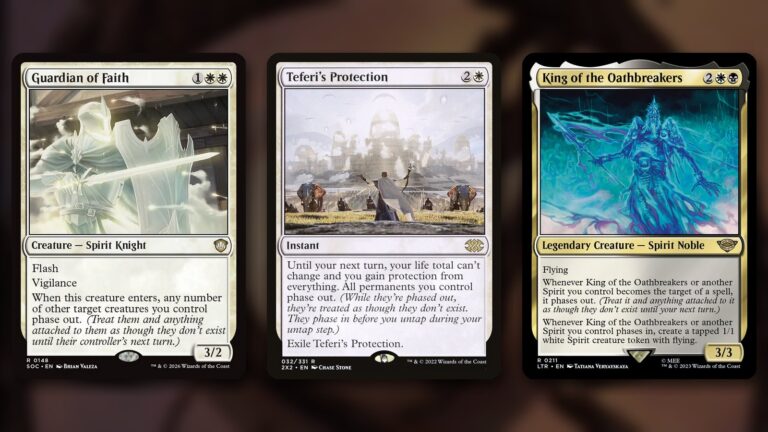
| Teferi’s Protection | {2}{W} | Phases out everything you control and makes you gain no damage this turn. A single card that blanks an entire lethal alpha strike | $49.57 |
| Blustersquall | {U} | Taps target creatures before attackers are declared. Forty-six cents to skip a turn of the clock | $0.46 |
| Fog | {G} | Prevents all combat damage this turn — the cleanest possible answer, since it prevents the damage from ever being dealt | $2.88 |
Note why Fog is categorically different from life gain. Rule 120.4b deals damage “as modified by replacement and prevention effects.” Prevented damage is never dealt, so it never enters the commander damage count in the first place. Life gain happens strictly after the damage was dealt and counted. The two are not remotely equivalent, and against a commander-damage deck only one of them is doing anything.
Teferi’s Protection is the only Game Changer on this list, which matters if you are building to a specific bracket — the same framework covered in detail in the Commander brackets and Game Changers guide.
You can lose the game to your own commander
Read 903.10a once more with this in mind: “A player who’s been dealt 21 or more combat damage by the same commander.” There is no clause about whose commander it is, and no clause about who controls it.
If an opponent takes control of your commander — Mind Control ($0.25), Agent of Treachery ($4.63), or any of the format’s many theft effects — and swings it back at you, that damage is dealt by “the same commander” and accumulates against you exactly as it would against anyone else. Combine that with the fact that the count never resets, and a commander you have already used to hit an opponent for 14 becomes a two-turn clock on you the moment it changes hands.
This is a real and underrated argument for keeping a way to sacrifice or bounce your own commander in decks built around a very large one. It is also the reason a stolen commander is worth answering immediately rather than racing.
A starting package
The following is a functional commander-damage core rather than a complete list — the protection, evasion and multiplier pieces that any build of this archetype wants, priced today. Slot it around whichever commander you have chosen from the table above, then fill out lands and ramp to taste.
Commander Damage Core Package
16 cards — one click loads the full list into a TCGplayer cart so you can check real prices and grab the whole deck at once.
Buy this deck on TCGplayerAffiliate link — buying through it supports KrakenTheMeta at no extra cost to you.Every card in that package is Commander-legal as of today and none of them are Game Changers, so the package itself does not push a deck out of Bracket 2. If you would rather start from a finished list, there are thousands of public builds on the community deck browser, and you can check any of these prices yourself with the card price tool.
The mistakes that decide games
| Mistake | What it costs |
|---|---|
| Tracking one combined commander damage total in a game with partner commanders | You will think you are at 19 and dead when you are at 10 and 9 and safe — or the reverse |
| Counting damage your commander dealt to blockers | Only damage dealt to a player counts. This is the most common overcount |
| Assuming a token copy of your commander is closing the game | Blade of Selves and Helm of the Host generate enormous board damage and zero commander damage |
| Playing a life-loss doubler in a deck built to kill with commander damage | It never moves the counter. Fireshrieker at 22 cents does more for that plan than Bloodletter at $37 |
| Gaining life against a voltron deck | Life is the wrong resource. Prevention, exile and blockers are the right ones |
| Stopping at 20 | The rule says 21. A 20/20 connecting once has not killed anybody |
| Racing a stolen commander instead of answering it | Your own commander’s damage counts against you and does not reset when you get it back |
Frequently asked questions
How much commander damage kills a player?
Twenty-one or more combat damage from the same commander over the whole game, per rule 903.10a. Twenty does not do it.
Does commander damage from two commanders add together?
No. Rule 702.124d requires you to “consider damage from each of your two commanders separately.” Twelve from one and eleven from the other is 23 total damage and zero progress toward the rule.
Does noncombat damage from my commander count?
No. Activated abilities, triggered abilities, fight damage and spell damage never count, even when your commander is unambiguously the source. The rule says combat damage.
Does gaining life reset commander damage?
No. The two loss conditions are completely independent. A player at 200 life who has taken 21 from one commander loses.
Does killing the commander reset the count?
No, and neither does exiling it, recasting it, or its returning to the command zone. Rule 903.3 states that the commander designation is an attribute of the card, which it retains across every zone change.
Do token copies of my commander deal commander damage?
No. A token is not a card, so it cannot be a commander. This applies to Blade of Selves myriad tokens, Helm of the Host copies, and every other token copy effect.
Does infect damage from my commander count toward 21?
Yes. The combat damage is still dealt (rule 120.4b); infect only changes the result into poison counters (120.3b). You are running the 21-damage clock and the ten-poison clock at once.
Do damage doublers increase commander damage?
Yes, if they replace the damage — Fiery Emancipation, Gratuitous Violence, Dictate of the Twin Gods. No, if they replace the life loss, like Bloodletter of Aclazotz.
Does commander damage apply in a two-player Commander game?
Yes. Rule 903.2 explicitly allows a Commander game to be a two-player game, and nothing in 903.10a is restricted to multiplayer.
Can I lose the game to my own commander?
Yes. Rule 903.10a says “the same commander,” not “an opponent’s commander.” If somebody steals yours and attacks you with it, that damage counts against you.
The short version
Twenty-one, combat only, to a player only, per commander, never reset. Tokens do not count, infect does, damage doublers do, life-loss doublers do not, and your own commander can kill you if somebody borrows it. Everything else is arithmetic — and the arithmetic is unforgiving in a way that is easy to miss, because 21 keeps landing exactly one point past where a clean number would put you.
If you want to see how a commander-damage plan looks in a finished ninety-nine, the fastest route is to describe the commander you want to build around and let the deck builder do the first draft — then test your commander recognition against the format in Guess That Commander.
Build your next deck with AI
KrakenTheMeta’s AI deck builder researches the current meta and writes you a complete, format-legal decklist in about a minute — free to try.
Build a Deck with AIor browse community decks