
Menace in MTG: Rules, the Two-Blocker Trap, and the Best Menace Cards
Menace is Magic’s two-blocker tax. A creature with menace can’t be blocked except by two or more creatures — so every time your opponent wants to stop it, they have to spend two bodies instead of one. It sounds like the simplest evergreen keyword in the game, and in one specific way it is the most absolute: there is not a single card in Magic that can take menace away.
This guide covers the exact rule, the five interactions that actually come up at a table, the most common wrong answer to menace (which is wrong in a way that costs people games), the colour data behind why menace feels so black-and-red, and the best menace cards at every budget. Every card, price, ruling and legality below was verified against the live Scryfall API on 17 August 2026.
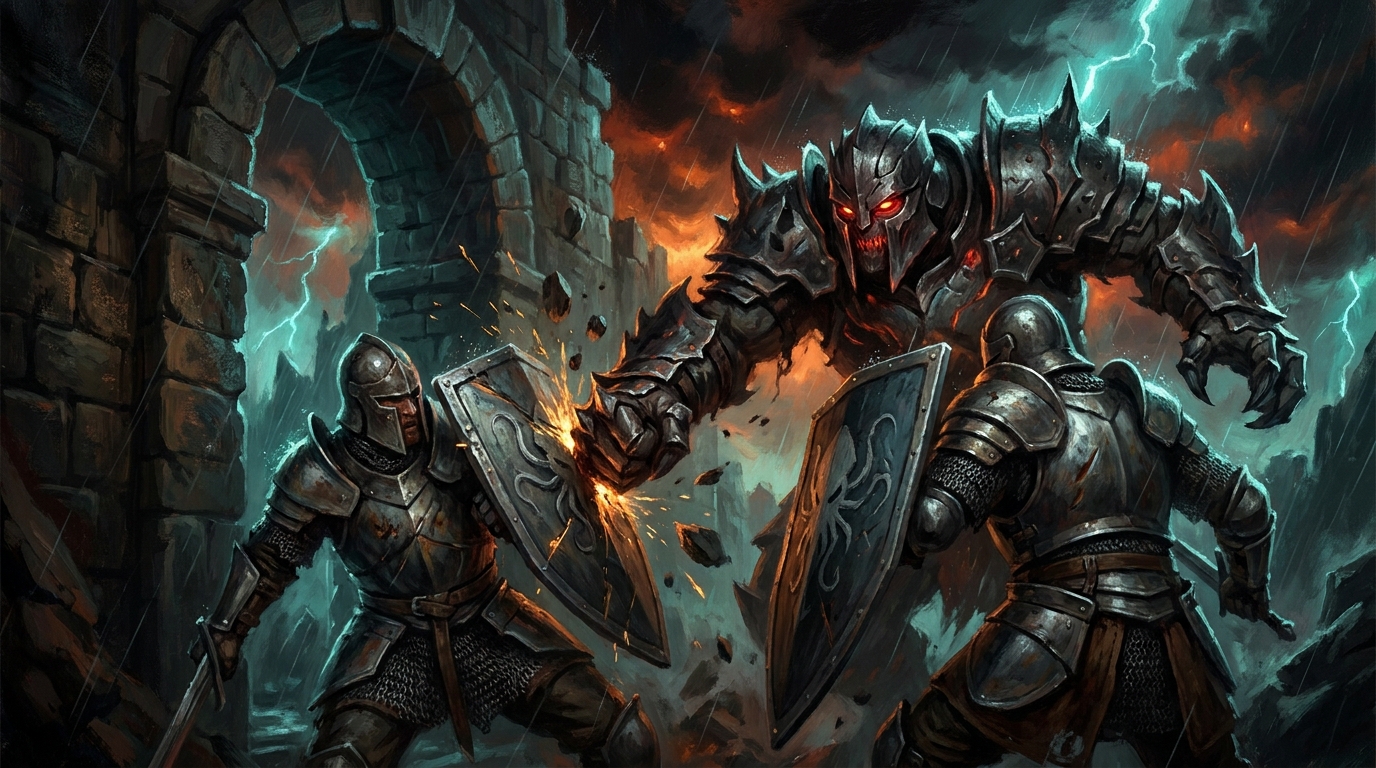
What menace does, in one sentence
Menace is an evergreen keyword ability that reads: “This creature can’t be blocked except by two or more creatures.” That’s the whole card text. It also means any block on a menace creature uses at least two blockers, which is exactly what rampage needs to trigger. It is a blocking restriction — it does not make a creature unblockable, it does not stop removal, and it does nothing at all on defence.
The practical effect is an economic one. Against a 3/3 with menace, your opponent can’t trade one creature for it. They must commit two. In a format where board presence wins games, forcing a two-for-one block every combat is a real tax — and in Commander, where three opponents are each hoarding blockers, it is one of the most reliable ways to keep connecting.
The one-blocker case people get wrong
If your opponent controls exactly one untapped creature, they cannot block your menace creature at all. Not “they block and it’s bad for them” — the block is simply illegal. A single creature can never satisfy the requirement, no matter how big it is or what abilities it has. This is why menace on an evasive body in the late game so often reads as unblockable in practice: by turn twelve, most players are holding one blocker, not two.
Blockers removed after blocks are declared
Once two creatures have legally blocked your menace creature, the requirement has been satisfied — permanently, for that combat. If your opponent then sacrifices one of the blockers, or you kill one with a removal spell, your creature stays blocked. It does not become unblocked and it does not deal damage to the player. This is the single most common misplay: people fire off removal at one of the two blockers expecting the damage to go through, and instead they’ve just spent a card to make their own attack worse.
Menace stacks with other evasion
Menace and flying are both restrictions, and both apply at once. A creature with flying and menace must be blocked by two or more creatures that can each block a flier. Junji, the Midnight Sky is the textbook case — a five-mana 5/3 Dragon with flying and menace, which in practice means most tables simply cannot block it. There are 15 paper cards with both flying and menace, 12 with menace and trample, and 8 with menace and deathtouch.
Menace and damage assignment
Because a menace creature is blocked by at least two creatures, the attacking player sets a damage assignment order among those blockers. You must assign lethal damage to the first blocker before any damage can go to the second. Without trample, none of it hits the player. This is why menace and trample on the same body is such an aggressive combination — Rograkh, Son of Rohgahh is a zero-mana 0/1 with first strike, menace and trample that, once suited up, forces two chump blocks and then tramples over both.
The mistake everyone makes: “block an additional creature” does not beat menace
This is the most valuable thing in this article, and it is wrong in most casual playgroups.
Magic has a family of cards that let a single creature block more than one attacker — Brave the Sands, Wall of Glare, Blaze of Glory, Palace Guard. Players reach for these as menace answers constantly. They do not work.
Menace counts creatures, not blocks. A single creature that can block an additional creature — or any number of creatures — is still exactly one creature. It cannot satisfy “two or more creatures” on its own. To block a menace attacker you need two separate untapped bodies, full stop, and no amount of extra-blocking ability substitutes for the second body.
The confusion is understandable, because these cards genuinely do solve the other half of the problem: if you’re being attacked by three creatures and only one has menace, Brave the Sands helps you cover the other two with fewer bodies. It just doesn’t help against the menace creature itself.
| Card | Mana | What it actually does | Beats menace? |
|---|---|---|---|
| Brave the Sands | {1}{W} | Your creatures have vigilance and each can block an additional creature | No — one creature is still one creature |
| Wall of Glare | {1}{W} | Defender; can block any number of creatures | No |
| Blaze of Glory | {W} | Target defender’s creature can block any number of creatures this turn | No |
| Palace Guard | {2}{W} | Can block any number of creatures | No |
| Guardian of the Gateless | {4}{W} | Flying; can block any number of creatures | No |
There’s a nice piece of trivia buried here. Two-Headed Dragon (Mercadian Masques, 4 October 1999) has flying, menace and “this creature can block an additional creature each combat” — it is simultaneously a menace threat and one of the cards people wrongly think answers menace. It has been quietly demonstrating the distinction on the same piece of cardboard for twenty-six years.
Nothing in Magic removes menace
Here is the claim, and it holds up to a direct search of every card ever printed: no card in Magic says a creature loses menace.
That is genuinely unusual, and it becomes stranger when you line it up against the other keywords players think of as harder to interact with:
| Keyword | Cards that strip it by name | Examples |
|---|---|---|
| Flying | 34 | Plummet, Hurricane, Gravity Well |
| Hexproof | 7 | Arcane Lighthouse, Shadowspear, Shay Cormac |
| Shroud | 2 | Arcane Lighthouse, Shay Cormac |
| Protection | 1 | Cephalid Snitch (black only) |
| Menace | 0 | — nothing — |
The cleanest proof is Shay Cormac, which reads: “Permanents your opponents control lose hexproof, indestructible, protection, shroud, and ward until end of turn.” Five defensive keywords named on one card, and menace is not among them. Neither is it on Arcane Lighthouse, the format’s standard “turn off their protection” land.
The only way to remove menace is to remove everything — the 64 paper cards that say “loses all abilities,” like Kenrith’s Transformation, Witness Protection and Lignify. You cannot surgically answer menace; you can only overwrite the creature entirely.
This completes a pattern worth stating plainly: across Magic’s defensive keywords, the ones players complain about most (hexproof, shroud, protection) all have dedicated hosers, and menace — the one nobody thinks of as oppressive — has none at all.
Menace is a black and red keyword, and the numbers are lopsided
There are 383 paper cards with the menace keyword. Broken down by exact colour identity, the distribution is one of the most skewed of any evergreen ability:
| Colour identity | Menace cards | Share of mono-coloured |
|---|---|---|
| Mono-black | 163 | 59% |
| Mono-red | 101 | 37% |
| Colourless | 9 | 3% |
| Mono-blue | 1 | 0.4% |
| Mono-green | 1 | 0.4% |
| Mono-white | 0 | 0% |
Black and red account for 96% of every mono-coloured menace card ever printed, and white has never received a single one. Mono-blue and mono-green have exactly one each — Wind Spirit and Vine Kami, both of which predate the keyword’s existence and were given it retroactively.
The inverse is just as sharp. Of the ten paper cards that let a creature block any number of creatures — the effect players mistakenly reach for against menace — all ten are mono-white. Magic handed white the entire family of blocking-math cards and none of the keyword that breaks blocking math.
Menace existed for twenty years before it had a name
Menace was keyworded in Magic Origins, released 17 July 2015. But the ability is far older: cards reading “can’t be blocked except by two or more creatures” go back to Wind Spirit, first printed in Ice Age on 3 June 1995 — twenty years, one month and fourteen days before the word existed. Those older cards were errata’d to menace when the keyword arrived.
| Card | First printing | Date | Note |
|---|---|---|---|
| Wind Spirit | Ice Age | 3 Jun 1995 | Oldest card now carrying menace; also has flying |
| Two-Headed Dragon | Mercadian Masques | 4 Oct 1999 | Has menace and blocks an additional creature |
| Vine Kami | Champions of Kamigawa | 1 Oct 2004 | The only mono-green menace card, one printing ever |
| Gilt-Leaf Winnower | Magic Origins | 17 Jul 2015 | One of the two original keyworded cards |
| Boggart Brute | Magic Origins | 17 Jul 2015 | The other; a vanilla 3/2 menace common |
The detail most people get wrong: Magic Origins contains exactly two menace cards. The set that named the keyword printed a rare Elf and a red common, and that was it. Menace’s real expansion came from Battle for Zendikar and Shadows over Innistrad onward — the latter alone delivered Relentless Dead, Insolent Neonate and Morkrut Necropod in a single set.
It replaced two earlier evasion keywords that did similar jobs badly. Intimidate (23 paper cards) and fear (40) were colour-dependent and swingy — useless against the right opponent, unbeatable against the wrong one. Menace is colour-neutral and always does something, which is why it has out-printed both by roughly six to one in a third of the time.
The best menace cards in Commander
Ranked by EDHREC inclusion. Prices are the cheapest available paper printing as of 17 August 2026.
| Card | Mana | EDHREC | Price | Why it’s played |
|---|---|---|---|---|
| Professional Face-Breaker | {2}{R} | #210 | $6.42 | Menace on a Treasure engine; the combat damage almost always connects |
| Noxious Gearhulk | {4}{B}{B} | #979 | $0.39 | Removal, lifegain and a 5/4 menace body in one card |
| Junji, the Midnight Sky | {3}{B}{B} | #1,222 | $0.62 | Flying and menace — effectively unblockable, plus a death trigger |
| Tergrid, God of Fright | {3}{B}{B} | #1,557 | $19.12 | The most feared menace creature in the format |
| Kozilek, the Great Distortion | {8}{C}{C} | #1,567 | $5.96 | A 12/12 menace Eldrazi that refills your hand and counters spells |
| Massacre Girl, Known Killer | {2}{B}{B} | #1,686 | $0.55 | Menace plus wither; Standard legal |
| Stormfist Crusader | {B}{R} | #1,931 | $0.87 | Two-mana menace with symmetrical draw that you break |
| Generous Plunderer | {1}{R} | #2,118 | $13.54 | Menace attacker that scales with Treasures; Standard legal |
| Lathril, Blade of the Elves | {2}{B}{G} | #2,133 | $1.50 | Menace turns her token trigger on almost every turn |
| Sire of Seven Deaths | {7} | #2,138 | $18.11 | Seven keywords on one colourless body, menace among them |
| Rograkh, Son of Rohgahh | {0} | #2,347 | $1.75 | Free commander with first strike, menace and trample |
| Sedgemoor Witch | {2}{B} | #2,365 | $5.51 | Menace and ward on a three-mana token engine |
| Relentless Dead | {B}{B} | #5,047 | $11.81 | Recursive menace Zombie that never stays dead |
The standout by playrate is Professional Face-Breaker at #210 — comfortably inside the top 250 cards in the format. Its whole design assumes the damage connects, and menace is what makes that assumption safe.
Cards that grant menace (and don’t have it themselves)
This is where most “menace card” lists go wrong. Several of the best-known menace enablers do not have the keyword at all — they hand it out. Worth knowing if you’re building around it, and worth double-checking before you tell a table your commander has menace.
| Card | Mana | EDHREC | Price | What it grants |
|---|---|---|---|---|
| Iroas, God of Victory | {2}{R}{W} | #1,460 | $12.75 | All your creatures have menace (Iroas itself has indestructible, not menace) |
| Piper of the Swarm | {1}{B} | #2,985 | $2.30 | Rats you control have menace |
| Lord of the Nazgûl | {3}{U}{B} | #3,643 | $2.73 | Creates 3/3 Wraith tokens with menace; itself has flying |
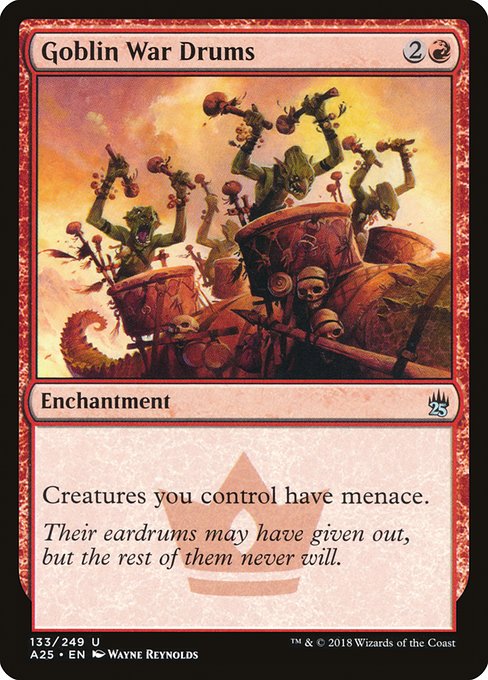
| Goblin War Drums | {2}{R} | #4,843 | $1.20 | Creatures you control have menace — the original anthem |
| Gut, True Soul Zealot | {2}{R} | #6,950 | $0.17 | Makes 4/1 Skeleton tokens with menace, tapped and attacking |
| Hive of the Eye Tyrant | Land | #7,753 | $0.42 | A creature-land that becomes a 3/3 with menace |
⚠ Two legality notes that catch people out: Goblin War Drums is not Modern legal (it is Pauper legal, which surprises most players given the effect), and Odric, Lunarch Marshal — often listed as a menace card — has no keywords of its own. Odric only shares menace across your board if some other creature you control already has it.
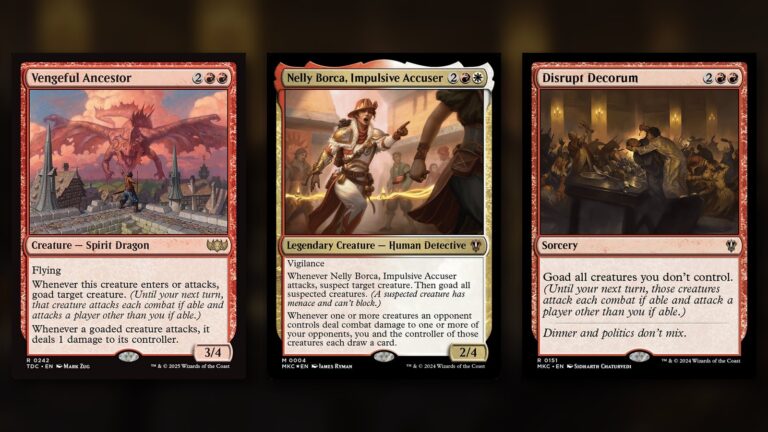
One way to hand an opponent’s creature menace on purpose: suspect it. A suspected creature has menace and can’t block, and the Murders at Karlov Manor Commander cards pair that with goad — Nelly Borca, Impulsive Accuser suspects a creature and then goads every suspected creature, so it must attack one of your other opponents with menace. Our goad guide has all 84 goad cards and a budget Nelly Borca deck.
Menace payoffs — the cards that care
Fifty-one paper cards reference “menace” as something to build around, but only one is a true lord for it.
| Card | Mana | EDHREC | Price | Payoff |
|---|---|---|---|---|
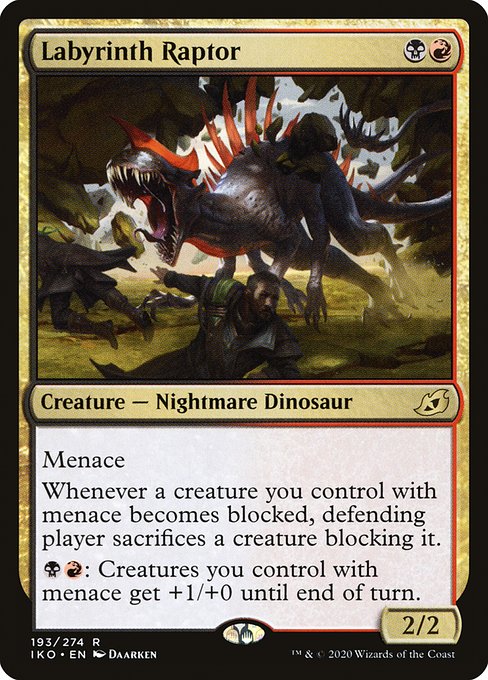
| Labyrinth Raptor | {B}{R} | #12,231 | $0.35 | Blockers get sacrificed; pumps all your menace creatures |
| In the Darkness Bind Them | {2}{U}{B}{R} | #4,104 | $0.88 | Saga that makes and buffs menace Wraiths |
| Restless Vents | Land | #5,033 | $0.33 | Creature-land with menace attached to a draw trigger |
| Bladewing, Deathless Tyrant | {5}{B}{R} | #6,441 | $3.70 | Grants menace to your Dragons |
| Cacophony Unleashed | {5}{B}{B} | #6,777 | $1.14 | Menace and a sacrifice trigger on every attacker |
| Rooftop Bypass | {1}{U}{B} | #7,170 | $5.98 | Menace matters for its damage trigger |
| Vraska, Relic Seeker | {4}{B}{G} | #8,511 | $2.14 | Makes 2/2 Pirates with menace |
Labyrinth Raptor is the only card in the game that turns a blocked menace creature into a punishment. Whenever a creature you control with menace becomes blocked, the defending player sacrifices one of the blockers — so the two-creature tax becomes a two-creature loss. At $0.35 and EDHREC #12,231 it is one of the most underplayed build-arounds in Commander.
Budget and Pauper menace
309 of the 383 menace cards cost under a dollar, and 91 are Pauper legal. This is a keyword you can build around for almost nothing.
| Card | Mana | Price | Format | Note |
|---|---|---|---|---|
| Insolent Neonate | {R} | $0.23 | Pauper, Modern | One-mana menace with a free loot on death |
| Boggart Brute | {2}{R} | $0.04 | Pauper, Modern | 3/2 menace vanilla; one of the two original Origins cards |
| Goldhound | {R} | $0.23 | Pauper, Modern | One-drop menace that makes Treasure |
| Snarling Gorehound | {B} | $0.22 | Pauper, Standard | Menace one-drop with a surveil payoff |
| Aradara Express | {5} | $0.04 | Pauper, Modern | An 8/6 menace Vehicle for four cents |
| Cryptcaller Chariot | {3}{B} | $0.49 | Standard, Modern | Menace Vehicle that makes Zombies on discard |
| Grim Servant | {3}{B} | $0.23 | Modern | Menace body that tutors to the battlefield |
A quirk worth flagging: eight of the nine non-creature menace cards in Magic are Vehicles. Menace on a Vehicle is unusually strong, because crewing at instant speed means the blocking player often has to commit two creatures to something that wasn’t a creature when they made their plan. There is exactly one menace land — Blackbloom Rogue // Blackbloom Bog, a Zendikar Rising modal double-faced card.
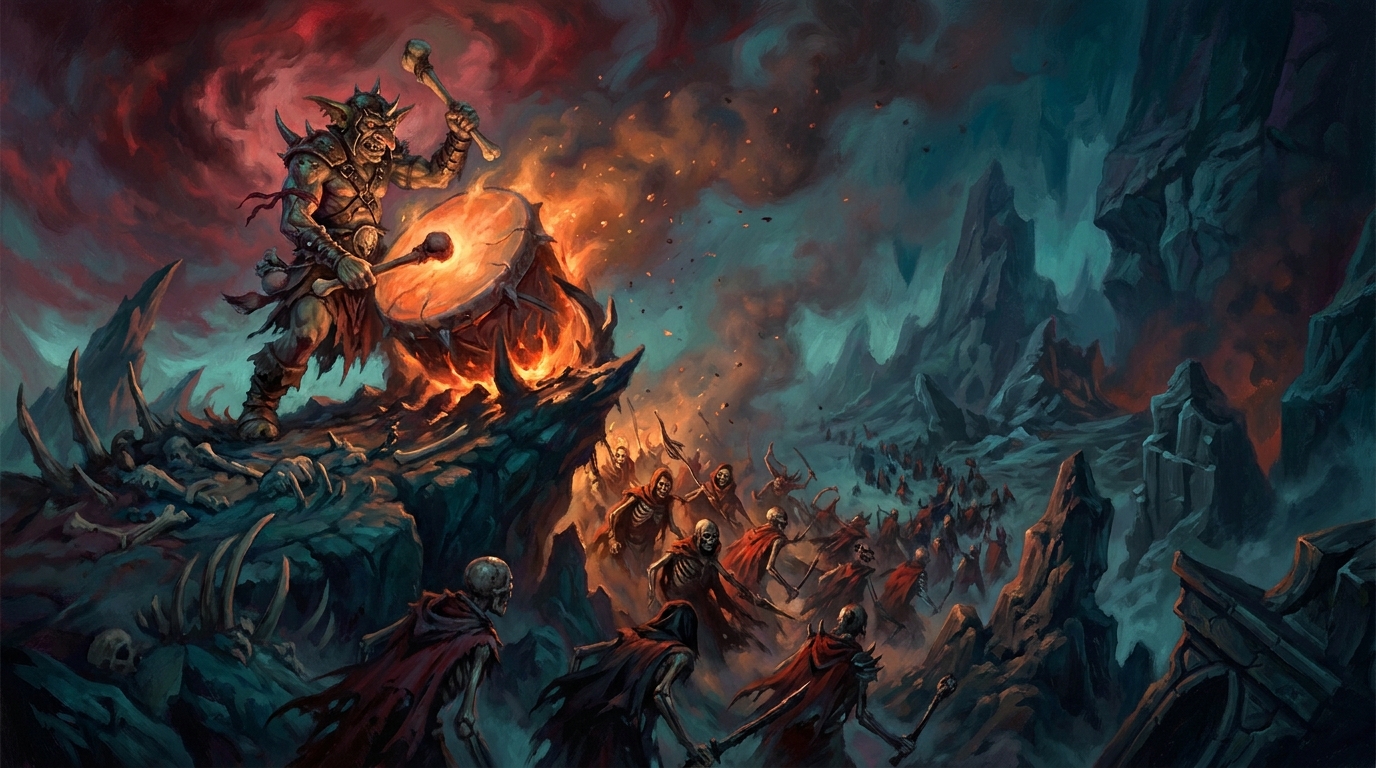
A budget menace package for Commander
These fourteen cards form the core of a black-red menace deck for roughly the price of a booster pack. Drop them into a Rograkh, Lathril or Stormfist shell and add removal and ramp to taste.
Budget Menace Core — Black/Red
14 cards — one click loads the full list into a TCGplayer cart so you can check real prices and grab the whole deck at once.
Buy this deck on TCGplayerAffiliate link — buying through it supports KrakenTheMeta at no extra cost to you.The engine is Labyrinth Raptor plus Goblin War Drums. Once every creature you control has menace, every block your opponents make costs them a creature to the Raptor’s trigger — and they still have to spend two to make the block in the first place. If you want to see how a build like this holds up against real decklists, you can browse public Commander decks or check current prices on the card pricing tool before you buy.
How to actually beat menace
Since nothing strips the keyword, your outs are structural rather than surgical:
- Keep two untapped creatures. Unglamorous and correct. Two 1/1 tokens answer a menace attacker that a single 8/8 cannot.
- Instant-speed tokens. Secure the Wastes ($4.85), Grand Crescendo ($3.39) and Arachnogenesis ($7.14) turn one card into the two bodies the rule demands.
- Kill it. Menace does nothing against removal — no hexproof, no ward, no protection. It is the least resilient of the evasion keywords in that respect.
- Overwrite it. Kenrith’s Transformation ($1.02), Witness Protection ($0.21) and Lignify ($1.40) remove all abilities, which is the only way to remove menace specifically.
- Tax the attack instead. Propaganda (#115, $2.56) and Crawlspace (#1,416, $11.26) stop the creature attacking at all, which sidesteps the blocking question entirely.
What will not work, to repeat the point: any card that lets one creature block additional creatures.
Menace versus Magic’s other evasion keywords
| Keyword | Paper cards | Status |
|---|---|---|
| Flying | 3,184 | Evergreen |
| Trample | 1,006 | Evergreen |
| Menace | 383 | Evergreen |
| Landwalk | 129 | Retired |
| Fear | 40 | Retired (replaced by menace) |
| Shadow | 40 | Retired |
| Horsemanship | 28 | Retired (Portal Three Kingdoms only) |
| Intimidate | 23 | Retired (replaced by menace) |
| Skulk | 16 | Deciduous |
Menace is the third most-printed evasion keyword in Magic, behind only flying and trample — and it out-numbers every retired evasion keyword combined (383 against 277). In eleven years it has comprehensively replaced the mechanics it was designed to succeed.
By current format legality there are 107 menace cards in Standard, 267 in Modern, 91 in Pauper and 376 in Commander. The newest arrived three days ago: Chief of the Wilds ($27.86), a legendary Wolf from The Hobbit Eternal released 14 August 2026, and currently the most expensive Commander-legal menace card in the game.
If you enjoy this kind of keyword breakdown, the companion guides on ward, hexproof and protection cover the defensive side of the same combat maths, and the menace, vigilance and haste overview covers how these three interact in an aggressive shell. For a different kind of test, Guess That Commander will tell you fairly quickly how well you actually know the card pool.
Frequently asked questions about menace in MTG
What does menace do in MTG?
Menace means a creature can’t be blocked except by two or more creatures. It’s a blocking restriction — it doesn’t make the creature unblockable and has no effect when the creature blocks.
Can one creature block a menace creature if it can block multiple creatures?
No. Menace requires two or more separate creatures. A single creature with “can block an additional creature” or “can block any number of creatures” is still one creature and cannot legally block a menace attacker alone.
What happens if one of the two blockers is removed?
The creature stays blocked. Once blockers are legally declared, killing or sacrificing one does not unblock the attacker, and no damage goes through to the player.
Can a creature with menace be blocked by two creatures with flying?
Yes, if the menace creature doesn’t also have flying. If it has flying and menace, it needs two blockers that can each block a flier.
Is there any card that removes menace?
No card removes menace by name. The only way is to remove all abilities, with cards like Kenrith’s Transformation, Witness Protection or Lignify.
What set introduced menace?
Magic Origins, on 17 July 2015 — though it contained only two menace cards, Gilt-Leaf Winnower and Boggart Brute. Older cards with the same wording, going back to Wind Spirit in Ice Age (1995), were errata’d to menace.
What colours get menace?
Almost entirely black and red — 163 mono-black and 101 mono-red cards, against exactly one mono-blue, one mono-green and zero mono-white.
Does menace stop a creature being blocked by two 1/1 tokens?
No. Two 1/1 tokens satisfy menace completely. This is the standard way to answer a large menace attacker cheaply.
Does menace work on defence?
No. Menace only restricts how the creature can be blocked when it attacks. It does nothing while blocking.
How does damage assignment work with menace?
You order the blockers and must assign lethal damage to the first before assigning any to the second. Without trample, no damage reaches the player.
Is menace better than intimidate or fear?
Generally yes. Intimidate and fear depend on your opponent’s colours, so they can be blanked entirely. Menace always demands two blockers regardless of what your opponent is playing. We counted it: only 29.3% of all creatures ever printed can block a creature with fear, and the fear and intimidate guide has the numbers for every colour.
What’s the best budget menace card?
Labyrinth Raptor at around $0.35 — it’s the only card that punishes opponents for making the two-creature block, and it pumps your whole menace board.
How many menace cards are there?
383 paper cards have the keyword, with 107 legal in Standard, 267 in Modern, 91 in Pauper and 376 in Commander as of August 2026.
Building a deck that leans on menace takes a fair amount of card-pool searching, which is exactly the sort of thing worth handing to a tool — create a free account and the AI deck builder will assemble a menace shell around whichever commander you pick.
Build your next deck with AI
KrakenTheMeta’s AI deck builder researches the current meta and writes you a complete, format-legal decklist in about a minute — free to try.
Build a Deck with AIor browse community decks
7 Comments
Comments are closed.