
Haste in MTG: What It Really Does, the Tap-Ability Half Everyone Misses, and the Best Haste Cards
Almost every explanation of haste in Magic: The Gathering says the same thing: a creature with haste can attack the turn it comes down. That is true, and it is roughly half of what the keyword does.
The other half is the one that decides games. Haste also lets a creature use activated abilities that cost {T} — tap abilities — on the turn it arrives. That is why Lightning Greaves is a format staple in decks that never attack with anything, why mana dorks and tap-combo engines want haste far more than aggressive creatures do, and why the rule that actually governs all of this is not “summoning sickness” at all.
This guide covers the real rule text, the tap-ability half nobody teaches, every meaningful haste enabler with current prices, the best haste cards in 2026, and a full derivation of all 645 paper haste cards — including one finding that contradicts the story usually told about the keyword’s colour history.
What haste actually does
Haste is a static ability (rule 702.10). It does not trigger, it does not need to resolve, and it cannot be responded to. It grants exactly two permissions:
- The creature can attack even though it has not been under your control continuously since your most recent turn began.
- The creature can activate abilities with {T} or {Q} in the cost under the same circumstances.
That is the whole keyword. Notice what is not on the list: haste does not affect blocking, it does not affect abilities without a tap symbol, and it does not affect what the creature can be targeted by.
Haste does not remove summoning sickness
This distinction sounds pedantic until it costs you a game. A creature with haste still has summoning sickness. Haste simply says the two restrictions summoning sickness imposes do not apply to it. The condition is still there; the consequences are switched off.
The practical version: if a creature with haste attacks and then loses haste mid-combat, it stays in combat — attacking is a one-time check made when attackers are declared. But if it loses haste before you activate a {T} ability, you can no longer activate it, because that check happens at activation time.
Summoning sickness is not about entering the battlefield
Here is the misconception that produces most haste arguments at a kitchen table. Summoning sickness is not “the creature entered the battlefield this turn.” The actual rule (302.6) is about continuous control since your most recent turn began.
Three consequences follow, and all three surprise people:
- Stealing a creature gives it summoning sickness. Take an opponent’s creature with a Threaten effect and it cannot attack or tap, even though it has been on the battlefield for six turns. It has not been under your control since your turn began. This is precisely why almost every Threaten effect in Magic hands out haste along with control — otherwise the card would do nothing.
- A creature that changes controllers and comes back is still sick. Control changes reset the clock in both directions.
- Flickering resets it. A creature that leaves the battlefield and returns is a new object with a new control timestamp, so a blink effect makes an established attacker summoning sick again.
If you have read our breakdown of vigilance, this is the same rule seen from the other side: vigilance creatures are still summoning sick and still cannot attack the turn they land. Haste is the only keyword that answers this restriction directly. All three of these keywords are covered together in our attacking and blocking keywords overview.
The half everyone misses: tap abilities
Ask most players what haste does and you will hear about attacking. But the {T} clause is where the keyword earns its price tag.
Derived from Scryfall across all 645 paper cards with haste, only 45 of them — 7.0% — have an activated ability with {T} in the cost. The keyword is overwhelmingly printed on creatures that will never use its second half.
That statistic is the entire argument for haste enablers. The cards that most want haste are the ones that were never printed with it:
- Mana creatures. A Llanowar Elves that can tap the turn it lands is a Dark Ritual with upside. This is the single most common reason to run Lightning Greaves in a deck with no aggressive plan at all.
- Tap-to-win combo pieces. Anything whose text begins “{T}:” and ends in a loop wants to do it before your opponents untap.
- Commanders. A commander with a {T} ability is a lightning rod. Giving it haste means it does its job once before it eats removal.
Thousand-Year Elixir is the pure expression of this: it grants no combat ability whatsoever, only “you may activate abilities of creatures you control as though those creatures had haste,” and it costs about $14.59 because that clause alone is worth it.
The clearest recent example of the tap-ability half is Loot, the Pathfinder from Aetherdrift, a five-mana commander printed with haste, vigilance and three exhaust abilities that each cost one coloured pip and a tap: add three mana, draw three cards, or deal three damage. Haste is what lets it do one of those the turn it lands instead of waiting a full turn cycle with a 2/4 on the table, and vigilance is what lets it attack and still tap for another. Six of the 39 exhaust abilities in Magic have {T} in their cost, and every one of them wants haste for exactly this reason.
Rules quick reference
| Question | Answer |
|---|---|
| Can a summoning-sick creature block? | Yes. Blocking never cares about summoning sickness. Haste is irrelevant to blocking. |
| Can a summoning-sick creature crew a Vehicle? | Yes. Crew taps creatures as a cost without using the {T} symbol, so summoning sickness does not apply. |
| Can a summoning-sick creature convoke? | Yes — same reason as crew. See our convoke guide for the full interaction. |
| Can a summoning-sick creature be equipped? | Yes. Equip targets a creature; it does not tap it. |
| Can a summoning-sick creature use an ability without {T}? | Yes. Only {T} and {Q} costs are restricted. |
| Does haste help a creature you steal? | Yes — and it is mandatory. Without haste, a stolen creature cannot attack or tap. |
| Does haste do anything for a planeswalker? | No. Planeswalkers are never summoning sick; loyalty abilities are unaffected. |
| If a creature loses haste after attacking, does it leave combat? | No. The check happens once, when attackers are declared. |
| Does haste let a creature attack the turn it is flickered? | Yes. The returning creature is a new object and is summoning sick — haste is the fix. |
| Can you give haste at instant speed after blockers? | You can, but it will not add an attacker. Haste only matters before attackers are declared. |
Haste vs vigilance vs flash
These three keywords get bundled together as “the tempo keywords,” and they solve completely different problems. Only one of them touches summoning sickness at all.
| Keyword | What it changes | Touches summoning sickness? | Paper cards |
|---|---|---|---|
| Haste | Lets a creature attack and use {T} abilities immediately | Yes — it is the only keyword that does | 645 |
| Vigilance | Attacking does not tap the creature | No — a vigilance creature still cannot attack turn one | 730 |
| Flash | Lets you cast the spell at instant speed | No — a flashed-in creature is fully summoning sick | 605 |
The flash line is the one that catches people. Flashing in a blocker works beautifully. Flashing in an attacker does nothing at all unless it also has haste — which is why flash creatures are almost always defensive cards.
The best haste creatures in 2026
Prices below are Scryfall USD checked on 21 August 2026 and move constantly.
| Creature | Cost | Stats | Why it matters | Price |
|---|---|---|---|---|
| Ragavan, Nimble Pilferer | {R} | 2/1 | A one-mana creature that generates a Treasure and steals a card the turn it lands. The most expensive haste one-drop ever printed. | $42.07 |
| Monastery Swiftspear | {R} | 1/2 | Haste plus prowess — the pairing that defines red aggro. Banned in Pauper. | $0.31 |
| Goblin Guide | {R} | 2/2 | Two power on turn one for one mana, with a real downside. Still the burn benchmark. | $1.41 |
| Slickshot Show-Off | {1}{R} | 1/2 | Flying and haste with a Plot cost, so it dodges sorcery-speed removal and arrives already attacking. | $5.30 |
| Screaming Nemesis | {2}{R} | 3/3 | The only haste card currently banned in Standard. Turns any damage dealt to it into a permanent lifegain lock. | $7.45 |
| Hellrider | {2}{R}{R} | 3/3 | Every attacker pings for one. Converts a wide board into lethal from nowhere. | $2.89 |
| Ball Lightning | {R}{R}{R} | 6/1 | Six trampling damage for three mana, once. The purest statement of what haste is for. | $0.24 |
| Purphoros, God of the Forge | {3}{R} | 6/5 | Indestructible, hard to kill, and the payoff every token deck wants. | $32.03 |
| Kiki-Jiki, Mirror Breaker | {2}{R}{R}{R} | 2/2 | The canonical tap-ability haste card: it copies a creature and the copy has haste. Half of Magic’s combo decks. | $16.00 |
| Etali, Primal Storm | {4}{R}{R} | 6/6 | Attack trigger that casts a free spell from every opponent’s library. Haste means it triggers the turn it lands. | $0.51 |
| Craterhoof Behemoth | {5}{G}{G}{G} | 5/5 | Green’s haste finisher. The keyword is the reason it wins on the spot instead of next turn. | $24.22 |
| Vorinclex, Monstrous Raider | {4}{G}{G} | 6/6 | Doubles your counters and halves everyone else’s, with haste and trample attached. | $57.48 |
| Godo, Bandit Warlord | {5}{R} | 3/3 | Tutors Equipment on entry and grants an extra combat. A one-card combo with the right boots. | $1.66 |
| Akroma, Angel of Wrath | {5}{W}{W}{W} | 6/6 | The only mono-white haste card in paper Magic. Flying, first strike, vigilance, trample, haste, and protection from two colours. | $5.13 |
Akroma is genuinely alone
That last row is not a figure of speech. Running the colour identity of all 645 paper haste cards returns exactly one mono-white card and two mono-blue ones — Bonded Fetch and Errant, Street Artist, both of which pair haste with defender, so neither can attack with it. Blue has never printed a mono-coloured haste creature that can actually use the attacking half.
Cheap haste: the one-mana tier
Exactly 42 haste creatures cost one mana, and three more cost zero (Scryfall counts an {X} cost as zero, so the X-spells below land in the one-mana bucket).
| Card | Cost | Stats | Note | Price |
|---|---|---|---|---|
| Legion Loyalist | {R} | 1/1 | Battalion gives your whole team trample and stops chump blocks. | $4.71 |
| Lightning Serpent | {X}{R} | 2/1 | Scales with mana, trample, sacrifices itself at end of turn. | $3.81 |
| Shivan Devastator | {X}{R} | 0/0 | Flying, haste, and X +1/+1 counters. A finisher that is also a two-drop. | $3.12 |
| Mistcutter Hydra | {X}{G} | 0/0 | Green haste with protection from blue — uncounterable and untargetable by half the format. | $2.80 |
| Mountain Bandit | {R} | 1/1 | Portal Three Kingdoms scarcity rather than power, but it is a real one-drop. | $1.77 |
| Goblin Bushwhacker | {R} | 1/1 | Kicked, it hands your whole board +1/+0 and haste. The classic go-wide finisher. | $1.68 |
| Spark Elemental | {R} | 3/1 | Three trampling damage for one mana, then it dies. Ball Lightning’s little sibling. | $0.36 |
| Phoenix Chick | {R} | 1/1 | Flying haste that returns from the graveyard. Recursion plus evasion at one mana. | $0.34 |
| Rabbit Battery | {R} | 1/1 | A haste creature that is also Equipment — it grants haste to something bigger later. | $0.34 |
| Gingerbrute | {1} | 1/1 | Colourless haste with a built-in evasion toggle. Fits any deck at all. | $0.34 |
| Reinforced Ronin | {R} | 2/2 | Returns to hand at end of turn, but Channel turns it into a card draw when you do not need a body. | $0.33 |
| Zurgo Bellstriker | {R} | 2/2 | Two power on turn one at the cost of being legendary. Still one of the best rates in red. | $0.28 |
Haste enablers: gear and targeted effects
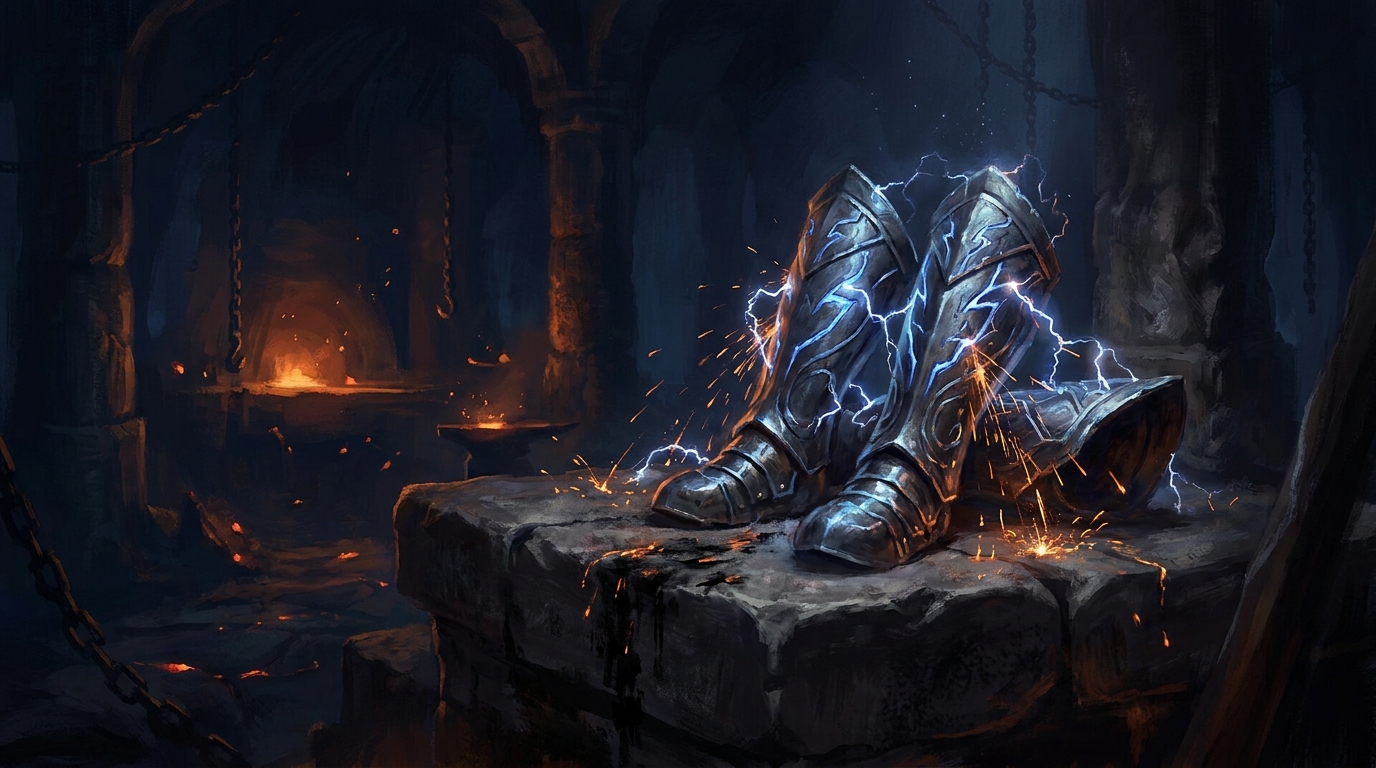
Because only 7% of haste cards have a {T} ability, most of the value in the keyword comes from cards that hand it out. There are 649 paper cards that grant haste without having it themselves — a larger enabler pool than any other combat keyword on this list.
| Enabler | Cost | Type | What it does | Price |
|---|---|---|---|---|
| Lightning Greaves | {2} | Equipment | Haste and shroud, equip {0}. The free equip is why it beats every other option in Commander. | $4.44 |
| Swiftfoot Boots | {2} | Equipment | Haste and hexproof for equip {1} — you keep the ability to target your own creature. | $2.14 |
| Thousand-Year Elixir | {3} | Artifact | Grants only the {T}-ability half, plus an untap. The purest combo enabler in the keyword. | $14.59 |
| Hall of the Bandit Lord | Land | Legendary Land | Pay 3 life for one mana that gives the creature it casts haste. A land slot that does the job. | $22.14 |
| Need for Speed | {R} | Enchantment | Sacrifice a land: target creature gains haste. Repeatable for one mana total. | $9.57 |
| Seize the Spotlight | {2}{R} | Sorcery | Threaten effect with haste attached — the format’s reminder that stealing needs it. | $15.42 |
| Goryo’s Vengeance | {1}{B} | Instant | Reanimates a legend with haste at instant speed, then exiles it. Built entirely around the keyword. | $15.17 |
| Finale of Devastation | {X}{G}{G} | Sorcery | Tutors a creature and, at X of 10 or more, gives your whole team haste and a pump. | $45.19 |
| Ogre Battledriver | {2}{R}{R} | Creature | Every other creature enters with +2/+0 and haste. A repeatable enabler on a body. | $0.31 |
| Crashing Drawbridge | {2} | Artifact Creature | Colourless, two mana, taps to give your whole board haste. Fits in decks with no red at all. | $0.74 |
Mass haste: the permanents that turn it on for good
Thirty-nine paper permanents grant haste to a whole team on a static basis. These are the ones that matter, and the cheap end is genuinely cheap.
| Staple | Cost | Scope | Price |
|---|---|---|---|
| Concordant Crossroads | {G} | All creatures, including your opponents’. One green mana. The original. | $43.95 |
| Xenagos, God of Revels | {3}{R}{G} | Doubles a creature’s power and gives it haste each combat. Indestructible. | $9.87 |
| Rhythm of the Wild | {1}{R}{G} | Riot — every creature enters with haste or a counter, and none can be countered. | $5.29 |
| Fervor | {2}{R} | Creatures you control have haste. The clean three-mana default. | $4.81 |
| Temur Ascendancy | {G}{U}{R} | Team haste plus a card whenever a 4-power creature enters. | $4.28 |
| Urabrask the Hidden | {3}{R}{R} | Team haste and your opponents’ creatures enter tapped. Two-sided. | $4.33 |
| Mass Hysteria | {R} | All creatures, one mana. Symmetrical, so it favours whoever is faster. | $4.05 |
| Samut, Voice of Dissent | {3}{R}{G} | Flash, double strike, vigilance, haste — and other creatures you control have haste. | $2.45 |
| Fires of Yavimaya | {1}{R}{G} | Team haste that can be sacrificed for a combat trick. | $0.66 |
| Anger | {3}{R} | Works from your graveyard as long as you control a Mountain. Discard it and never cast it. | $0.59 |
| Hammer of Purphoros | {1}{R}{R} | Team haste plus a Golem factory. Indestructible legendary artifact. | $0.34 |
| Tuktuk Rubblefort | {2}{R} | A 0/4 Wall that gives your other creatures haste. Blocks and enables. | $0.24 |
| Hellraiser Goblin | {2}{R} | Team haste, but your creatures attack each combat if able. Downside is real. | $0.14 |
| Keldon Strike Team | {2}{R} | The cheapest mass-haste body in paper Magic at seven cents. | $0.07 |
One entry in that table is not quite a haste card. Rhythm of the Wild grants riot, the Ravnica Allegiance keyword that lets each creature enter with your choice of a +1/+1 counter or haste — and the haste it gives is permanent, not until end of turn, which is the line in the rulings most players have never read. Only thirteen cards have riot printed on them and three grant it, but the choice has real arithmetic behind it: haste is worth one attack at printed power, the counter is worth +1 on every attack after that, so the break-even is the creature’s power. The riot guide works it through for all thirteen.
Haste in Commander: the combo keyword
In 60-card aggro, haste is a tempo bonus. In Commander it is an enabler for entire archetypes, because so many win conditions read “attack” or “{T}:” and cannot wait a turn cycle for four opponents to answer them.
| Payoff | Cost | What haste unlocks | Price |
|---|---|---|---|
| Aggravated Assault | {2}{R} | Untap and extra combat repeatedly. With enough mana, infinite attack steps. | $35.98 |
| Sneak Attack | {3}{R} | Puts a fatty in play with haste for {R}, then sacrifices it at end of turn. Haste is the entire card. | $11.81 |
| Fury of the Horde | {5}{R}{R} | An extra combat that can be cast free by exiling two red cards. | $6.00 |
| Relentless Assault | {2}{R}{R} | Untap all attackers and take another combat phase. | $4.72 |
| Terror of the Peaks | {3}{R}{R} | Every creature that enters afterwards throws damage. Pairs with haste-granting token makers. | $27.91 |
| Combat Celebrant | {2}{R} | Exert for an extra combat. With an untapper, it loops. | $1.70 |
| Through the Breach | {4}{R} | Instant-speed cheat-into-play with haste, at forty-five cents. | $0.45 |
| Bloodthirsty Adversary | {1}{R} | Haste plus a flashback engine that scales into the late game. | $0.39 |
| Zealous Conscripts | {4}{R} | Steals and untaps a permanent with haste. Half of the classic Kiki-Jiki loop. | $0.33 |
Want to see how these fit together in a real list? Browse public decks on KrakenTheMeta — filter by commander and you will find haste packages slotted into almost every red build.
Haste also arrives welded to graveyard recursion. Every creature returned with unearth gains haste automatically — that is the entire point of the mechanic, which rents a body for exactly one attack before exiling it.
A budget haste package for any red deck
Twelve cards, every one verified Commander-legal, that turn a slow red deck into one that acts the turn things land. Total is around $23 at the prices above.
Budget Haste Package
12 cards — one click loads the full list into a TCGplayer cart so you can check real prices and grab the whole deck at once.
Buy this deck on TCGplayerAffiliate link — buying through it supports KrakenTheMeta at no extra cost to you.Two notes on building it. Anger wants a discard outlet and a Mountain, not a cast — it is a free effect if your deck can bin it. And Mass Hysteria and Concordant Crossroads are symmetrical: they help the fastest deck at the table, which is only you if you have built for it.
The data: all 645 haste cards

Every figure in this section was derived directly from the Scryfall API on 21 August 2026, counting unique paper cards. Where two derivation methods could disagree, both were run and reconciled.
| Keyword | Paper cards |
|---|---|
| Flying | 3,184 |
| Trample | 1,006 |
| Vigilance | 730 |
| Haste | 645 |
| Flash | 605 |
| Reach | 427 |
| First strike | 388 |
| Menace | 383 |
| Lifelink | 367 |
| Deathtouch | 328 |
| Defender | 309 |
| Double strike | 119 |
Haste is the fourth most-printed combat keyword — and it has been overtaken by vigilance, which now leads it 730 to 645. That is a recent reversal: vigilance has been printed at roughly 86 new cards a year since 2023 against haste’s 54, despite haste being the older and far more iconic mechanic. Menace, by comparison, sits at 383.
Of the 645, 623 are creatures (96.6%) — the highest creature concentration of any keyword we have measured. The remainder is 14 artifacts, 5 enchantments, 1 land, 1 Battle, and one Unfinity sticker.
Haste was always red — the colour story is wrong
The commonly repeated history of haste is that it started in black and green and was later moved to red as the colour pie settled. The first card is genuinely black: Alpha’s Nether Shadow (5 August 1993), which predates the keyword by nearly six years.
But run the colour identity of every haste card against its debut year and the migration story does not survive.
| Debut era | White | Blue | Black | Red | Green | Multicolour | Colourless | Red share of mono |
|---|---|---|---|---|---|---|---|---|
| 1993–1999 | 0 | 0 | 4 | 34 | 1 | 0 | 0 | 87.2% |
| 2000–2009 | 1 | 1 | 7 | 60 | 4 | 26 | 2 | 82.2% |
| 2010–2019 | 0 | 0 | 11 | 98 | 12 | 45 | 7 | 81.0% |
| 2020–2026 | 0 | 1 | 10 | 161 | 24 | 123 | 13 | 82.1% |
The counts sum to 645 exactly, so nothing is missing. And the pattern is not a migration — it is a flat line. Red’s share of mono-coloured haste was 87.2% before the keyword even existed, and it has never been higher since. Haste did not move into red over thirty years; it was red from the first decade and the only thing that has changed is that multicolour cards went from 0 to 123.
What is true is narrower and more interesting: the very first haste cards were black and green, and red took the mechanic almost immediately. By the end of the 1990s the question was already settled.
The printing curve
Haste became a keyword in the Sixth Edition rules update of April 1999. The first three cards ever printed with the word on them were all Sixth Edition reprints of creatures that already did it: Raging Goblin, Talruum Minotaur and Volcanic Dragon. Like vigilance, the ability existed for years before it had a name, and Oracle applied the keyword backwards.
| Era | New haste cards | Years | Per year |
|---|---|---|---|
| 1993–2015 | 215 | 23 | 9.3 |
| 2016–2026 | 430 | 11 | 39.1 |
| of which 2022–2026 | 272 | 5 | 54.4 |
The two era rows sum to 645. The peak year on record is 2022 with 64 new haste cards — more than the entire period from 1993 to 1998 combined. The current rate of 54.4 per year runs at 4.2 times the 12.9 per year of the preceding twenty-nine years.
Note the shape of that acceleration against the mana curve, though. Haste is not primarily a cheap-creature keyword: the modal cost is three mana (143 cards), with 138 at four and 120 at five. Only 42 haste creatures cost exactly one mana. Wizards prints haste on midrange threats far more often than on one-drops.
Bans: only three haste cards, and only one for power

Across all 645 paper haste cards, exactly three carry a ban or restriction anywhere.
| Format | Status | Reason |
|---|---|---|
| Standard | Screaming Nemesis — banned | A 3/3 haste body that permanently shuts off lifegain for any player it damages. The only power-level haste ban currently live in a major constructed format. |
| Pauper | Monastery Swiftspear — banned | Haste plus prowess at one mana proved too efficient for a commons-only format. |
| Legacy, Vintage, Pauper, Oathbreaker, Duel | Minotaur de Force — banned | An Unfinity card with the stickers mechanic. Banned by construction rather than power level — sticker cards are not eternal-legal. |
Everything else with haste is legal everywhere it is in print. Notably, Ragavan, Nimble Pilferer is banned in Legacy but is legal in Commander and Modern — and its ban has nothing to do with haste. For the full picture across every format, see our 2026 MTG banned list.
Nothing in Magic removes haste
Some keywords can be stripped. Searching the full Oracle text of every paper card for the literal phrases “loses haste” and “lose haste” returns zero results.
That zero is real rather than a failed query: the identical search shape run on flying returns 34 cards, reproducing the figure established in our earlier keyword work. The method finds removal effects when they exist.
| Keyword | Cards that strip it |
|---|---|
| Flying | 34 |
| Hexproof | 7 |
| Shroud | 2 |
| Protection | 1 |
| Menace | 0 |
| Vigilance | 0 |
| Haste | 0 |
The reason is design symmetry. Flying is a defensive problem that other cards need an answer to; haste is a one-shot tempo effect that has already happened by the time you could respond. Stripping it after attackers are declared would do nothing anyway — which is exactly the rule we started with.
Frequently asked questions
What does haste do in MTG?
Haste lets a creature attack, and use activated abilities with {T} or {Q} in the cost, even though it has not been under your control continuously since your most recent turn began.
Does haste remove summoning sickness?
No. The creature still has summoning sickness — haste means the two restrictions summoning sickness imposes do not apply to that creature.
Can a creature with summoning sickness block?
Yes. Blocking has never been restricted by summoning sickness, so haste does nothing for a defender.
Can a summoning-sick creature tap for mana?
No, if the mana ability uses {T} in its cost — which nearly all of them do. This is why haste enablers are so valuable in decks built around mana creatures.
Can a summoning-sick creature crew a Vehicle or convoke a spell?
Yes to both. Crew and convoke tap creatures as part of a cost, but neither uses the {T} symbol on the creature’s own ability, so summoning sickness does not apply. The Vehicle itself is different: once crewed it is a creature, so it still needs haste to attack the turn it arrives. Our crew and Vehicles guide covers the rest of the crew rules.
Do I need haste on a creature I steal?
Yes, if you want to attack or tap with it. A creature you gain control of this turn has not been under your control since your turn began, so it is summoning sick regardless of how long it has been in play.
What is the best haste enabler in Commander?
Lightning Greaves, because equip costs {0} — you can move it freely and protect a new threat the moment it arrives. Swiftfoot Boots is the alternative when you need to target your own creature.
How many cards in Magic have haste?
645 unique paper cards as of 21 August 2026, of which 623 are creatures.
How many cards grant haste to other creatures?
649 paper cards grant haste without having it themselves — a larger pool than the cards that carry the keyword.
Is haste a red keyword?
Overwhelmingly. 353 of the 645 haste cards are mono-red, and red has made up 81–87% of mono-coloured haste in every decade since 1993.
Is there a white haste card?
Exactly one in mono-white: Akroma, Angel of Wrath. There are plenty of multicolour haste cards that include white.
Is any haste card banned?
Three. Screaming Nemesis in Standard, Monastery Swiftspear in Pauper, and Minotaur de Force in the eternal formats for being a stickers card.
Can anything take haste away?
No paper card says “loses haste” or “lose haste.” Effects that remove all abilities will strip it, but nothing targets the keyword specifically.
Does haste help a planeswalker?
No. Planeswalkers are never summoning sick and can use a loyalty ability the turn they arrive.
What is the difference between haste and vigilance?
Haste lets a creature attack the turn it arrives. Vigilance means attacking does not tap it. A vigilance creature is still summoning sick and still cannot attack on its first turn — the two keywords do not overlap at all.
Putting it into a deck
Haste is the cheapest way to make a slow deck feel fast, and the only way to make a stolen creature or a freshly cheated-in fatty do anything at all. If you are building around it, the two questions worth asking are whether your win condition needs to attack or needs to tap — because a deck full of {T} abilities wants Thousand-Year Elixir and Lightning Greaves, while a deck full of attackers wants Fervor and a wide board.
You can test either shape in a few seconds: KrakenTheMeta’s AI deck builder will assemble a full list around a commander and a strategy, and you can check the real cost of any haste package on our card price tool before you buy a single sleeve. If you would rather test your knowledge first, Guess That Commander is a faster way to learn what red actually plays. Create a free account to save what you build.
Build your next deck with AI
KrakenTheMeta’s AI deck builder researches the current meta and writes you a complete, format-legal decklist in about a minute — free to try.
Build a Deck with AIor browse community decks



4 Comments
Comments are closed.